Get Full Government Meeting Transcripts, Videos, & Alerts Forever!
Get email alerts on the Cannabis Zoning topic
No spam. Unsubscribe anytime.
Montgomery County committee delays vote on 100‑foot residential setback for cannabis dispensaries after planning staff flags long‑term impacts
Summary
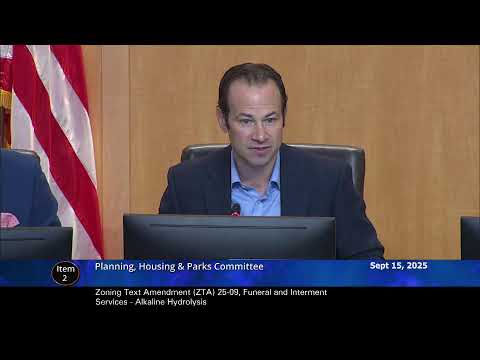
Councilmember Gabe Albornoz opened discussion of Zoning Text Amendment 25‑07 on Sept. 15, which would add a local 100‑foot residential setback for cannabis dispensaries in addition to state 500‑foot sensitive‑use buffers. The Planning, Housing and Parks Committee did not vote and asked staff and the sponsor to return with maps, additional data and potential refinements.
Councilmember Gabe Albornoz opened discussion of Zoning Text Amendment 25‑07 on Sept. 15, which would add a local 100‑foot residential setback for cannabis dispensaries in addition to state 500‑foot sensitive‑use buffers. The Planning, Housing and Parks Committee did not vote and asked staff and the sponsor to return with maps, additional data and potential refinements.
The measure matters because Montgomery County’s zoning increasingly permits mixed‑use development downtown; planning staff told the committee a 100‑foot residential buffer could immediately or gradually eliminate available sites for dispensaries in many commercial‑residential zones, creating nonconforming uses and limiting business flexibility.
At the public hearing on June 17, residents voiced concerns about dispensaries abutting single‑family homes, citing safety, construction noise and late hours; others warned that limiting dispensaries could harm nearby businesses and pointed out that alcohol retailers operate closer to residences. Ms. Nadeau, planning staff, summarized the testimony and staff analyses, including a racial equity and social justice (RESJ) statement that found a minimal net impact and noted potential offsetting benefits and burdens depending on perspective. Planning board members recommended approval with amendments (4‑1) but flagged language and long‑term effects in mixed‑use zones.
Ben Burbert of the Montgomery County Planning Board presented a county‑wide mapping exercise. He told the committee planners mapped parcels that currently allow dispensaries and those that would intersect the 100‑foot buffer. Of 18 county dispensaries they reviewed, 16 fall under county zoning and two are in the City of Rockville. The analysis found five dispensaries currently entirely within the proposed buffer and therefore would become nonconforming, eight on parcels partially overlapped by the buffer, six in zones that could allow future residential growth but with no current buffer overlap, and one located on industrially zoned land unlikely to become nonconforming. Burbert summarized that roughly 30% of currently available areas could become disallowed and the remainder would be uncertain as mixed‑use development proceeds.
Councilmember Majorana and others asked about racial equity and economic impacts. Majorana noted an outside breakdown indicating a majority of awardees were African American and asked whether the Office of Legislative Oversight (OLO) had those data when it issued its assessment; staff said OLO did not have the awardee breakdown at the time of its analysis and agreed to include the information in future packet materials. Majorana said the maps raised concern about rushing to enact a prohibition that could reduce opportunities and revenue that could be directed to communities harmed by past cannabis enforcement.
The County’s executive branch also weighed in. Earl Stoddard, Chief Administrative Officer, and Mr. Cart Hartman (DPS portfolio) told the committee the Executive shares the Planning Board’s concern that a 100‑foot buffer could unintentionally restrict sites over time and that a more nuanced solution might be preferable. They flagged the difference between a drive‑through dispensary immediately adjacent to a home and a dispensary located in a high‑rise mixed‑use building.
Sponsor Albornoz reiterated that the intent is to protect single‑family residential neighborhoods — not downtown mixed‑use corridors — and that existing licensees would not be affected unless they sought to expand or relocate. He committed to working with Ms. Nadeau, Planning, the Executive Branch and the Council attorney to draft alternatives and to circulate a follow‑up proposal to committee members before a future meeting.
The committee agreed not to vote. Members asked staff to provide (1) the more detailed web map of parcels that allow dispensaries and how the buffer overlaps them, (2) the racial/awardee breakdown and any available economic impact data, (3) analysis of options that would exempt certain commercial‑residential zones (for example CR and CRT) or otherwise narrow the buffer by zone type, and (4) input from the state delegation about legislative intent and any potential conflict with state enabling law. The item was held for further work and return to committee.
A few factual points from the discussion: state law establishes 500‑foot buffers around specified sensitive uses, and the statute that enabled local 100‑foot residential buffers was referenced by the sponsor as enacted by the General Assembly; planning staff reported 18 dispensaries in the county‑area sample (16 under county zoning, two in Rockville), and the Planning Board’s recommendation was 4‑1 supporting the ZTA with language amendments. Committee members explicitly distinguished discussion (policy options and mapping) from decision (no vote taken).