Get Full Government Meeting Transcripts, Videos, & Alerts Forever!
Get email alerts on the Real Time Information Center topic
No spam. Unsubscribe anytime.
Greeley police report first year of Real‑Time Information Center; one‑week drone testing began
Summary
Greeley Police Department officials reported the Real‑Time Information Center has touched more than 5,000 calls in its first year and that a limited drone‑as‑first‑responder test has begun after obtaining waivers for targeted deployments.
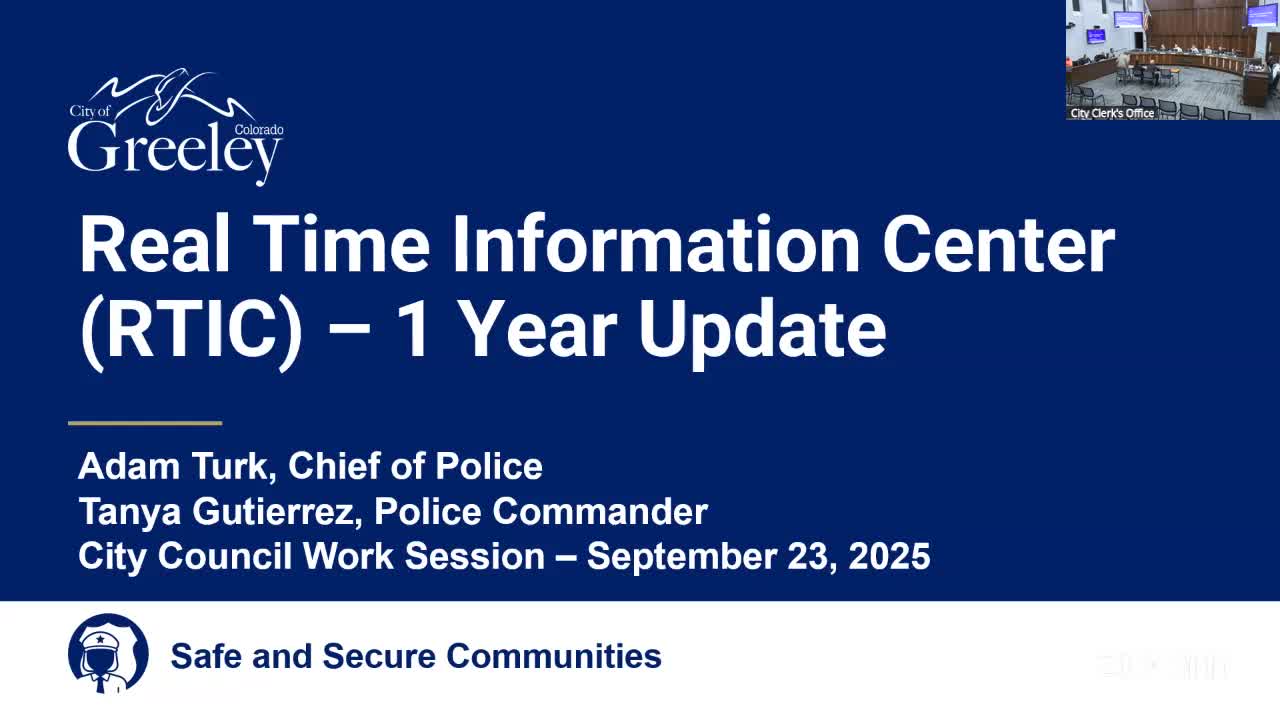
The Greeley Police Department updated the City Council on the Real‑Time Information Center (RTIC) and a drone‑as‑first‑responder test program, reporting first‑year operational statistics and recent field tests.
Why it matters: The RTIC aggregates traffic and security cameras, license‑plate readers and other feeds to provide officers situational awareness; the department says the tool has supported arrests, improved officer safety and in some cases reduced the need to dispatch officers.
Staff said the RTIC went live about one year ago and that the department has four full‑time technicians assigned to the center (covering 7 a.m.–1 a.m. daily) plus three sworn officers who augment the team as collateral duty. Commander Tanya Gutierrez and Chief Turk described the center’s activity since September 2024: the RTIC has touched more than 5,000 police calls for service, including about 1,500 priority‑1 or priority‑2 incidents. Presenters said the center was “virtually on scene first” roughly 2,600 times (about 51% of calls) and that staff exported 309 videos for evidence or public video requests. The department reported roughly 76 felony arrests and 85 misdemeanor arrests tied to RTIC activity.
The department also described a limited, multi‑day test of drones deployed as first responders under regulatory waivers. Presenters said the drone program obtained necessary waivers to permit trained pilots to dispatch drones to high‑priority calls in a defined area; they cited an incident where a drone arrived at a weapons‑involved disturbance before officers and provided live situational video that contributed to a safe resolution without injuries. Skydio’s sales representative, Andrew Warren, told council the company’s modeling suggests a network of docking stations and hives could reach most calls within 90 seconds in a full rollout; he and staff emphasized a phased, data‑driven approach and noted Lakewood and other agencies have seen significant operational benefits in early programs.
Councilors asked about cost and staffing. Presenters said the department requested drone funding in the 2026 budget; initial equipment and docking estimates cited in discussion were roughly six figures for equipment plus ongoing staffing costs (presenters said those technician and operator costs — not fully specified — are a major portion of program expense). Councilors also asked about 24‑7 operation; staff said some large agencies run around‑the‑clock centers but that in Colorado most local RTICs are not yet 24/7 and that demand data drives hours of operation.
Transparency and community outreach: Presenters said the department has issued three press releases, hosted a community meeting in March with about 50 attendees, and received 150–200 visitors to the RTIC for demonstrations and briefings. Staff said they are tracking retention rules and plan a permanent facility solution (plans for remodeling an annex near the police department were deferred for space reasons) and want to expand hours and staffing as resources permit.
Ending: Council members praised the program’s contribution to officer safety and crime solving; staff said they will continue testing, seek funding options and bring budget requests when they are ready.