Get Full Government Meeting Transcripts, Videos, & Alerts Forever!
Get email alerts on the Climate Energy topic
No spam. Unsubscribe anytime.
Denver staff brief committee on city climate projects: solar, batteries, EV charging and building electrification
Summary
City Office of Climate Action staff updated the Transportation & Infrastructure Committee on municipal solar and battery projects, EV charging expansion and building electrification, including a newly commissioned battery at Green Valley Ranch Library and work to identify mechanical replacements across municipal buildings.
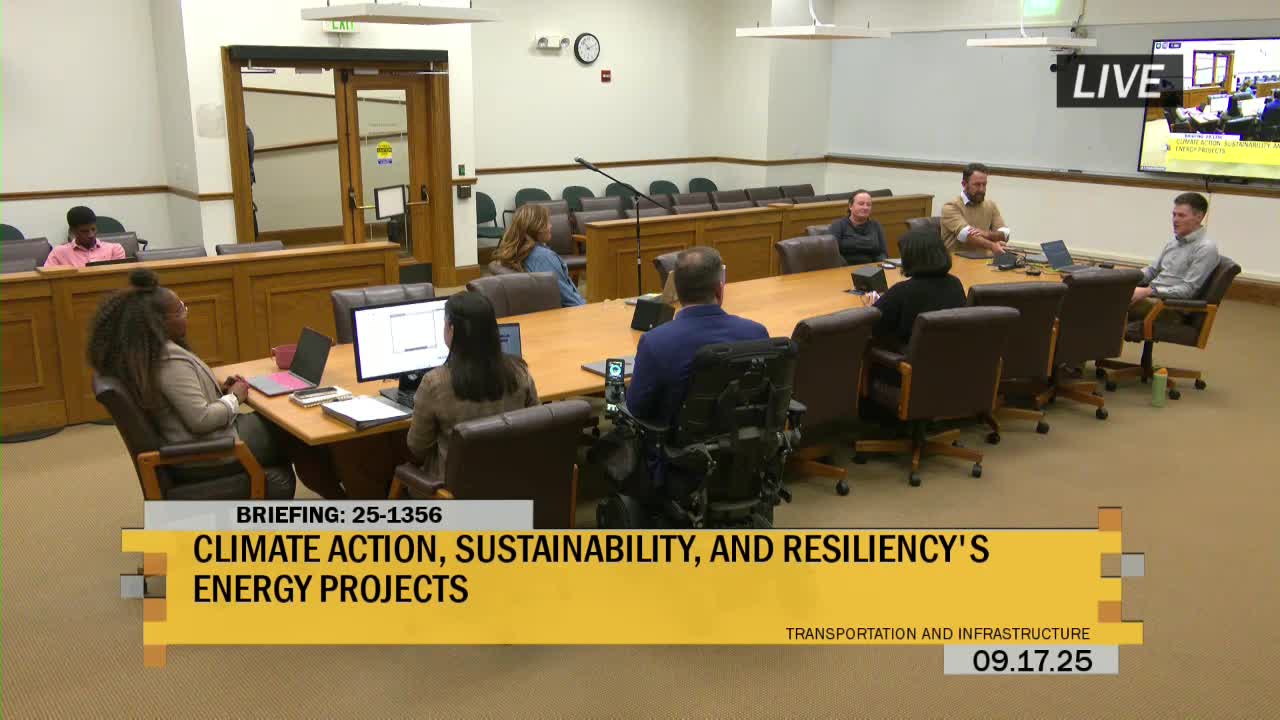
City of Denver climate staff briefed the Transportation & Infrastructure Committee on Sept. 17 about ongoing and planned municipal energy projects, including community solar, battery energy storage, public and fleet electric vehicle charging, resilient building retrofits and a downtown thermal energy study.
The Office of Climate Action said the city has more than 7 megawatts of solar in operation, commissioned its first municipal battery energy storage system two weeks earlier at Green Valley Ranch Library and forecasts roughly $13 million in total bill savings from its community solar subscribers, with about $12 million of those savings expected to benefit low‑income subscribers. Staff also described pilots and planning work for EV charging, microgrids and a concept they called an ambient loop — a district thermal system intended to reduce downtown demand.
Why it matters: these projects are intended to lower municipal greenhouse gas emissions, reduce operating costs over time and demonstrate technologies the city hopes private actors and other jurisdictions will replicate.
Key points from the briefing
Jonathan Rogers, acting deputy director in the Office of Climate Action, said the city aims to “lead by example” by deploying projects that show what is technically and economically feasible and that projects should provide benefits for climate‑vulnerable community members.
Drew Halpern, senior energy project manager, summarized four program areas: solar generation and battery storage; public and fleet EV charging; resilient city buildings; and renewable thermal systems. Halpern said the city is shifting from a demonstration mode toward more systematic evaluation and communication of project outcomes to support broader replication.
Solar and storage
The city said its Renewable Denver community solar program serves municipal customers and more than 300 Denver families, with plans to enroll another 250 families in successive phases. Staff reported more than 7 MW of solar in operation and forecast about $13,000,000 in total bill savings to subscribers, with roughly $12,000,000 expected to benefit low‑income subscribers working through Energy Outreach Colorado and Denver Public Schools.
The city also reported commissioning its first behind‑the‑meter battery energy storage system at Green Valley Ranch Library and said the installation has achieved more than a 50% reduction in peak demand at that facility. Staff called the battery a step toward larger microgrid demonstrations.
EV charging
Staff described two priorities for EV charging: a reliable, convenient public network and fast, location‑appropriate charging for municipal fleets. The team said there are about 150 public fast‑charging plugs in the city (often multiple plugs per site) and that the city will publish a mapping layer to clarify which chargers are publicly accessible and which are private. Staff also noted most public fast chargers are operated by private charging companies and that the city is coordinating with ChargePoint and other vendors.
Councilmembers raised accessibility concerns for people with disabilities at charging sites. Councilmember Hanks, who described several recent accessibility problems at public chargers, urged the city to prioritize universal access. Staff said the Office of Climate Action has adopted accessibility as a guiding principle and works with internal partners (including the city’s accessibility teams) to include a universally accessible stall at new charging sites and to improve older locations.
Resilient buildings and thermal decarbonization
Staff said they have completed about 165 energy audits of municipal buildings since late 2023 and identified nearly 80 systems beyond expected useful life and roughly 350 systems that will reach end‑of‑life in the next decade. The Office of Climate Action said it is preparing energy efficiency contracts and will coordinate mechanical replacements with the Department of Public Works (Dottie) as funding allows. The office is also proposing a downtown ambient loop study of district thermal systems and said preliminary modeling for 14 city buildings showed the potential for about 11 MW of demand reduction.
Funding and implementation
Staff said projects will be funded from a combination of sources including the Climate Protection Fund, grants and potential capital packages. They noted a bond package being planned for the November ballot would be one source of capital if voters approve it, but they emphasized that funding and timelines are contingent on available capital and external approvals.
Next steps and follow‑ups
City staff said they will continue site‑level design and permitting work, will file formal interconnection requests for microgrid projects and will share project maps and RFP information with councilmembers. Staff also said they will continue collaborating with Xcel Energy, the Public Utilities Commission framework (for community solar) and partners such as Energy Outreach Colorado and Denver Public Schools for subscriber outreach.
Authors’ note: This article summarizes a staff briefing; no contract approvals or formal votes were recorded on these items at the Sept. 17 committee meeting.