Fort Collins begins review of 2024 building‑code package; council weighs wildfire, EV and energy changes
Loading...
Summary
City staff previewed the 2024 International Code Council model codes, state wildfire‑resiliency requirements and several proposed local amendments — including EV charging tradeoffs, an ADU alarm alternative and a modeled energy‑performance path. Staff will return with additional cost analyses and outreach plans before formal adoption.
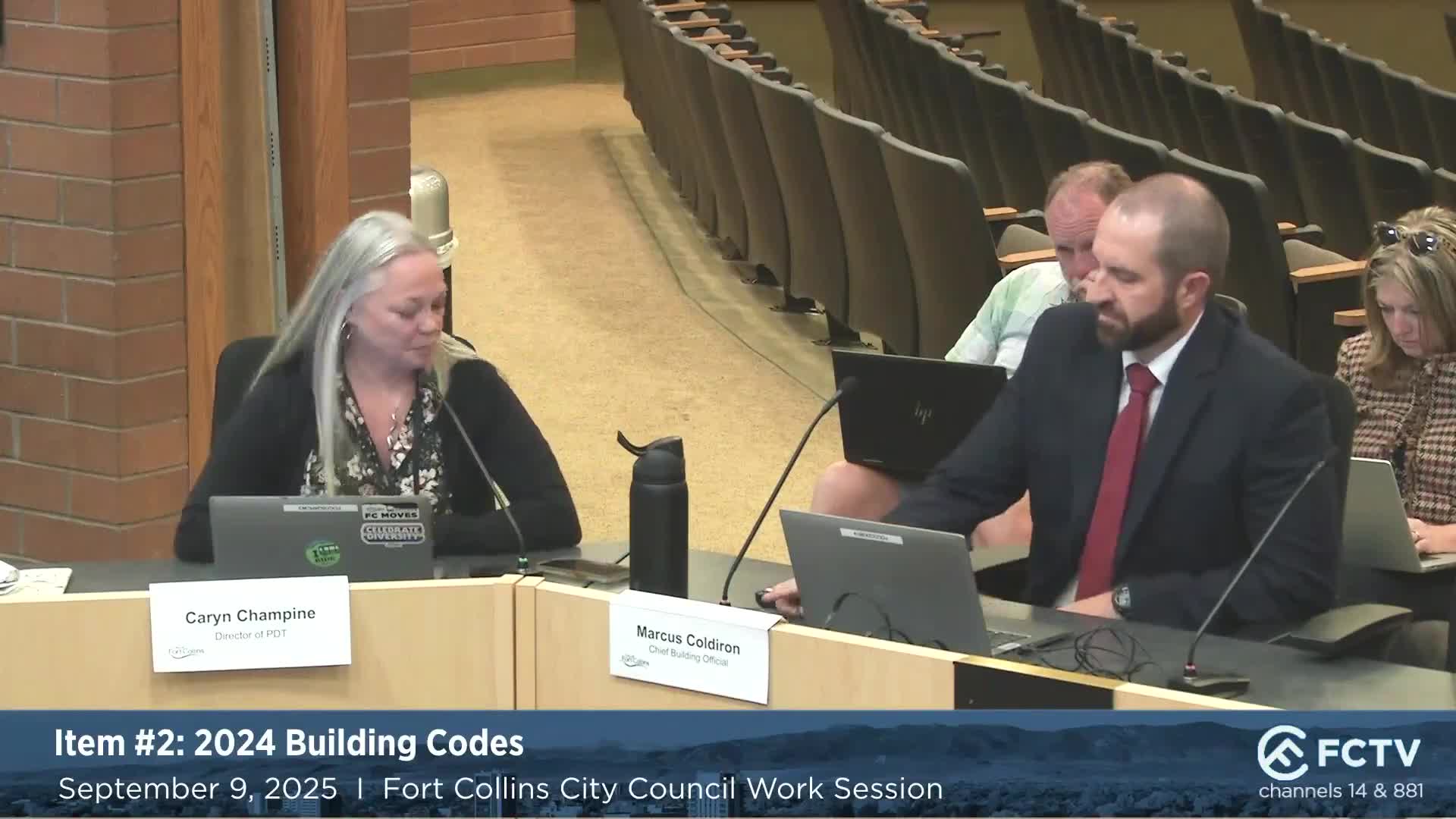
Fort Collins staff presented the city’s proposed 2024 building‑code adoption package at a City Council work session, outlining state mandates, local amendments and a timeline for outreach and adoption.
The package centers on adopting the 2024 International Code Council (ICC) model codes, folding in state requirements such as a new Colorado wildfire‑resiliency code and proposing local amendments to reflect community priorities on housing, safety and climate.
What’s in the state and model codes Marcus Coldiron, the city’s chief building official, summarized two state law impacts the city must address. House Bill 1273 requires jurisdictions with populations over 100,000 to allow certain design options that can permit a single‑exit, up to five‑story multifamily building under specific life‑safety conditions (sprinklers, egress and other requirements). Coldiron said that the height allowance would apply only where local zoning already permits taller buildings and would not expand height allowances citywide.
Staff also summarized House Bill 23‑166, the state wildfire resiliency law, which creates a Wildland‑Urban Interface (WUI) designation and requires jurisdictions with WUI areas to adopt a wildfire resiliency code by April 1, 2026. The state map shows Fort Collins contains low‑ and moderate‑hazard WUI areas on the city’s northwest, southwest and portions of the east side; staff said Fort Collins currently requires Class A roofing and therefore is ahead of some of the new standards. The state code focuses largely on exterior hardening (roofing, siding, defensible‑space landscaping) and maintenance requirements; staff said the city will provide outreach and phased implementation so existing homeowners are not immediately out of compliance.
Local amendments and notable changes Staff proposed several local amendments intended to increase flexibility or reduce unnecessary costs while preserving life‑safety objectives: - EV charging: Fort Collins’ 2021 EV requirement set a relatively strict mix of installed EV supply equipment (EVSE), EV‑ready and EV‑capable (conduit) spaces. Staff said developers asked for greater ability to prioritize installed EVSE or EV‑ready spaces in exchange for reducing conduit‑only spaces. The proposal would allow trade‑offs (for example, providing additional installed chargers above the required baseline to lower conduit requirements) and applies percentages to provided parking spaces rather than to a fixed parking minimum (the current land‑use code no longer mandates fixed parking counts). - ADUs (attached/internal): For ADUs created within existing single‑family homes, staff proposed an appendix that would permit an interconnected smoke/CO alarm system in lieu of installing a full 1‑hour fire‑rated separation in some cases. Coldiron said the change is limited to internal ADUs attached to single‑family homes (it would not apply to detached ADUs or to duplex/triplex conversions) and is focused on early occupant notification as an equivalent life‑safety strategy. Staff said the provision reduces construction waste and cost tied to retrofitting older interiors to meet fire‑rated assembly requirements. - Water demand calculator: The 2024 package would require a water‑demand calculator on multifamily projects to right‑size domestic plumbing and reduce standing water, improve water quality and reduce over‑sized pipe material and associated energy losses. Staff said the tool will be optional for most single‑family projects but required for multifamily. - Temporary emergency uses: Staff proposed codifying long‑standing temporary shelter practices (community‑based and seasonal overflow shelters) and adding explicit allowances for declared emergencies. - Energy code: The city proposes moving further toward a modeled performance path for energy compliance rather than a purely prescriptive checklist. Staff said more than half of permit submittals already use a modeled path; the move is intended to reward design flexibility, support electrification goals and enable the city to set measurable Energy Use Intensity (EUI) targets for future code cycles. Preliminary, nationally produced cost studies cited by staff suggest the 2024 code changes are less costly than earlier cycles, and staff’s initial analysis estimated the local adoption plus amendments would increase construction costs by less than 1% relative to the 2021 code; staff said they are preparing a more detailed, local cost‑impact analysis prior to formal readings.
Council questions and next steps Councilmembers asked for specifics on implementation, enforcement and the city’s outreach plan for owners in WUI zones. Coldiron and Director Karen Champine said staff will meet with boards, professional stakeholders and the public, and will return with a more complete cost‑impact analysis and targeted outreach materials. For the wildfire code specifically, staff said they plan outreach and an implementation schedule in order to meet the state’s April 1, 2026 adoption deadline.
No votes were taken. Staff said they will present a formal ordinance package and the more detailed cost analysis at a future regular City Council meeting and will provide advance timelines so developers and homeowners can plan for changes.
Ending Council thanked staff for convening a broadly based code review committee and for attempting to balance safety, housing and climate goals; members asked staff to document where Fort Collins exceeds state requirements, to quantify cost trade‑offs and to return with outreach and phased implementation plans.