Get Full Government Meeting Transcripts, Videos, & Alerts Forever!
Get email alerts on the Impact Fees topic
No spam. Unsubscribe anytime.
Fort Collins staff propose new impact-fee structure; council asks for phased, lower-cost options
Summary
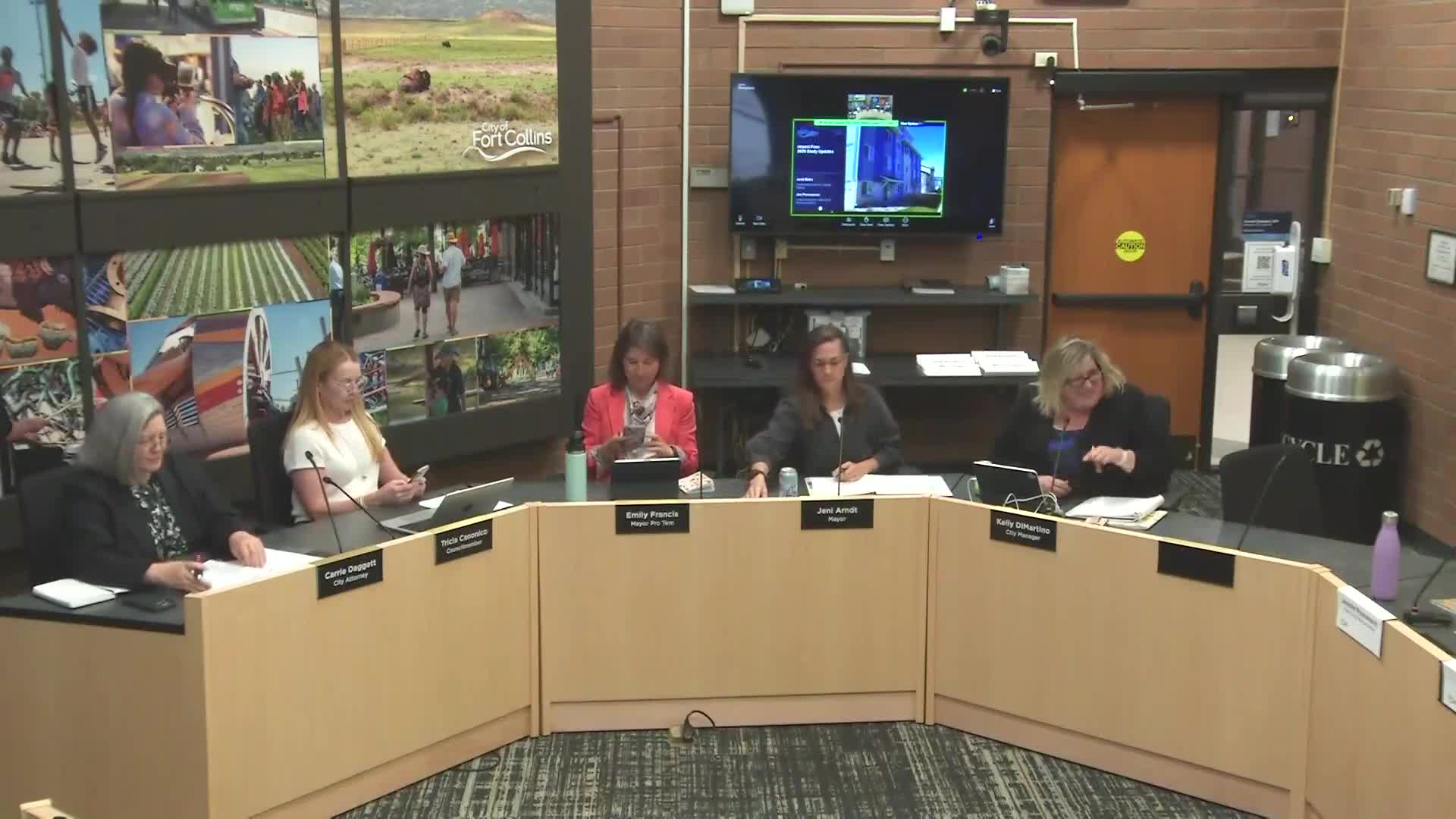
City staff on Tuesday presented a proposed overhaul of Fort Collins’ impact‑fee schedule, telling the City Council that the changes are intended to align fees with the city’s updated land use code and more recent replacement costs.
City staff on Tuesday presented a proposed overhaul of Fort Collins’ impact-fee schedule, telling the City Council that the changes are intended to align fees with the city’s updated land use code and more recent replacement costs.
The presentation, led by Josh Birx, sustainability services deputy director, and staff member Jen Posnanevich, proposed three major changes: more granular square-foot categories for residential units (expanding roughly from five to about seven categories), different fee schedules by unit type (single-family detached, attached single-family, multifamily), and splitting the current general-government capital expansion fee into two fees (government facilities and government capital equipment). The plan also updates the underlying replacement-cost study used to calculate fees; the current fee schedule is still based on a 2017 study and the city code calls for updates about every five years.
Why it matters: impact fees are charged to new development to offset the city’s cost to provide infrastructure and services. Staff said the proposed changes would increase fees for many larger single-family detached units while lowering fees for many multifamily units, shifting how new development pays for parks, police, fire and transportation capacity.
Staff summary and examples Josh Birx explained that Fort Collins uses a buy‑in approach: the replacement cost of existing capital assets is divided by current population and the per-person share is applied to new units using household-size assumptions. He said household size is a primary driver and that expanding square‑foot categories and distinguishing unit types would better reflect how many people occupy different housing forms. "We use what's called a buy in approach to impact fees where we take the replacement cost of our existing assets and we divide that by the existing population," Birx said.
Jen Posnanevich walked council through projected revenue and example-unit impacts using 2024 unit counts. Key figures she presented (apples‑to‑apples comparison using 2024 unit counts): - Under the proposed capital expansion schedule, single‑family detached fees would rise about 29%, single‑family attached about 14% and multifamily/ADU fees would decline about 3%; across all capital expansion fees the net increase would be roughly 13%. - Under the proposed transportation capital expansion fees, single‑family detached fees would increase about 13%, single‑family attached largely decrease (about 14% for many categories) and multifamily/ADU fees would fall about 41%; across all transportation categories the net change would be a decline of about 12%. - Combined across the capital expansion and transportation fees, single‑family detached would increase ~22%, single‑family attached ~3% and multifamily/ADU would decline ~16%; cumulatively that comparison produced an overall revenue increase of about 3% using 2024 unit counts.
Panosom examples included a 2,000‑square‑foot single‑family detached example with total fee increases of roughly 23% (capital + transportation). A typical 750‑square‑foot ADU example showed a fee decline of about 16% under the proposed schedule.
Policy questions and council reaction Councilmembers pressed staff on key policy choices. Several members, including Councilmember Melanie, questioned whether the replacement‑cost (buy‑in) approach is the right methodology and whether the city should instead consider a plan‑based method that spreads future infrastructure costs over anticipated future population. "I don't agree with the way we're approaching it," Melanie said, arguing that the replacement approach can look like assuming full replacement of existing assets even where partial renovation would suffice.
Staff responded that replacement cost is being used as a way to measure the current level of service and to determine each new unit’s fair share. "What is calculated before you is the maximum allowable fee," staff reminded council, noting that adopting the calculated maximum is a policy choice.
Council asked for alternatives and trade‑offs rather than a single recommendation. Staff agreed to bring multiple options back for a future regular meeting: phased approaches (examples discussed included a two‑year split or a multi‑year phasing) and proposals that adopt less than 100% of the calculated maximum. Council asked staff to quantify the revenue and likely trade‑offs of those options.
Other clarifications Staff noted the proposal includes an update to nonresidential fees by land‑use category. Under the proposed capital expansion changes, commercial fees would rise about 12%, office and other services down about 12%, and industrial and warehouse up about 49% (all numbers include inflation adjustments through 2025 where noted). Staff also said the proposed effective date for any ordinance would be Jan. 1, 2026 if council proceeds, and that staff plans the next detailed fee study for 2030 with interim inflation adjustments in off years.
Next steps Council did not vote. Staff will return with a package of actionable options (phased implementation schedules and lower‑than‑maximum alternatives), modeled revenue estimates for each option and the likely policy trade‑offs. Staff indicated an initial first‑reading timeline had targeted Oct. 7 but said additional analysis is likely to push formal readings a meeting or two later; staff said an adoption before November is preferable but final timing remains to be set.
Ending Councilmembers voiced support for improving granularity (differentiating by unit type and square footage), but they asked for more work on methodology and the cumulative cost impacts on housing affordability before choosing a fee level. The discussion closed with staff agreeing to present illustrative phased and partial‑adoption options and the revenue consequences of each.