Get Full Government Meeting Transcripts, Videos, & Alerts Forever!
Get email alerts on the Transitional Community Residence topic
No spam. Unsubscribe anytime.
Pompano Beach zoning board denies special exception for Luminess Care transitional residence after staff and neighbors cite violations and call volumes
Summary
The Zoning Board of Appeals unanimously denied a special‑exception application from Luminess Care to operate a transitional community residence after city staff cited code enforcement cases, BSO and EMS reported repeated calls to the property, and neighbors described safety and quality‑of‑life problems.
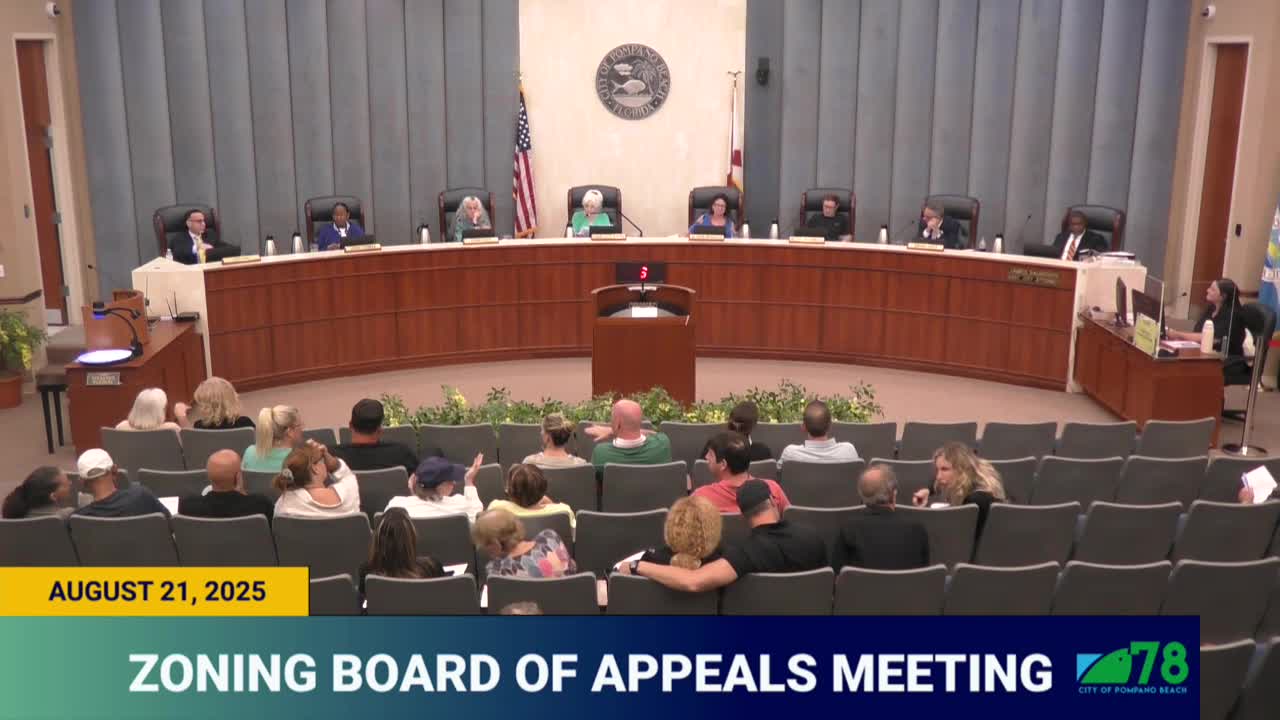
The Pompano Beach Zoning Board of Appeals on Aug. 21, 2025 denied a special exception requested by Luminess Care to operate a transitional community residence at the property identified in staff materials as 2500 Northeast Nineteenth Street. The denial followed staff recommendations to reject the application, testimony from code compliance, public safety officials, and multiple neighbors describing ongoing disturbances, and a unanimous roll‑call vote against the motion to approve.
City staff presented the special‑exception application (PNZ case 25‑17000008) and flagged multiple deficiencies: two open code enforcement cases tied to the property, an active lien, an extensive 911/BSO call log and a Fire Rescue/EMS incident log included in the agenda backup. Staff said the application lacked supporting documentation required by the city’s review standards governing transitional community residences — specifically evidence demonstrating normalization and community integration, state licensure or equivalent operational standards, staffing and training protocols, and measures to avoid clustering of similar uses.
Mario Sotelongo, the city’s code compliance director, described open enforcement cases stemming from operating without a required community residence certificate, trash and exterior storage violations, unpermitted interior work (split air‑conditioning units and two kitchens), and electrical issues. Deputy Robert Ferrelli of the Broward Sheriff’s Office summarized the police call history the board requested: he reported 12 police calls tied to that address over the last year and said some calls were for violent or threatening incidents. Matthew Aldridge, assistant chief of EMS for Pompano Beach Fire Rescue, said the Fire Rescue/EMS incident log showed rising medical calls at the address — 24 year‑to‑date with five in August — and clarified those were medical/EMS responses (including incidents related to intoxication and seizures).
The applicant and representatives for Luminess Care (including executive director Vedanti Vyas and petitioner Yasmina Llanos) said the organization operates a 45‑day program for adults with substance use and co‑occurring mental health disorders, asserted state licensing and Florida Association of Recovery (FAR) accreditation, and described on‑site supervision and clinical programming. The applicant also acknowledged operating two unapproved residences on the same block and apologized, saying they recently obtained FAR certification and were working to submit documents the city requires; they offered to close one residence if required.
Neighbors provided multiple accounts of repeated disturbances, incidents of individuals in the street, alleged drug or intoxication‑related behavior, and fear for children’s safety. Several residents said the houses are drawing many people, have generated frequent calls for police and EMS, and have reduced use‑and‑enjoyment of nearby yards and sidewalks. One speaker said the properties were showing liens and foreclosure activity in county records; another speaker described a pattern of rapid resales and alleged the properties had been bought and resold at elevated prices before being leased to the operator.
Staff recommended denial on the ground that the application failed to meet the special‑exception review standards (normalization/community integration, residential character and avoidance of clustering, compatibility with residential zoning, impact on residential stability, state certification or license, and operational standards when no license exists). The board heard extensive public comment and testimony from city departments, the applicant and neighbors.
A motion to grant the special exception subject to staff‑recommended conditions was moved, seconded and put to a roll‑call vote. Every member voted "no," and the motion failed; the board therefore denied the special exception.
Because the board’s decision was based on the special‑exception review standards and the record presented at the hearing, the transcript shows staff and public testimony focused on lack of documentation, existing code enforcement actions and public safety call volume rather than an evidentiary finding that the operator’s clinical model is ineffective. The applicant may seek to resolve outstanding code cases, provide licensure/certification documentation, and refile. The transcript records staff conditions the board would have required if the board had approved the request, including obtaining a community resident certificate, maintaining a business tax receipt, resolving outstanding code cases, providing proof of licensing or equivalency, limiting occupancy to seven residents, and providing a lease that specifies length of stay and house rules.