Get Full Government Meeting Transcripts, Videos, & Alerts Forever!
Get email alerts on the Zoning Variance topic
No spam. Unsubscribe anytime.
Pompano Beach zoning board rehears Festival Real Estate variance but fails to reach 5‑vote threshold; variance denied
Summary
After granting a rehearing, the Pompano Beach Zoning Board of Appeals considered a request to reduce required driveway stacking lengths at the former Festival Flea Market site but a 4‑2 vote in favor did not meet the five‑vote supermajority required for variances, so the petition failed.
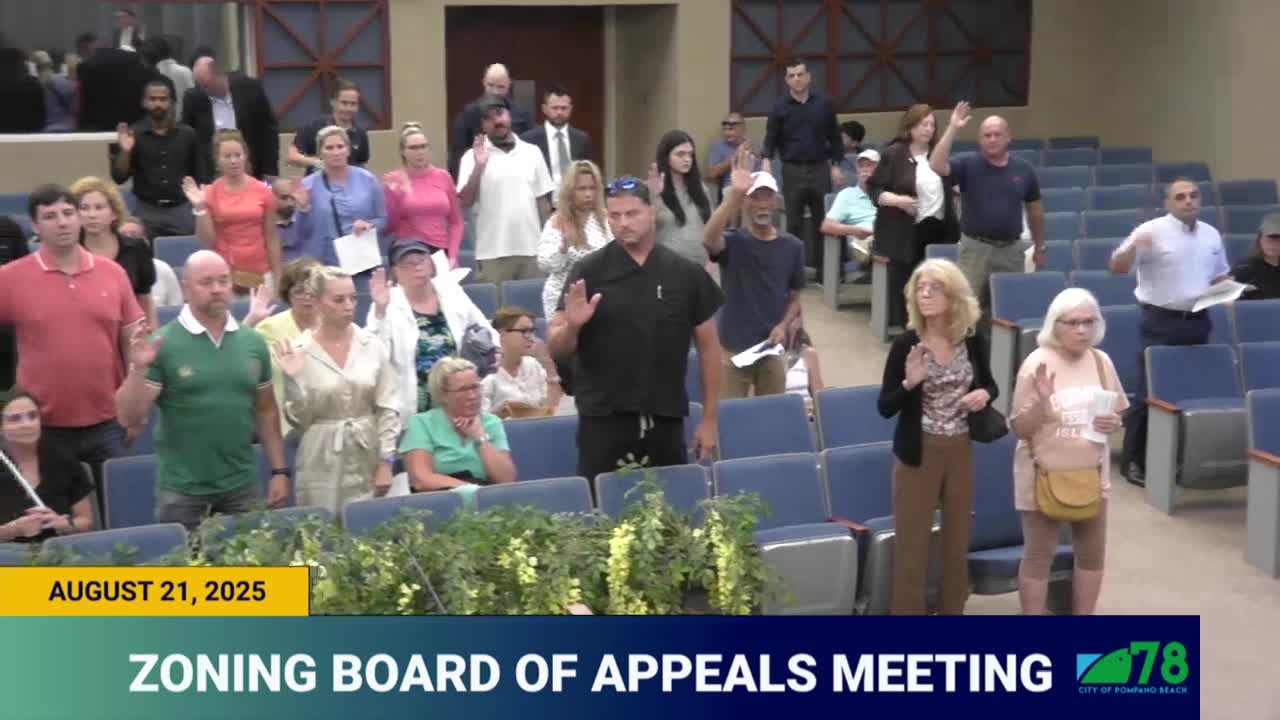
The Pompano Beach Zoning Board of Appeals on Aug. 21, 2025 voted 4‑2 in favor of granting a variance that would allow driveway stacking lengths of 50 to 70 feet instead of the 100 feet required by city code for a proposed industrial redevelopment of the former Festival Flea Market site, but the board’s attorney and the chair clarified that variances require five affirmative votes of the six‑member board, so the motion failed and the variance was denied.
The board first voted to rescind its earlier denial and reopen the matter for a full rehearing, a motion the board approved by roll call after the vice‑chair submitted a written request to place the rescission on the agenda. That rehearing included a staff presentation and testimony from the applicant’s attorney and project team.
Staff and the applicant said the property at 2900 West Sample Road is roughly 24 acres and proposed for redevelopment into three industrial warehouse buildings totaling roughly 474,000 square feet with about 422 parking spaces. The applicant requested relief from section 155.5101(g)(8)(b) of the Pompano Beach zoning code to allow stacking lane depths ranging from 50 to 70 feet instead of the required 100 feet, arguing that the size of the site, fixed/platting access points and multiple access drives would distribute traffic and that FDOT and Broward County have measured or preliminarily approved some driveway lengths under their standards.
Staff described the project, summarized the materials submitted (site plan, traffic analysis and narrative addressing variance review standards) and relayed the city’s independent traffic consultant’s conclusion that the proposed throat depths were functionally adequate if the applicant met several conditions. Staff recommended approval conditioned on five items including obtaining all necessary permits and approvals (major site plan PNZ24‑12000024 being one), submitting written County approval for two county‑jurisdiction driveways, restricting an internal east‑west drive to right‑turn only at a specified intersection, and requiring a new variance application if future agency changes reduce approved throat depths.
The applicant’s attorney, Matthew Scott of Greenspoon Modern, and Foundry Commercial representatives argued the code requirement does not contemplate an expansive, multi‑access 24‑acre industrial site and that strict application would unreasonably restrict development of the land. They said FDOT had approved the Sample Road driveway configuration and Broward County had given conceptual acceptance but written county approval remained a condition.
Board members questioned whether the applicant could reduce building sizes or otherwise redesign the project rather than seek a variance, examined the record of prior testimony, and asked about agency approvals, measurement differences between FDOT/County and the city, and site safety for trucks. The city’s traffic consultant recommendations and the applicant’s willingness to adopt them were discussed at length.
A motion to grant the variance subject to the five staff conditions passed on a roll call vote (Penny Cutt, Allison Morales, Michael McCormack, Charlotte Burry in favor; Rafael Katz and Linda Thomas opposed), 4 yes to 2 no. The chair then confirmed that because the code requires a supermajority (five of six members) for variances, the 4‑2 result did not meet the legal threshold and the variance failed.
Votes and the legal‑threshold clarification were recorded on the public record; no additional motion was made to continue or remand the case. The board therefore left in place the status that the variance request was not approved.
The board also made a procedural finding earlier in the meeting to rescind the prior denial and rehear the item, allowing the applicant to present anew. That rescission vote passed on roll call prior to the rehearing.
With the outcome, the project’s next steps remain subject to the applicant pursuing new design options, reapplying for a revised variance, or seeking further administrative or legislative remedies outside the Zoning Board of Appeals process.