Get Full Government Meeting Transcripts, Videos, & Alerts Forever!
Get email alerts on the Solid Waste topic
No spam. Unsubscribe anytime.
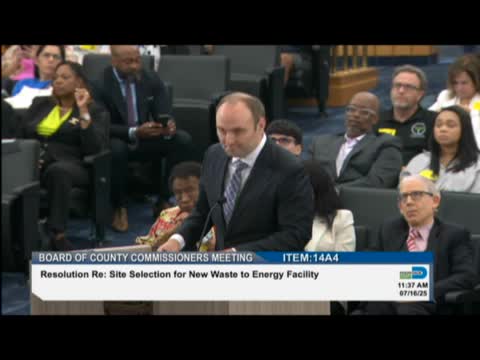
County board directs administration to pursue waste-to-energy options, sets limits on site locations
Summary
After hours of public comment and expert presentations, the Miami‑Dade County Board voted to adopt policy favoring a waste‑to‑energy (WTE) component in a broader solid‑waste portfolio and directed the county mayor to negotiate with industry proposers under specific geographic limits and conditions.
The Miami‑Dade County Commission directed the county mayor to pursue negotiated agreements with interested waste‑to‑energy and related technology vendors and to return recommendations to the board within a targeted timeline. The board adopted a policy that a WTE option should be included as part of a broader portfolio (recycling, composting, diversion and landfilling) while setting geographic limits for siting and asking the administration to explore multiple delivery modalities.
The move followed a briefing by county staff and market research consultant AtkinsRealis, which described responses from more than three dozen firms across several waste‑management categories. Ross Byers, project lead for AtkinsRealis, told the board the county had solicited information from the private sector and assembled a road map of “phase 1: siting and information; phase 2: implementation of advanced technologies; phase 3: future‑looking infrastructure.” Chief Utilities Officer Roy Coley told commissioners the county currently manages roughly 2,000,000 tons of solid waste a year and has been exploring public‑private partnerships, landfilling options, recycling, organics processing and advanced thermal conversion.
Commissioners debated whether to prioritize particular parcels. The board approved a motion directing the mayor to negotiate with market respondents (including major vendors that had previously submitted campus‑style proposals) but excluded certain locations from consideration and set a half‑mile residential setback specifically for large WTE facilities. The action also directed staff to continue examining rail and out‑of‑county disposal options, to study decentralized transfer‑station sorting and composting pilots that could be implemented in the near term, and to return to the board with negotiated terms (including proposed locations and draft agreements) for approval.
Public commenters and local advocacy groups urged the county to invest first in recycling and organics diversion and to avoid siting incinerators near residential areas or sensitive environmental resources. The board heard dozens of public speakers, including elected officials and city attorneys from Doral and Miramar, representatives of farming and composting firms, environmental organizations and residents from neighborhoods that previously hosted or were proposed as waste facilities.
The administration and several commissioners emphasized that the county will seek a portfolio approach — not a single, all‑or‑nothing solution — and that proposals could include a mix of facilities and decentralized operations (transfer‑station sorting, regional composting and advanced processing) rather than one large campus. The commission also asked staff to include transportation costs and other operational impacts in any analysis returned for board approval.
The board’s direction: (1) adopt a policy that includes WTE as one option within a broader waste‑management portfolio; (2) instruct the mayor to negotiate with qualified proposers and return negotiated agreements and site recommendations to the board for approval; (3) require a half‑mile residential setback for large WTE facilities and exclude certain sites specified on the record from consideration; and (4) direct immediate steps to reduce landfill tonnage through transfer‑station sorting and organics/composting pilots.
Implementation timelines and the full financial implications will depend on what proposers present during the negotiation phase and what additional pilot projects the administration can stand up while larger decisions proceed to the board.