Get Full Government Meeting Transcripts, Videos, & Alerts Forever!
Get email alerts on the Ai Harms Chatbots topic
No spam. Unsubscribe anytime.
Assembly subcommittee advances Padilla bill imposing safety requirements on AI companion chatbots
Summary
SB 243 would require companion chatbot operators to include disclosures, safety notifications, suidical‑ideation protocols and annual reporting; opponents called the bill overly broad and urged narrowed definitions. The subcommittee voted to send the bill to Judiciary.
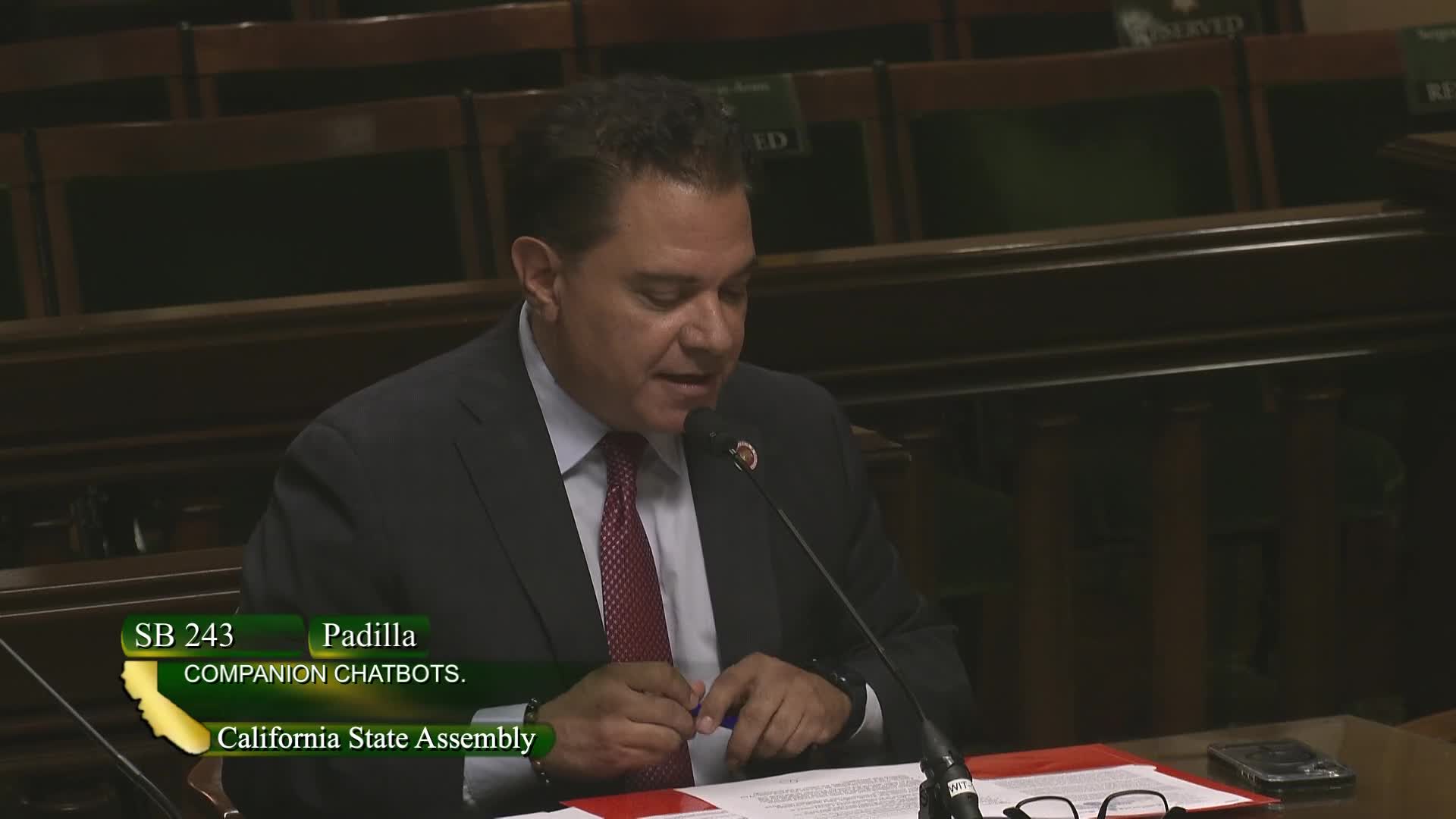
Senator Alex Padilla presented SB 243, a measure that would impose safety and transparency requirements on commercially offered AI “companion” chatbots, and the Assembly subcommittee referred the bill to the Judiciary Committee.
Padilla described companion chatbots as artificial personas marketed as cures for loneliness and said studies and anecdotal reports link prolonged chatbot use to higher loneliness, dependency and harmful outcomes for vulnerable people — especially minors. The bill requires operators of companion‑chatbot platforms to implement preventive measures against addictive engagement, provide disclosure that the interlocutor is AI, display suitability notices for minors, include protocols for responding to suicidal ideation (including referrals to crisis services), and file annual reports on links between chatbot use and self‑harm.
Megan Garcia, mother of a 14‑year‑old who died after prolonged interactions with a chatbot, testified in support and urged the Legislature to enact safeguards. Opponents including TechNet, the California Chamber and the Electronic Frontier Foundation raised concerns that SB 243’s definitions — terms such as “social needs” and “anthropomorphic features” — are overly broad and could sweep in general‑purpose models and productivity tools (examples cited: Gemini, Google Cloud, ChatGPT). TechNet offered targeted clarifying amendments intended to narrow scope to systems expressly designed for social companionship; written opposition from EFF raised First Amendment concerns.
Committee members praised the author’s intent to protect minors and vulnerable users while several members urged the author to work with industry on definitions and scope. The subcommittee paused briefly for quorum and then approved a motion to refer SB 243 to Judiciary; the final reported vote on SB 243 was 11–1 in favor of due‑pass to Judiciary.