Get Full Government Meeting Transcripts, Videos, & Alerts Forever!
Get email alerts on the Ai Policy topic
No spam. Unsubscribe anytime.
Assembly subcommittee backs bill to create AI team inside California Department of Justice
Summary
The Assembly Privacy and Consumer Protection subcommittee voted to send SB 69 to the Judiciary Committee after hearing testimony that the state lacks in-house legal expertise to oversee AI-related civil-rights and consumer-protection issues.
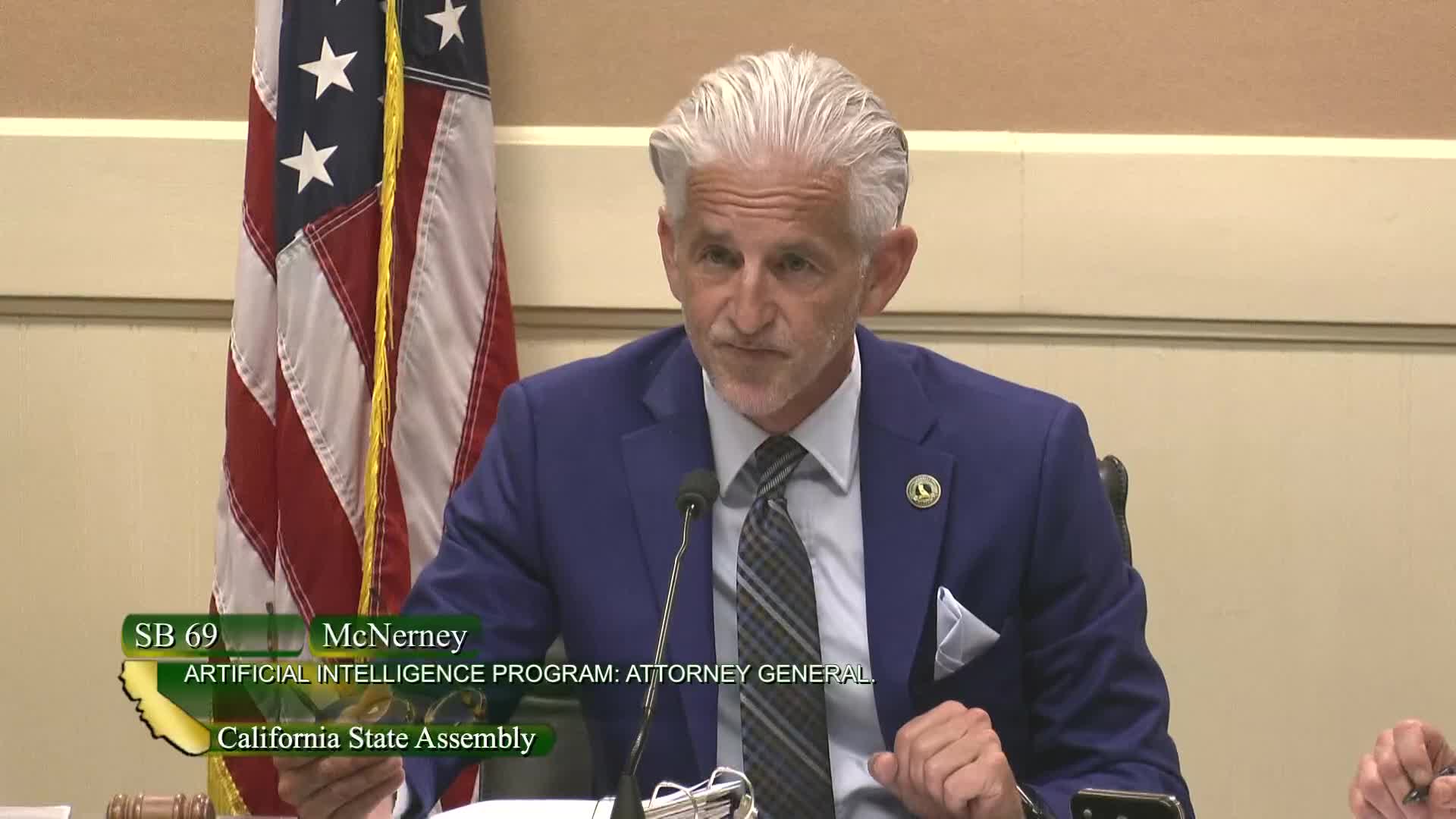
Senator Marc McNerney’s proposal to create an artificial intelligence unit inside the California Department of Justice cleared the Assembly subcommittee and was referred to the Judiciary Committee.
Supporters told the panel the state’s attorney general’s office lacks the technical expertise needed to enforce consumer-protection and civil-rights laws in the age of AI. Rob Ellavel, co‑founder and CEO of the Transparency Coalition, said many state attorneys general have specialists for racketeering and trafficking but none with dedicated tech‑policy enforcement roles.
McNerney said SB 69 would require the Department of Justice to recruit and train staff, work with outside experts and report to the Legislature on AI risks and legal gaps. “This bill complements the governor’s executive order by building in‑house expertise to guide oversight and protect Californians,” McNerney said.
Witnesses and committee members emphasized the bill would be narrowly built: Ellavel recommended a small team — “4 to 6 lawyers” — to start. No witnesses testified in opposition during the hearing; Tracy Rosenberg (Oakland BRIDGE) and Mariko Yoshihara (Tech Equity Action) registered brief “me‑too” support statements.
Committee discussion focused on where such expertise should sit inside state government. McNerney and supporters said enforcement duties make the Attorney General’s Office (DOJ) the appropriate home for the team. Committeemember Pellerin asked whether the attorney general’s office supported the plan; McNerney said the office was aware and broadly neutral at the time of the hearing.
Because a quorum was not immediately present, the subcommittee waited to record a formal motion. Once quorum was established, members moved and seconded a motion to refer SB 69 to Judiciary. The final recorded vote was 14–0 in favor of due‑pass to Judiciary.
SB 69 will next be considered by the full Assembly Judiciary Committee, where its staffing and budget implications will be explored further.