Get Full Government Meeting Transcripts, Videos, & Alerts Forever!
Get email alerts on the Refuse Rates topic
No spam. Unsubscribe anytime.
Recology proposes 18% residential rate increase for 2026 as San Francisco considers improved performance metrics and mixed‑waste processing
Summary
Recology presented a three‑year refuse‑rate application proposing an 18.18% increase in year one (2026) followed by 7.53% (2027) and 3.86% (2028); the proposal includes a contingent plan to build a local mixed‑waste processing line and an organics depackager to recover more recyclables and organics.
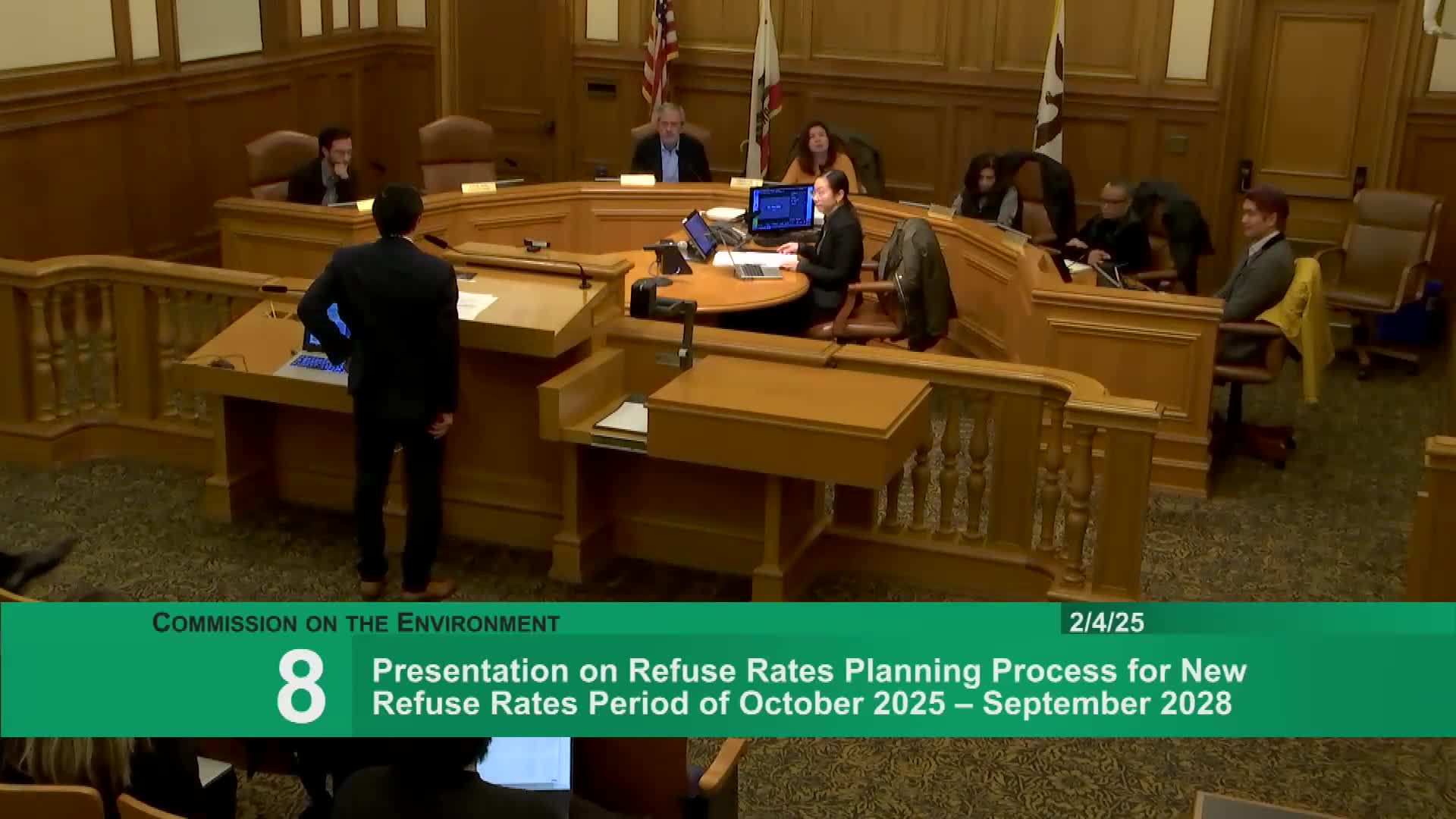
Recology presented its refuse‑rate application to the San Francisco Commission on the Environment on Feb. 4, proposing a three‑year residential rate cycle that would take effect Oct. 1, 2025, and run through Sept. 30, 2028. The company requested an 18.18% increase in the first year, 7.53% in the second year and 3.86% in the third year.
Jay Liao, the city’s Refuse Rates Administrator in the Comptroller’s Office, provided process context: voters’ Proposition F (2021) moved refuse‑rate administration into the controller’s office and requires the refuse‑rate administrator to present a proposed rate order to the Environment Commission. Liao said the initial 18.18% increase equates to about $8.50 per month for a single‑family household with default service; his office’s preliminary analysis identified roughly 8 percentage points of the first‑year increase as structural drivers (prior year revenue shortfalls, payroll underprojections and a new business tax burden on Recology).
Recology representatives said several program enhancements informed the request. Evan Boyd, Recology regional vice president, and Rich Schlancer, controller, highlighted proposed additions such as three abandoned‑material collection routes (to reduce illegal dumping), onboard camera/AI systems for contamination monitoring and bin ‘right‑sizing,’ a citywide compost giveaway and expanded outreach. Recology included an organics depackager to separate food waste from contaminants (notably plastics) and said that could increase organics yield from roughly 50% to about 66%.
A significant component of the proposal is a contingent $35 million capital plan to retrofit the company’s 501 Tunnel facility with mixed‑waste (trash) processing that could recover an estimated 49% of material currently going to landfill (projected processing capacity ~500 tons/day). Recology said the processing contingency would require two key milestones to be met before funds are released: (1) an Authority to Construct permit from the Bay Area Air Quality Management District and (2) identification of viable outlets for recovered materials. If firms meet those milestones, the trash‑processing contingency would phase into the rate years beginning in 2027.
Commissioners asked about the contingency triggers, timeline, revenue shortfalls that drove the request and outreach plans for behavior change and contamination reduction. Department staff and Recology representatives said the city has an opportunity to retain more recovery locally and to support zero‑waste and circular‑economy goals, but stressed that significant capital and operational investments are required. Department staff and several public commenters urged strong multilingual outreach and monitoring of compost quality and markets for recovered materials.
The refuse‑rate administrator and Recology noted this is a maximum three‑year proposal under Prop F; if adopted, the Prop 218 notices will set the maximum rates for the cycle and the rate board can set rates at or below those caps.