Get Full Government Meeting Transcripts, Videos, & Alerts Forever!
Get email alerts on the Climate Action Plan topic
No spam. Unsubscribe anytime.
San Francisco staff outline 2025 Climate Action Plan update, emphasizing transportation, buildings and equity
Summary
San Francisco Environment Department staff presented proposed refinements to the 2025 Climate Action Plan on Feb. 4, keeping the city’s net‑zero‑by‑2040 goal and laying out near‑term, measurable actions for transportation, buildings, housing and ecosystems.
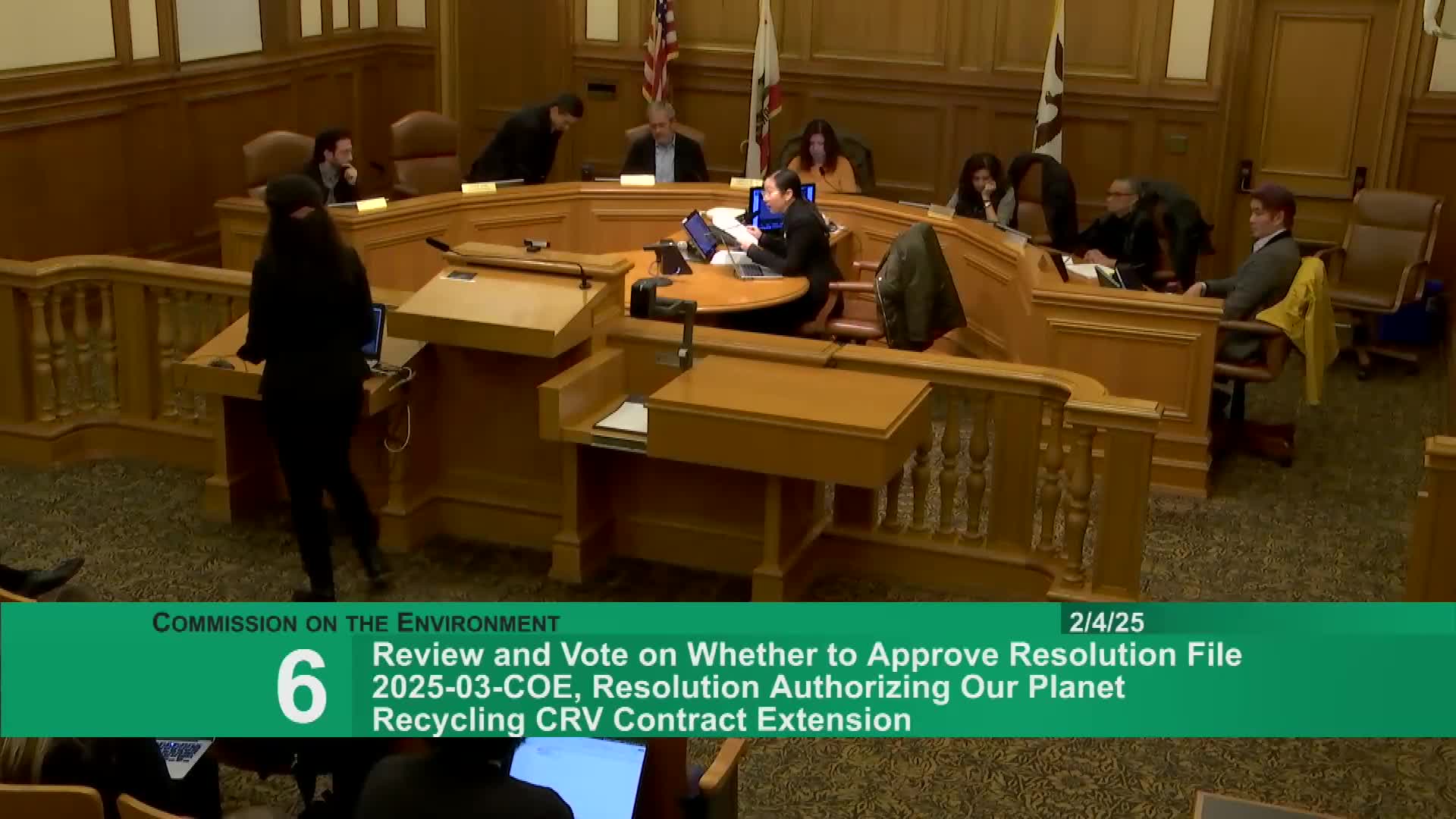
San Francisco Environment Department staff presented an update on the city’s 2025 Climate Action Plan (CAP) at the Commission on the Environment meeting Feb. 4, describing refinements to goals, strategies and actions and laying out a public engagement and equity review timeline leading to publication later this year.
Cindy Comerford, Climate Program Manager, and Elizabeth Stamp, Senior Climate Action Coordinator, summarized progress since the 2021 CAP and outlined priority sectors for the 2025 update: transportation (mode shift and vehicle electrification), buildings, housing and land use, energy supply, water supply and healthy ecosystems, along with circular‑economy thinking for responsible production and consumption. Staff said the plan maintains the city’s net‑zero by 2040 objective and focuses on near‑term, measurable actions through 2030. The department is also adding sections on funding and financing, governance, innovation and initial carbon‑removal exploration.
Key changes and proposed targets included a clarified mode‑shift goal to emphasize walking, biking and transit (60% of trips by 2030; 80% by 2040 for those sustainable modes), and updated electrification milestones for medium‑ and heavy‑duty vehicles (25% by 2035 and 100% by 2045 for those categories, reflecting technology timelines). Building goals remain ambitious: the department proposes preserving the existing standard that new buildings be net‑zero emission and consolidating large building goals into an all‑buildings decarbonization target by 2040.
On healthy ecosystems, staff recommended shifting emphasis away from expecting large carbon sequestration gains from local nature‑based solutions — research indicates a limited sequestration potential in San Francisco — toward biodiversity, greening and an urban‑forest target of 30,000 new street trees by 2030.
Commissioners pressed for clarity on several items, including whether EV targets represent vehicles registered or on the road (staff said the target refers to registered vehicles in San Francisco, both private and public fleets) and the modeling behind all buildings being net‑zero by 2040. Commissioners asked for clearer water metrics and more accessible multilingual outreach; staff said a racial and social equity review and expanded public engagement are planned and invited commissioner participation.
Public commenters, including representatives of the San Francisco Climate Emergency Coalition and health professionals, urged full funding for the CAP’s implementation, stressing health and cost consequences of delayed climate investment.
Staff said the department will complete a racial and social equity review, finalize outreach plans (including language‑specific virtual meetings), refine measurable actions with city departments and publish a revised CAP before the end of the year.