Get Full Government Meeting Transcripts, Videos, & Alerts Forever!
Get email alerts on the Stormwater topic
No spam. Unsubscribe anytime.
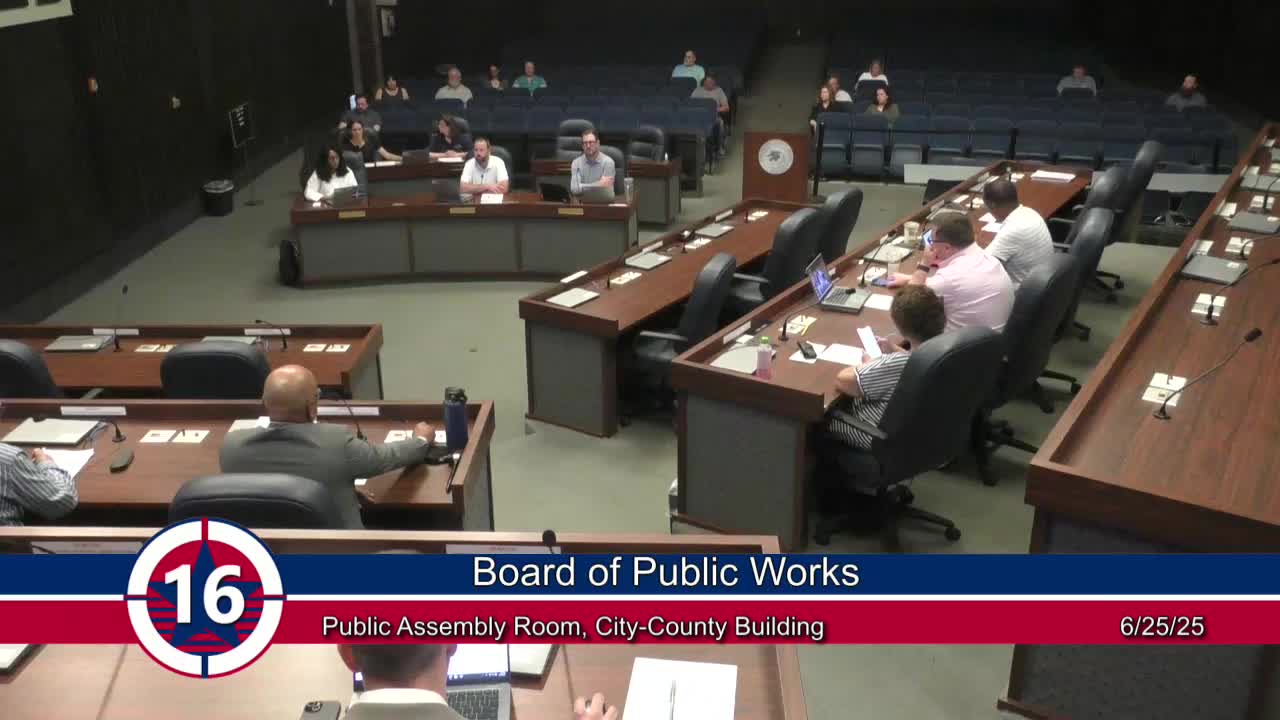
Board of Public Works adopts revised stormwater manual to meet MS4 permit requirements
Summary
The Indianapolis Board of Public Works on June 25 approved updates to the Stormwater Design and Construction Specifications Manual to implement the city’s MS4 permit, clarify enforcement, harmonize terminology with state and INDOT standards and reduce some O&M burdens after outreach and public hearings.
The Board of Public Works of the consolidated city of Indianapolis and Marion County on June 25 voted to adopt modifications to the Stormwater Design and Construction Specifications Manual as recommended by Department of Public Works (DPW) engineering staff.
The revisions are intended to incorporate requirements from the Indianapolis MS4 permit that became effective Feb. 1, 2024, refine enforcement procedures, harmonize terminology with state and INDOT guidance, and reorganize the manual to make it easier for designers and permit reviewers to use.
DPW engineering stormwater staff told the board the update followed about 18 months of drafting, two virtual public outreach sessions in May with roughly 100 attendees, and a public notice and hearing process. DPW said the city has 24 months from the permit effective date to implement the permit changes. The board packet, draft manual and recordings were placed on indy.gov for public review, staff said.
Shannon Killian, who led the presentation to the board, credited a large internal and consulting team for the work and introduced Gail Boydson, DPW’s MS4 coordinator, to review the technical changes. Boydson said the update contains a mix of regulatory-driven changes and usability improvements. She told the board the MS4 permit drove additions around injection wells, new training requirements referenced by IDEM, and controls for new fuel tanks. The manual also adds explicit protections for activities that could affect groundwater and clarifies when best-management practices are required in the public right of way.
Boydson said the team harmonized terminology across the manual (for example, changing the phrase “stormwater facilities” to “drainage facilities” and “disturbed” soil to “altered” soil) and reorganized easement, operation and maintenance (O&M) material to improve usability. She said DPW worked with IDEM to scale back some O&M requirements that reviewers found unnecessarily onerous while preserving environmental protections.
Public commenters at the hearing voiced support for the revisions. John, identified as the district manager for the Marion County Soil and Water Conservation District, said his organization inspects construction sites and “supports and recommends the proposed revisions,” adding the changes would better enable construction-site enforcement. Melissa Walker, representing ACEC Indianapolis (the American Council of Engineering Companies), said ACEC participated in the outreach and also “supports and recommends the proposed stormwater changes.”
Board members asked for clarifications during the Q&A. A board member asked whether the municipal separate storm sewer system (MS4) coverage includes natural drainage such as culverts. Boydson replied that conveyances identified as part of the MS4 system are included and that the permit requires the city to map MS4 conveyances and infrastructure in GIS to within a five-meter location accuracy; she said that map is publicly available on indy.gov.
DPW noted other topics the department expects to address in later updates, including potential local responses to state House Enrolled Act (HEA) 1037 concerning the state “no more stringent than” requirements for the Construction Stormwater General Permit (CSGP); an evaluation of how the city handles non-stormwater discharges that are permitted by IDEM; possible fees or processes for permit variances that now consume DPW engineering time; and development of clearer local standards for green infrastructure and for uses such as dog parks and kennels.
The board approved Resolution No. 5-2025, adopting the manual modifications. The motion carried with the board signaling “aye” and no recorded oppositions.
DPW staff said remaining clerical or scrivener edits identified during public comment would be addressed before final publication of the manual on the city website.
What happens next: DPW plans further code and manual revisions where state law or permit changes require them and will bring those back to the board and to the public for review.