Get Full Government Meeting Transcripts, Videos, & Alerts Forever!
Get email alerts on the Electrification topic
No spam. Unsubscribe anytime.
Consultants present draft electrification study, warn of substation and conductor upgrades
Summary
Consultants and Los Alamos staff presented chapters 1–4 of a draft electrification study showing winter-peaking electrification scenarios that could require an Eastgate substation, several new feeders and distribution upgrades; a full financial analysis will follow in July.
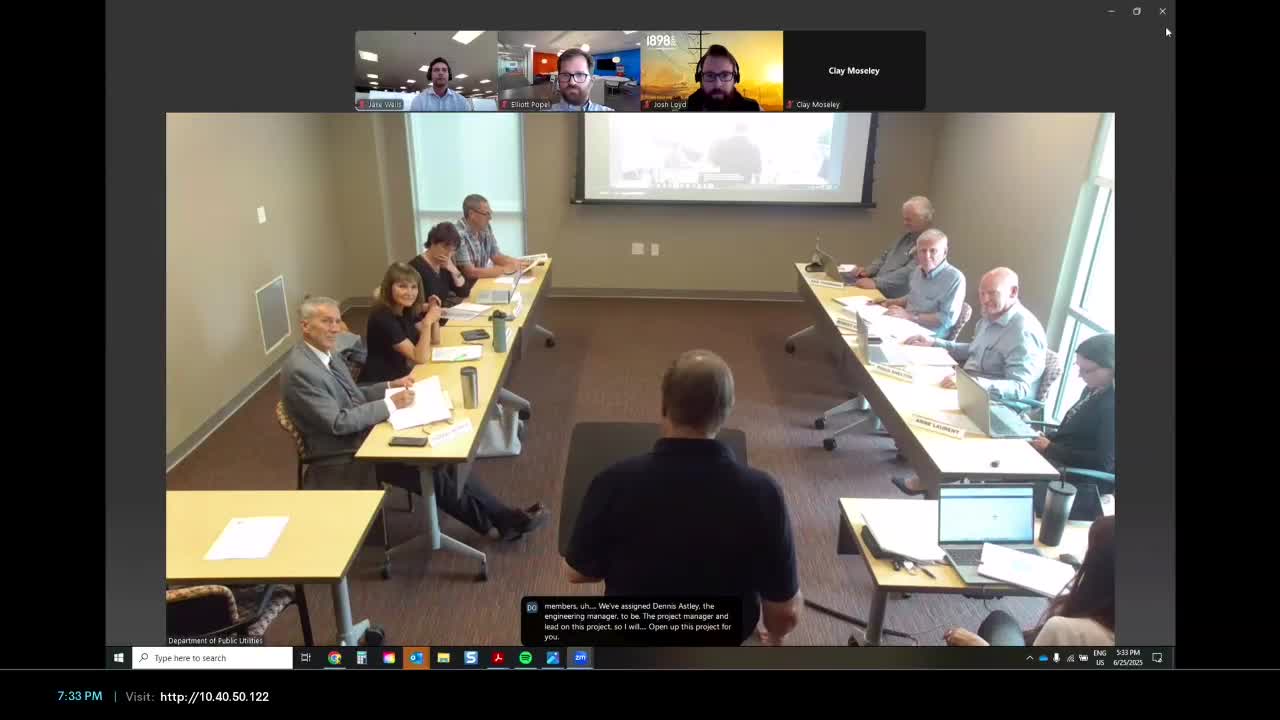
Los Alamos Board of Public Utilities Chair Jerry Gibson introduced a partial draft of the county's electrification study on June 25, 2025, and consultants from 1898 & Company (working with Burns & McDonnell) walked the board through chapters 1–4. The contractors said the analysis — driven by scenarios for vehicle and building electrification over a 30-year horizon — focuses on winter peak impacts and will be followed by a financial summary at the July meeting.
Why it matters: the study models how rapid adoption of electric vehicles, heat pumps and other electrified loads would change distribution planning and capital requirements. Consultants told the board that under the highest-adoption scenario the county could see a roughly 44.4 megawatt increase in peak demand by 2055 and that distribution and substation upgrades would be needed to keep voltages and equipment within planning criteria.
Jake Wells, a lead consultant, said the intermediate draft contains the inputs, system assessment and the electrification forecast used for power-flow simulations. "This intermediate draft release contains chapters 1 through 4 of the full electrification study report," Wells told the board. The consultants described the study's approach: convert billing and SCADA data into a Windmill power-flow model, export to CYME/Eaton for hosting-capacity analysis, and apply three illustrative adoption scenarios (high, medium, low) across 15- and 30-year horizons.
Key technical findings: the team centered analysis on wintertime peaks because of anticipated increases in space-heating demand. They used a 95% power factor assumption and modeled solar PV at a reduced output (about 70%) for minimum daylight scenarios. Hosting-capacity visuals showed that reverse power flow — not conductor overload or voltage limits — was the most common constraint near substations. On longer laterals, voltage rise became the limiting factor.
Infrastructure implications: the consultants reported the town-site and LANL TA3 substation together have a contractual capacity limit of about 20 MVA from LANL sources; to serve high-electrification scenarios they identified the need for a new Eastgate substation and upgrades at White Rock substation. For the most aggressive 2055 scenario the draft maps show conductor upgrades and as many as six new distribution feeders tied to Eastgate to move load away from constrained feeders. The team also recommended tracking capacity projects (for electrification) separately from routine asset replacement costs.
Operations and modeling issues: consultants warned about model convergence problems when adding very large amounts of load to the distribution model. They removed some single-phase service transformers from long-range power-flow runs to stabilize simulations and recommended incremental, customer-level studies to assess specific transformer impacts. The report also flags opportunities to improve the county's planning workflow by linking GIS, meter-level billing and SCADA data into a living Windmill model.
Grid modernization options: the presentation summarized potential investments — distribution-scale batteries, modular substations and fault location/isolation/service-restoration (FLISR) — noting some technologies may not be cost‑effective in the near term for a predominantly underground system. The consultants described volt‑VAR (voltage‑reactive power) inverter settings and PNM's (Public Service Company of New Mexico) approach as one precedent for limiting high‑voltage events caused by rooftop PV.
Board questions and next steps: board members pressed the consultants on how the study separates costs that are due to asset aging versus new capacity needed for electrification; consultants said chapter 4 and the forthcoming financial analysis will separately track capacity improvement projects and asset replacement. Several board members asked for more county‑specific inputs (vehicle registration or assessor data) and for higher‑resolution service‑transformer analyses. The consultants said they will present the financial totals and methods to minimize customer impacts at the July meeting.
The draft is explicitly labeled intermediate; consultants and staff told the board the final draft — including financial implications and recommended project phasing — will be presented at the next meeting for further discussion.