Get Full Government Meeting Transcripts, Videos, & Alerts Forever!
Get email alerts on the Hero Way Road Projects topic
No spam. Unsubscribe anytime.
Leander council favors larger Hero Way build; staff to pursue option adding lanes and examine financing
Summary
Councilmembers signaled consensus to pursue the most expansive county-proposed Hero Way option (three lanes each direction on key segments), and directed staff to advance design, perform level‑of‑service analysis and refine funding plans as part of a broader roadway financing discussion.
Leander — The City Council indicated support June 25 for a more robust build of the Williamson County‑led Hero Way project and agreed to pursue a financing strategy to address numerous planned roadway projects across the city.
Council consensus on Hero Way option 3
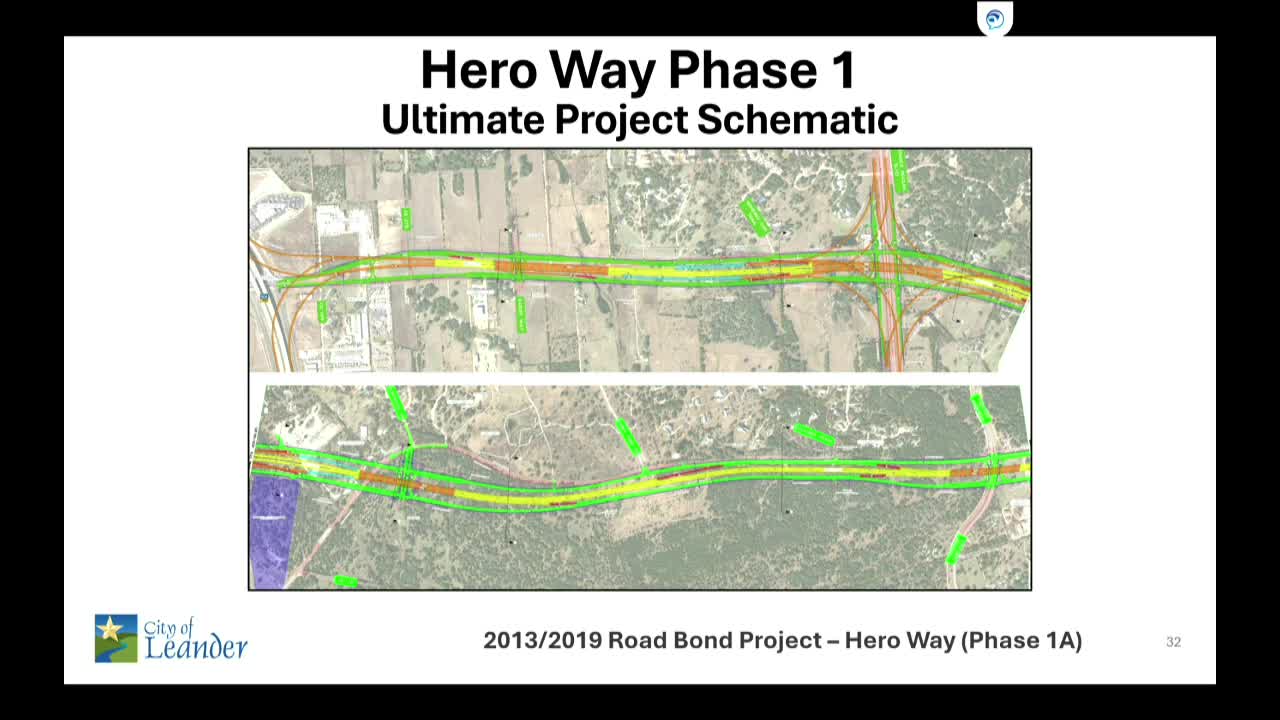
Assistant City Manager Ravel and staff reviewed three alternate build options proposed by Williamson County and TxDOT for the Hero Way (County Road 2235) corridor segment within Leander limits. After discussion, councilmembers voiced consensus for Option 3 — a more extensive build that would provide three lanes in each direction on the corridor segment within city limits and add corresponding frontage‑road capacity — rather than the county’s baseline plan (a single lane each direction with a center turn lane).
Staff reported the county’s updated city‑share cost estimate for the Option 3 frontage and related work at roughly $27.9 million (including an approximately $1.5 million estimated water‑line/utility relocation component). Councilmembers asked staff to pursue additional due diligence, including a level‑of‑service analysis to quantify traffic benefit and a review of construction timing and procurement options.
Why council favored the larger option
Several councilmembers said the more robust option would address existing and anticipated congestion near Leander Station, Harmony School and new commercial development, and could reduce later inflationary costs if future construction were deferred. Staff noted the county had acquired right‑of‑way for the project’s ultimate alignment and that the county is ready to move the baseline portion of its project forward; the Option 3 addition would likely be implemented in coordination with county construction to avoid substantial schedule delay.
Related road projects and financing
Staff also briefed the council on a slate of near‑term roadway projects and needs across the city — including Crystal Falls Parkway, San Gabriel widening phases and Reagan corridor improvements — totaling many tens of millions of dollars in additional capital need. The city’s draft 10‑year capital plan under discussion included roughly $127 million of additional CIP projects; staff and the city’s financial adviser presented an illustrative debt‑capacity analysis showing the city could, under conservative revenue assumptions and by maintaining the current interest and sinking (I&S) rate, issue multiple debt financings that might generate roughly $350–370 million over a 10‑year period to fund priority projects while preserving the tax rate.
Council direction and implementation tasks
Councilmembers asked staff to: (1) pursue the Option 3 pathway with the county — coordinating design details and schedule; (2) complete a technical level‑of‑service study to quantify traffic relief under Option 3; (3) follow up on the memorandum of understanding (MOU) with TxDOT regarding possible jurisdictional swaps for specific roadway sections; and (4) prepare materials to start formal consideration of potential debt issuances (authorizations and timing) to capture current borrowing capacity while maintaining the city’s tax‑rate objectives. Staff indicated design work and ROW issues would be coordinated with Campo, TxDOT and the county and that they would circulate the county’s updated cost estimate and schedule to the council.
Conclusion and next steps
Councilmembers asked staff to return with the level‑of‑service analysis, the final county cost breakdown (including escalation assumptions), and a recommended financing timetable. Staff said the county expects to execute the construction contract for the county’s baseline project later in 2025, and that the city’s funding obligation (if the Option 3 path is chosen) would be due in staged payments tied to construction milestones.