Get Full Government Meeting Transcripts, Videos, & Alerts Forever!
Get email alerts on the Community Media And Broadband Policy topic
No spam. Unsubscribe anytime.
Mount Hood Cable Regulatory Commission budget passes as members flag declining franchise revenue
Summary
The board approved the Mount Hood Cable Regulatory Commission (MHCRC) FY 2025–26 fund budget after MHCRC staff and Multnomah County's liaison warned of declining franchise fees and an ongoing strategic planning process to address shrinking revenue.
The Multnomah County Board of Commissioners on Wednesday approved the fiscal-year 2025–26 fund budget for the Mount Hood Cable Regulatory Commission (MHCRC), the interjurisdictional body that collects cable franchise and PEG fees and distributes funds to community media centers.
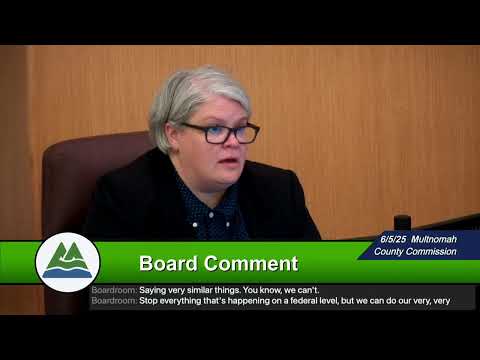
Commissioner Moyer, who serves as Multnomah County’s MHCRC liaison, told the board she participated in the commission’s discussions and warned that franchise-fee revenue is a “diminishing pot of money” and that the commission is engaging in strategic planning to address industry changes and declining subscriber counts.
Douglas Imaralu, MHCRC finance manager, presented budget details: estimated FY26 fund resources of roughly $4.7 million with a beginning fund balance around $6.3 million, for total resources near $11 million. Staff said projected revenues are down by about $773,000 year-over-year, driven by subscriber declines that the presenters reported as: roughly 100,000 subscribers in 2022, 88,000 in 2023 and 75,000 in 2024.
How the money is used: the MHCRC fund supports the commission’s operating costs, quarterly transfers to member jurisdictions and capital and operating allocations to the two community media centers — MetroEast Community Media and Open Signal. Staff outlined an approximate FY26 allocation that would direct about $1.6 million to MetroEast (split between operating and capital) and about $2.4 million to Open Signal (operating support and a separate grant agreement for city coverage commitments), and the commission plans a $1,000,000 community grant pool for nonprofits and community groups producing public education or government content.
Public testimony came from Seth Ring, MetroEast director of education and volunteers, who described a recent community needs assessment showing nonprofits want production services and equipment checkouts to tell local stories. Another public commenter urged the jurisdictions to develop a comprehensive community-media funding plan tied to larger revenue sources.
Why it matters: MHCRC funding supports local public-access and community media operations that record and distribute government and civic programming in east Multnomah County and Portland. Presenters said the commission must balance operating support for community media centers with declining franchise-fee revenue and rising costs.
Board action and next steps: the board adopted the MHCRC budget by roll call. Commissioners asked staff to continue strategic planning work and to keep member jurisdictions informed about the impacts of subscriber declines and any future funding changes that might affect community media services.
Ending: MHCRC staff and county commissioners signaled they expect further conversations this year as the commission completes strategic planning and examines sustainable funding options for community media.