Get Full Government Meeting Transcripts, Videos, & Alerts Forever!
Get email alerts on the Short Term Rentals topic
No spam. Unsubscribe anytime.
Riverton council reviews short‑term rental rules, enforcement and differences with Murray
Summary
City staff and councilors discussed Riverton’s existing owner‑occupancy and annual‑day limits for short‑term rentals, compared Murray City’s “hosted sharing” model, and said enforcement has been limited but possible when evidence shows noncompliance.
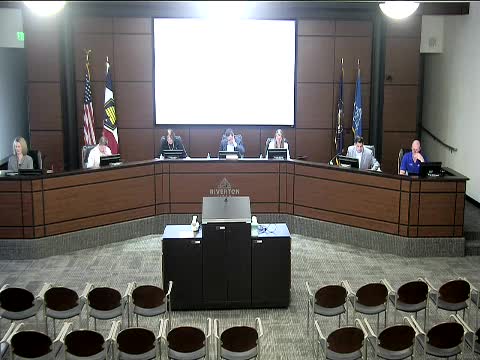
Riverton city staff briefed the City Council on short‑term rental rules and enforcement during the council’s work session, comparing the city’s existing ordinance to a recent Murray City model and asking whether the council wants staff to pursue changes.
Ryan Carter, a city staff member, summarized Murray’s ordinance and how it differs from Riverton’s rules. “Murray’s code … define[s] the term hosted sharing, meaning … running for a period of less than 30 days where the primary residence is with the host while the host lives on the site in the dwelling unit throughout the visitor’s stay,” Carter said. He noted Murray’s ordinance allows year‑round back‑to‑back rentals so long as the owner cohabitates during visitors’ stays and that Murray adopted the ordinance in January 2025.
The council’s current code requires an owner to live in the property a minimum of 185 nights per year and caps short‑term rentals at 150 nights per year, Carter said. He described Riverton’s regulatory steps for short‑term rentals: registration or business license, a conditional‑use permit review by the planning commission (which examines off‑street parking, lighting and neighborhood impacts and may impose conditions), and a posted contact number available 24/7.
Council members and staff framed the conversation around enforcement and neighborhood impacts. Chief Taylor, Riverton’s police chief, said code enforcement had responded to a “couple” of short‑term rental complaints and issued compliance letters, but that short‑term rental calls remain minimal compared with other ordinances the department enforces. “Code enforcement’s responded out on a couple that I’m aware of … but it is somewhat minimal, in comparison to other ordinances they enforce daily,” Chief Taylor said.
Council member McDougall said the council had “struck a kind of a perfect … balance” with the city’s existing rules and that most reported problems involved properties where the homeowner was not present. “What I’ve found in every case when we’ve had an owner living there, we haven’t had a problem,” McDougall said, adding that frequent changes to the ordinance would require more education and enforcement work.
Staff also identified common complaint patterns: overcrowding, too many unrelated guests, parking impacts and after‑hours activity. Carter told the council that when a short‑term rental operates without the required conditional‑use permit, the city typically brings the property into compliance by requiring the permit and imposing limits—commonly on occupancy and number of cars.
Carter warned that state law has constrained some enforcement tools; he said Utah statutes limit what cities may rely on as evidence (for example, listing a property on a commercial website cannot automatically be used as proof of illegal operation). He recommended that Riverton consider whether the council wants staff to draft an ordinance amendment adopting Murray‑style “hosted sharing” language requiring cohabitation, or maintain Riverton’s approach of a day cap plus owner occupancy.
No ordinance change was proposed or voted on at the meeting. Council members asked staff to keep pursuing comparative analysis and enforcement data; staff said they would return with draft language if the council wants to pursue that direction. “We could still maintain the same number of days per year limitation in the city’s code and in addition to that require cohabitation,” Carter said.
The council and staff emphasized the practical enforcement threshold: the city needs evidence that an owner is not meeting the 185‑night occupancy requirement to begin an investigation and pursue compliance actions. Carter said, “If there’s evidence that shows that the property owner is not living there, we would … undertake enforcement action against them. We just need that information.”
The discussion closed without formal direction to draft immediate code changes; several council members said they preferred retaining the current model unless enforcement or new data indicate a problem requiring revision.
Riverton officials said they will continue to monitor complaints, compare peer city ordinances, and report back to the council if staff recommends ordinance drafting and planning‑commission review.