Get Full Government Meeting Transcripts, Videos, & Alerts Forever!
Get email alerts on the Kennel Zoning topic
No spam. Unsubscribe anytime.
Wicomico County council amends kennel rules, raises setback to 1,000 feet and adopts 3‑year sunset for some nonconforming uses
Summary
After public comment about noise and grandfathering, the council amended Legislative Bill 2025‑01 to raise the required kennel setback from dwellings to 1,000 feet (from property line) and added a three‑year sunset for certain nonconforming uses; the amended bill passed unanimously.
WICOMICO COUNTY, Md. — The Wicomico County Council on Feb. 4 amended and approved Legislative Bill 2025‑01, a zoning change that sets new standards for commercial kennels, raising the minimum setback for runs from dwellings to 1,000 feet measured from the property line and adding a three‑year sunset clause for nonconforming uses, the council said.
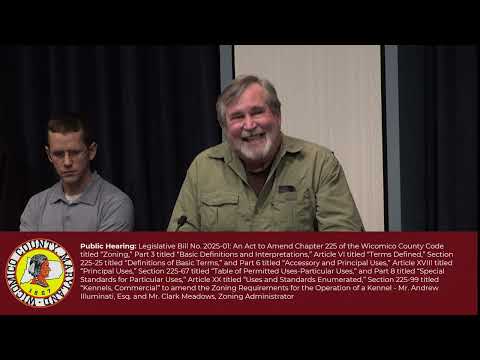
The bill, introduced for a public hearing at the meeting, originally proposed a 200‑foot setback. Residents who live near an unlicensed facility near Sharptown urged a longer distance and tighter grandfathering rules, saying noise and other impacts had reduced quality of life.
“My recording was taken from over three football fields away from these dogs, 1,170 feet,” resident Dan Beebe told the council during public comment, urging a 1,000‑foot minimum. “Distance where loud dogs are concerned needs to be a minimum of 1,000 feet.”
Other residents also asked the council to narrow or remove grandfathering for operations that do not meet the present legal definition of a kennel, or to include a sunset that would require nonconforming properties to come into compliance or stop operating.
County Attorney Andrew Illuminati and County Administrator Clark Mattis outlined how the draft compares with neighboring jurisdictions and what enforcement tools exist. Illuminati said the planning commission had reviewed the draft and that kennels in commercial districts that are fully indoors were treated differently from agricultural and transitional districts.
The council debated three principal issues: the setback distance (revised upward), whether grandfathered nonconforming uses should be phased out, and what numeric limit of animals should trigger special regulation. Council members agreed to amend the setback to 1,000 feet measured from the property line and to add a three‑year sunset for nonconforming uses. A proposal to change the numeric threshold for defining a kennel was discussed but left for future action; the current draft uses 10 animals as the numerical threshold for special review, and councilmembers asked staff to clarify enforcement for litters and temporary increases.
Councilman Baker moved to increase the setback to 1,000 feet; the motion was seconded and passed. Later, the council adopted a motion to add a three‑year sunset for nonconforming uses. The amendment and then the full bill passed unanimously on a roll call vote: Councilman Holloway, Councilman Hastings, Councilman Baker, Vice President Merritt and Councilwoman Shields all voted yes.
Illuminati said the county had received no public comments from any operating, licensed kennel opposing the changes and that the draft seeks to regulate boarding, breeding, training, selling, exhibition and raising activities so that entities cannot avoid being defined as kennels simply by not selling animals.
The new rules also rely on established animal control and public nuisance processes for noise complaints; Illuminati noted changes to animal control procedures allow citizens to file complaints without requiring an animal control officer to witness an incident, but cautioned that prosecutorial success can depend on witness attendance at hearings.
The ordinance will take effect as codified once administrative steps are complete. Council members directed staff to work with the county attorney on final language, including precise definitions for litters, temporary increases and enforcement timelines.
Ending: Council members and staff said they would monitor post‑adoption complaints and may return with additional clarifying language after implementing the new code sections.