Get Full Government Meeting Transcripts, Videos, & Alerts Forever!
Get email alerts on the Bulky Collection topic
No spam. Unsubscribe anytime.
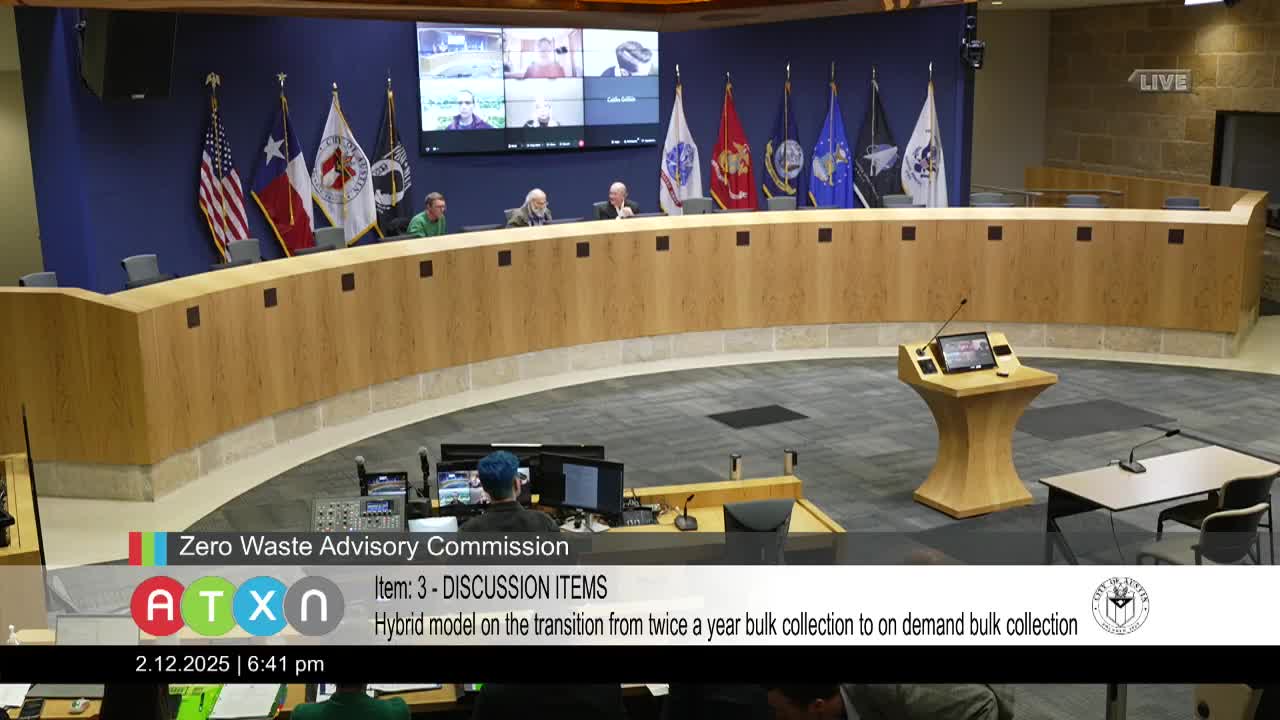
Commission debates hybrid bulky‑collection model, staff urges year‑long evaluation and more metrics
Summary
Commissioners and public speakers discussed a proposed hybrid approach to the city’s twice‑yearly bulky collection, raising concerns about scavenging, diversion metrics and environmental impacts. Staff said the new program is one month in and recommended waiting a year while collecting additional data and surveys.
The Resource Recovery Commission discussed possible changes to Austin Resource Recovery’s bulky‑collection program after public commenters and commissioners raised concerns that a new hybrid model could change diversion and reuse activity.
Kate Moon, a resident who identified herself during public comment, said the previous twice‑yearly curbside piles created an informal scavenger ecosystem that enabled neighborhood reuse and kept reusable items out of the landfill. "Twice a year on my evening walks, I would walk around my neighborhood and watch as those piles appeared and then grew, but then shrank," Moon said. She said the new policy could make piles larger when the city collects them — which might raise ARR’s diversion percentage on paper, but not necessarily reflect better reuse or progress toward the city’s zero‑waste goals.
Richard McHale, director of Frost and Resource Recovery (presenting for Austin Resource Recovery), told commissioners the new initiative is only a month old and staff would prefer to collect at least a year of data before recommending changes. McHale said staff will provide updates over the year and examine outcomes before pursuing adjustments.
Commissioners and staff discussed several tradeoffs. Commissioners noted the program reduces miles driven and staff overtime in some areas but also affects neighborhood differences in scavenging activity. Commissioner Greg suggested publishing a route to allow informal salvagers to collect items ahead of pickup; McHale cautioned that encouraging scavenging could lead to safety and compliance problems (for example, people removing refrigerants from appliances without proper equipment).
Commissioner Amanda and others asked which additional metrics ARR will track. Assistant Director Gina McKinley briefed the commission later in the meeting on diversion metrics and said ARR plans to track a broader set of indicators: miles driven by collection vehicles, driver overtime, tons collected, number of set‑outs by route, and comparative route volume year over year. McKinley said staff are developing a customer survey for participants and will study whether material collected by on‑demand services (particularly household hazardous waste) would otherwise have gone into regular trash or to a drop‑off center. She said ARR is examining capture rates, per‑capita disposal, diversion rate and other commodity‑level measures so staff can better understand reuse and recycling patterns.
Multiple commissioners recommended a holistic evaluation that looks beyond a single diversion percentage and includes customer surveys, route‑level comparisons and tracking of outcomes such as furniture warehousing and reuse. McHale emphasized the program’s operations goals — routing efficiency and worker safety — and said the furniture reuse warehouse the department is planning would help capture higher‑quality reusable items before scavengers or weather degrade them.
No formal action or policy change was taken; staff will return with updates and recommended metrics after additional data collection.