Get Full Government Meeting Transcripts, Videos, & Alerts Forever!
Get email alerts on the Open Meetings Brown Act topic
No spam. Unsubscribe anytime.
Dixon Unified trustees receive extended Brown Act training; board reports closed‑session settlement and approves consent agenda
Summary
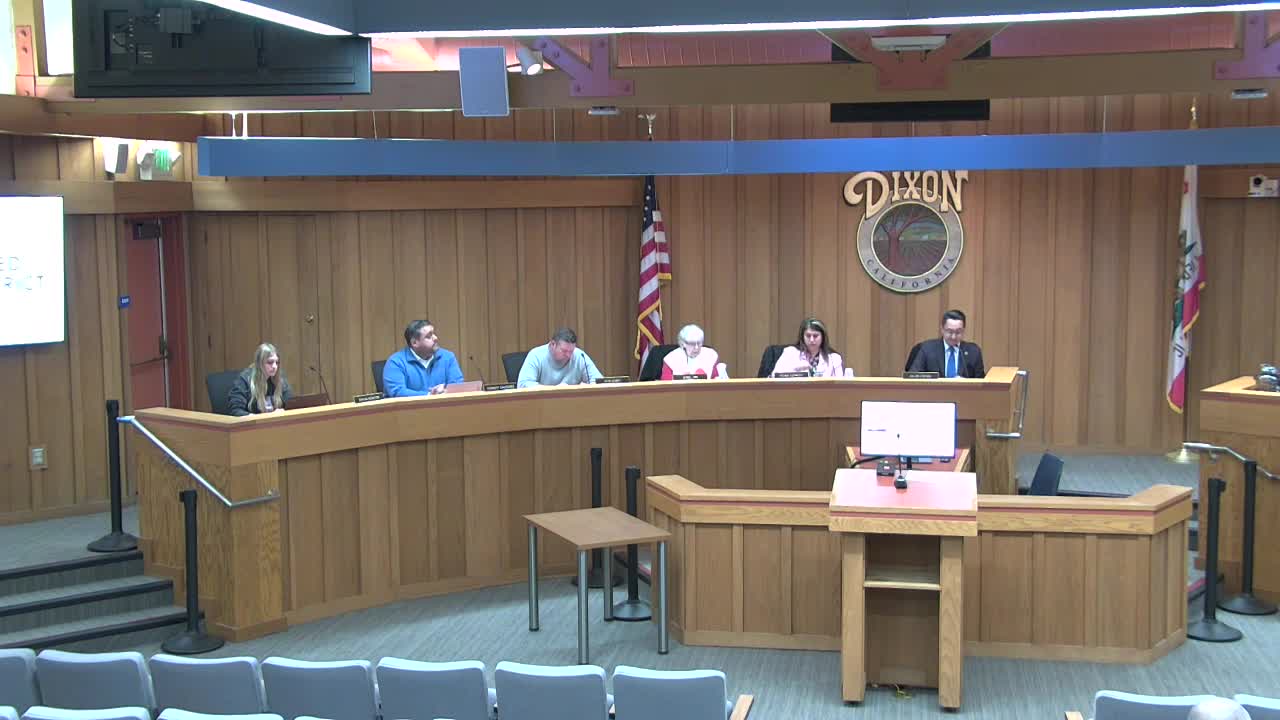
At a regular Dixon Unified School District board meeting, trustees heard a detailed Brown Act presentation from outside counsel, asked questions about social media and remote attendance rules, and approved a consent agenda after a closed‑session settlement was reported as unanimously approved.
Dixon Unified School District trustees on a date not specified spent the bulk of a board meeting receiving a two‑hour Brown Act training from outside counsel and then handled routine business, including a vote to approve the consent agenda and a public report that the board had approved a closed‑session settlement.
Outside counsel George L. Cuevas of Atkinson, Anderson, Loya, Rudd & Romero (AALRR) led the training, saying the Brown Act requires that "the deliberations and discussions of boards in addition to the actions taken by boards be conducted openly in front of the public." Cuevas walked trustees through meeting basics, serial‑meeting rules, teleconferencing and remote‑attendance exceptions, the limits on board discussion of items not on the posted agenda, and new guidance on social media interactions.
Cuevas told trustees that simple online interactions can create Brown Act exposure: "The updated version says that a member can't respond directly to a communication on social media that's posted or shared by another member and is within the subject matter jurisdiction of the board. ... Using digital icons like buttons or smiley face buttons or little care heart hugging button, all of those count as responding." He cautioned that reposting or "reply all" on staff email packets can create an impermissible chain of communications among a majority of board members.
The presentation covered how and when trustees may attend remotely, including the distinction between traditional teleconferencing rules and the temporary "just cause" and emergency standards that allow remote video participation. Cuevas explained limits on remote attendance, identification requirements for adults at a remote location, and the need to preserve live public access: if a board's public call‑in or livestream fails, the board "has to take no further action on the item" until access is restored.
Trustees asked numerous clarifying questions, including whether short social‑media posts on non‑board topics (for example, sports or pop culture) fall under the rule (Cuevas said not if the post is outside the board's subject matter jurisdiction) and how the Brown Act applies to advisory committees and superintendent‑created work groups. Cuevas emphasized that committees created by the superintendent without formal board action generally are not Brown Act legislative bodies, but standing committees with continuing subject‑matter jurisdiction may be.
Public reaction during the meeting reflected both criticism and appreciation. A public commenter who identified themselves as a longtime observer criticized the board's past handling of curriculum and equity work, while another speaker who identified themselves as having worked with civic open‑government advocate Terry Francke praised the district for arranging the training and suggested purchasing Francke's book on open meetings. One public commenter used the meeting to attack the district's diversity, equity and inclusion work; those remarks were recorded as public comment and not a board position.
Votes at a glance
- Closed‑session settlement: The board "took action in closed session by unanimous vote of all trustees present to approve a settlement agreement with a district classified employee to resolve a grievance," the board announced at the meeting open session. No additional details of the settlement were provided during open session. (Reported by the board at the start of the meeting.)
- Consent agenda: Trustees moved, seconded and voted to approve the consent agenda; the president called the vote and the motion carried. No items were pulled from the consent agenda.
Why it matters
The training clarified how trustees must avoid informal serial discussions (including via email, text chains or social media interactions) that could effectively substitute for a public meeting, and it highlighted several areas where state law and court guidance limit how board members use personal social media accounts or respond to constituents online. The Brown Act guidance also outlines practical steps trustees and staff must take to ensure public access when members attend remotely or when meetings are held under emergency exceptions.
What comes next
District staff said they will follow up by circulating materials and scheduling the advisory groups and work‑group kickoff meetings discussed later on the agenda. Trustees and staff also noted upcoming agenda items including the mid‑year Local Control and Accountability Plan (LCAP) update and an English learner strategic plan. The board chair closed the meeting after listing those future items.