Get Full Government Meeting Transcripts, Videos, & Alerts Forever!
Get email alerts on the Education Kindergarten topic
No spam. Unsubscribe anytime.
Timberlane students press board on equity; board directs administration to seek funds for fully funded full‑day kindergarten and creates 1.0 FTE
Summary
High school students in the Timberlane Regional School District presented a class project on school funding and urged the school board to prioritize student supports such as theatre, cleaner bathrooms, athletic field repairs and crossing guards.
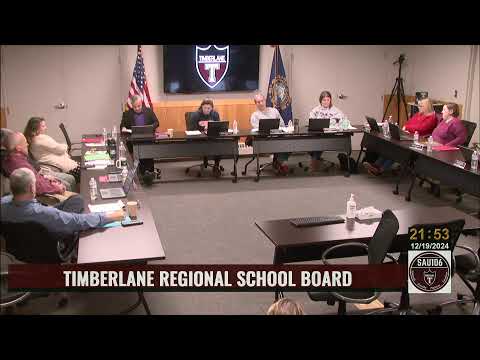
High school students in the Timberlane Regional School District presented a class project on school funding and urged the school board to prioritize student supports such as theatre, cleaner bathrooms, athletic field repairs and crossing guards. After a separate ad hoc committee report on tuition‑based full‑day kindergarten and a lengthy discussion about budget tradeoffs, the board voted to ask the superintendent to identify $150,000 in existing funds to fully fund full‑day kindergarten for the 2025–26 school year and separately voted to convert two half‑time kindergarten positions into one 1.0 full‑time equivalent (FTE).
The students said their classroom exercise, conducted with the New Hampshire Funding Fairness Project, showed how local funding responsibility creates disparities: “It was surprising to all of us that New Hampshire towns are responsible for the majority of funding in our schools,” student Gracie Griffiths said during the presentation. The students handed the board a set of short notes summarizing what they called “highlights” (programs the district does well) and “requests” (areas needing investment), and they asked the board to consider student needs as the budget process continues.
The ad hoc early childhood committee reported research and local listening‑tour findings that said cost is a primary barrier to access for tuition‑based full‑day kindergarten. The committee told the board the district currently receives $1,933 per student in state aid; staff also presented an estimate that, in the first year of offering fully funded full‑day kindergarten with the state aid formula, the district would receive roughly double that — “just over $4,000 per student” in year one, moving to 100% base adequacy in year two, according to the committee presentation. The committee reported the district employs 15 kindergarten teachers now (13 full time and two half time) and that projected enrollment would not require additional classrooms; presenters estimated the maximum additional salary and benefit cost to convert two half‑time positions to full time at about $143,548 (presenter figure).
Board members and the superintendent pressed on practical issues such as registration uncertainty, transportation, and how any increase would be handled if the school budget is cut elsewhere. Superintendent Justin Kreger noted that the crossing‑guard positions are already in the voters’ budget and are budgeted at $18,900, answering students’ questions about that request.
After extended discussion about principle and fiscal constraints, board member Kim (board member) moved — seconded by Alyssa (board member) — that the board direct the superintendent to find $150,000 in the current budget to fully fund kindergarten for the 2025–26 year (the motion text asked the superintendent to “find that $143,000” and the board rounded to $150,000 in later amendment). The motion passed on a voice vote; specific roll‑call tallies were not recorded in the public minutes. The board then approved a separate motion (made by Ken, seconded by Dawn) to convert the two current half‑time kindergarten positions into two 1.0 FTE positions representing a net increase of one FTE; that motion also passed.
Board members said they view fully funded kindergarten as an investment that supports working families and can reduce later intervention costs by identifying and addressing needs earlier. Members who opposed funding the change at this time said the district faces an uncertain budget environment — the budget committee had requested further reductions from the administration — and preferred to put a warrant article before voters. Supporters argued the additional cost is relatively small compared with the district’s overall budget and could produce long‑term savings and equity gains.
Next steps: the board directed the superintendent to create the administrative positions necessary to house the funded kindergarten staffing and to reflect the change in the operating budget submission to the budget committee, which is scheduled to meet Dec. 26. Board members and staff encouraged students and families to engage at public budget committee meetings, and several board members said they would help connect students to legislators if statewide funding discussions are scheduled.
The student presentation and the ad hoc committee’s report were recorded in the meeting minutes and will be retained with the board packet for future reference.