
Muskogee district financial report: early ad valorem payments and federal claim boosted November revenue; $91,000 supplemental appropriation proposed
Get AI-powered insights, summaries, and transcripts
Subscribe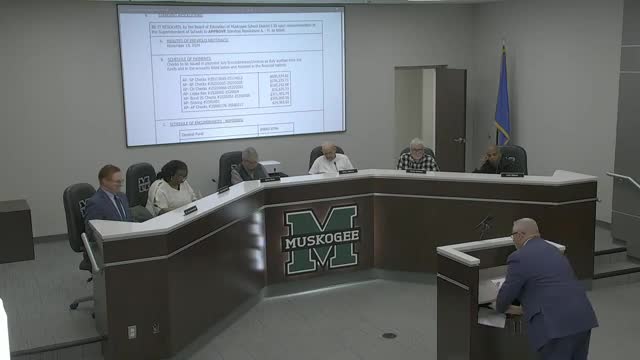
Summary
A finance presenter told the Muskogee Board of Education that November general‑fund revenue was higher than last year largely because of an early ad valorem payment and a large federal claim, and that a roughly $1,004,000 negative operating balance reflected a timing issue that should resolve when current ad valorem receipts arrive.
A district finance report presented during the Muskogee Board of Education meeting said total general‑fund revenue for November was higher than the same month a year earlier because the district received an early ad valorem tax payment and a large federal claim.
The presenter said building‑fund revenue was similarly higher for the month for the same timing reasons and noted that the district is winding down CARES Act funds. Child nutrition revenue and expenses showed year‑to‑year timing differences that affected monthly comparisons.
The presenter reported an actual negative operating balance of approximately $1,004,000 as of Nov. 30 and said the deficit was driven by timing for the board‑book cutoff and was expected to resolve within a month as current ad valorem payments arrive.
A supplemental appropriation (a 307 form) of about $91,000 for revenue sources not previously budgeted was presented for addition to the budget. The presenter also reviewed purchase orders over $15,000 and noted the following items described in the meeting records:
- A county assessor revaluation charge allocated to Muskogee based on the district’s share of ad valorem collections. - Child nutrition purchase orders for food and related supplies. - Two sinking‑fund purchase orders for interest payments on bond issues identified as 02/20 and 02/22. - A contract with Solidus Ed for a new time‑clock system to replace the district’s former Alio time system; the presenter said the new system will integrate with the district accounting system. - An interlocal cooperative purchasing agreement that the presenter said would have no cost to the district and allow cooperative purchasing options.
Board members were given an opportunity for questions; none were recorded in the transcript.
The presenter characterized the November month‑to‑month differences as largely the result of timing (early tax receipts and a federal claim) and reiterated that CARES funds are being wound down, which will change year‑to‑year comparisons going forward.