Get Full Government Meeting Transcripts, Videos, & Alerts Forever!
Get email alerts on the Violence Prevention topic
No spam. Unsubscribe anytime.
Residents and council members press for more staff and oversight as 1 Lexington details decline in youth shootings
Summary
1 Lexington, the city-funded violence-prevention initiative, presented a year-end report showing declines in shootings among youth while residents and council members pressed the program for clearer financial controls and more administrative support following an internal audit.
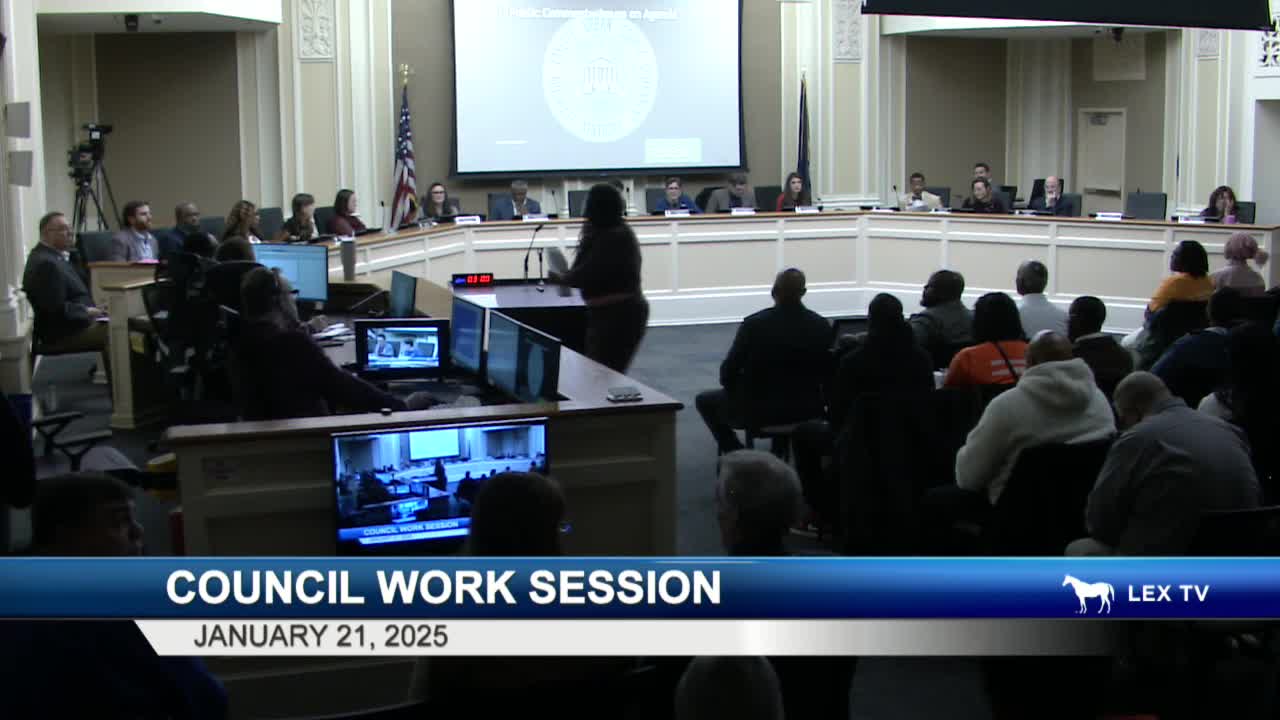
At a Lexington Fayette Urban County Council work session on Jan. 21, 2025, the city-funded violence intervention initiative 1 Lexington reported year-end results showing fewer shootings and homicides among the young people the program serves, while residents and council members pressed its leaders for clearer financial processes and more staff after a recent internal audit.
The report, presented by Devine Karama of 1 Lexington and members of his staff, said the program’s targeted age range has been adjusted to 10–29 and that the initiative’s casework and school-based mentoring reached students in 29 Fayette County Public Schools. Karama said nonfatal shootings in the program’s age cohort fell from about 135 in 2021 to 66 in 2024, and that young-person homicides in that cohort fell from 24 to 10 over the same period.
The figures, Karama said, reflect work by community nonprofits, schools, survivors and 1 Lexington’s staff. “We are a city initiative that leverages community partnerships and government funding to address youth and young adult gun violence,” Karama told the council during the presentation.
Why it matters: Council members described 1 Lexington as a central coordinating body for community-based violence intervention (CVI) work in Lexington. Council members and residents said they want the program to keep improving recordkeeping and to gain capacity so crisis-response and survivor services can be expanded and — where appropriate — shifted to fully staffed community nonprofits that can deliver wraparound services without the administrative limits of a city program.
Discussion highlights and follow-up items
- Audit and financial controls: Public commenter Shambra Mulder, a licensed psychologist and District 2 resident, cited the initiative’s recent audit and pointed to what she said was an advertised salary for a human-resources manager of $85,693.92. Mulder urged the council to consider providing 1 Lexington with administrative staff to tighten processes around grants and payments and to scale case management. In response, Karama and staff described changes they have already implemented after the audit, including strengthened documentation tied to each emergency payment or gift card and more complete reconciliations for ProCard transactions.
- ProCard and vendor questions: Council members pressed 1 Lexington on past payment practices raised in the audit report, including split transactions and use of online payment platforms. Karama explained that earlier practices reflected limited staffing and that the program has since consolidated documentation and corrected processes; he said the program now links receipts to the full supporting paper trail for each emergency payment.
- Service model and results: Karama described several program components — in-school mentoring (29 schools served), crisis response teams, youth mediation and scholarships. He said the program is shifting some summer resources into in-school mentoring because weekly contact during the school year has shown stronger academic and behavioral improvements. Karama described a new “Building Bridges to Opportunity” strand of scholarships and skills grants that expands access for rising seniors and training pathways (CDL, HVAC and similar tracks) and funds trauma-informed care for survivors.
- Community handoff for survivor services: Several council members and Karama discussed issuing an RFP to place survivor-centered, long-term trauma and case-management services into the hands of a community nonprofit with sustained capacity (examples named during Q&A included Lexington Rescue Mission and other local service providers). Karama said 1 Lexington’s team supports moving more survivor support to community-based providers that can deliver longer-term services.
Ending note: Council members thanked 1 Lexington staff for the presentation and urged continued openness about audit follow-up. Karama said the initiative will pursue the strategic planning session scheduled for early February to finalize program adjustments and to incorporate survivor, youth and community feedback.