Get Full Government Meeting Transcripts, Videos, & Alerts Forever!
Get email alerts on the Open Meetings topic
No spam. Unsubscribe anytime.
County attorney briefs supervisors on Arizona open-meeting law
Summary
A legal presenter summarized Arizona's open-meeting statute and its key requirements for public notice, meeting definition, legal action and remedies, urging supervisors to avoid private deliberations that could invalidate decisions.
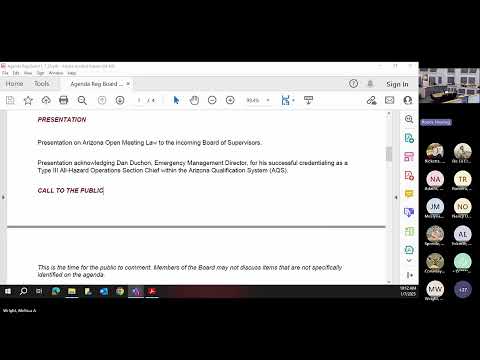
A presenter reviewed key provisions of Arizona's open-meeting law at the Cochise County Board of Supervisors meeting on Jan. 7, 2025, telling supervisors that the statute requires public notice, defines what constitutes a meeting and explains remedies and penalties when the law is violated.
The presenter said the open-meeting statute requires written notice and an agenda specific enough to inform the public what will be discussed, and that a "meeting" for the statute's purposes can occur when two members of a public body exchange deliberative comments, including electronically. He said legal action under the statute is any collective decision, commitment or promise made by a public body about county business. The presenter cited ARS 38-431.02 and related sections as the controlling law and noted that violations can be investigated by the county attorney or the Arizona Attorney General and may lead to civil penalties or, in extreme cases, removal from office.
The presenter noted there are statutory procedures for curing inadvertent violations through a ratification process if the board acts quickly (ratification within 30 days with a public presentation and formal vote). He advised supervisors to use work sessions and executive sessions for legal advice when appropriate rather than discuss matters informally.
No formal action was taken on the briefing; the presenter declined to give legal advice in open session and offered to meet separately or in a work session for questions.