Get Full Government Meeting Transcripts, Videos, & Alerts Forever!
Get email alerts on the Pediatric Care topic
No spam. Unsubscribe anytime.
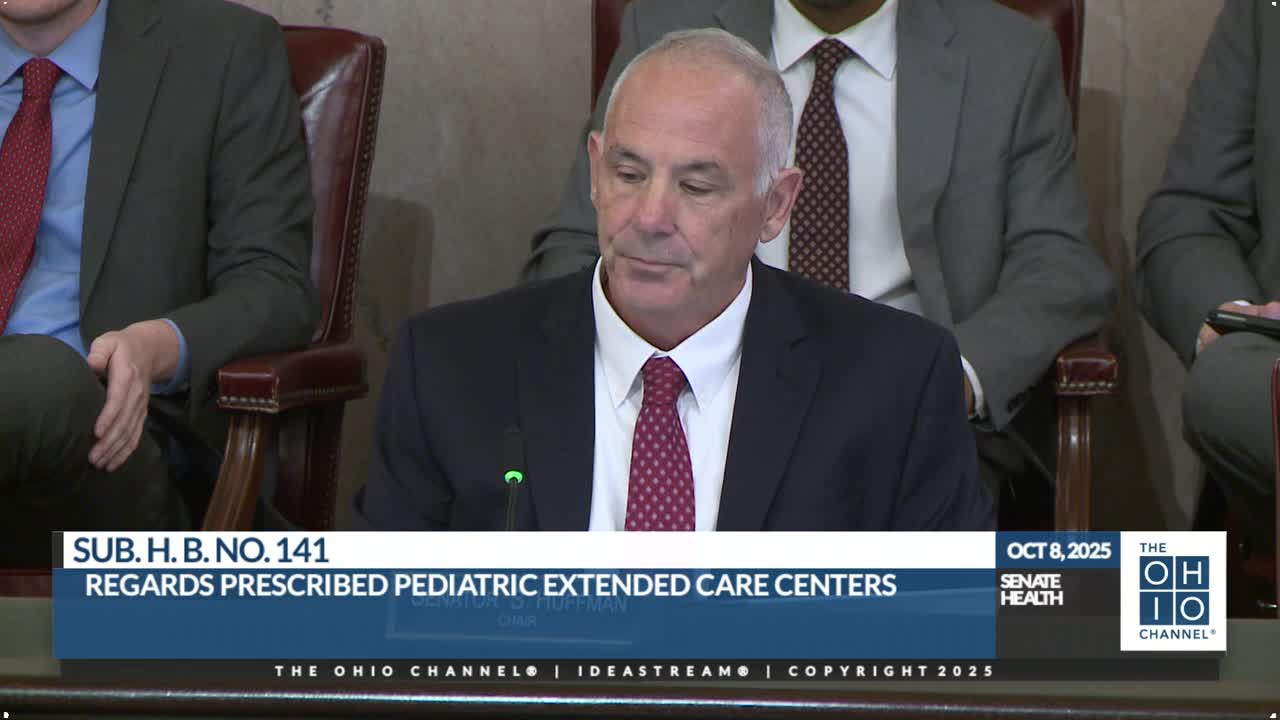
Committee hears bill to license prescribed pediatric extended-care centers to serve children with complex medical needs
Summary
Representatives Baker and Abrams testified in favor of House Bill 141, which would establish licensure and a Medicaid service for nonresidential pediatric extended-care centers providing day services and therapies for children with complex medical needs.
The Senate Health Committee held a first hearing on substitute House Bill 141, which would create a licensure pathway and Medicaid service for prescribed pediatric extended-care centers (PPECs), nonresidential day centers for children with complex medical needs.
Representative Baker, a joint sponsor, described PPECs as "nonresidential, community based day care centers for children with complex medical needs" that provide early childhood education and nursing care for infants through preschool and before- and after-school services for older children. Baker said centers would be staffed with a medical director, nurses for routine and emergency care, and classroom teachers; centers could partner with local health providers to provide therapy services on-site.
Representative Abrams said the centers are designed to be inclusive, mixing children with complex medical needs and typically developing children so siblings can attend the same center and children can benefit from socialization and inclusive early-learning experiences. Abrams said the bill would set up a licensure process through the Department of Health and establish PPECs as a Medicaid-covered service for qualifying children.
Testimony included background data and examples: a March 2023 Southwest Ohio Task Force survey of childcare resource and referral agencies across all 88 counties found that most agencies reported poor access to childcare for children requiring nursing services, testimony said. Witnesses described examples from other states and cited data from a Texas center that documented many seizure and trach or feeding-tube dislodgement incidents managed on-site; the testimony said those on-site interventions avoided ambulance transfers and estimated about $1,500,000 in taxpayer savings over a 34-month period.
Committee members asked questions about service hours and whether centers would substitute for 24-hour residential care. Sponsors said PPECs would be daytime, nonresidential services—an additional option for families and not a replacement for in-home nursing or residential care. Representative Baker said centers could free up home-health nursing hours by providing daytime coverage so families could better manage overnight or continuous needs.
No formal committee action was taken during the first hearing.