Get Full Government Meeting Transcripts, Videos, & Alerts Forever!
Get email alerts on the Scope Of Practice topic
No spam. Unsubscribe anytime.
Committee hears sponsor testimony on bill to modernize CRNA statute; sponsors say bill clarifies, not expands, practice
Summary
Testimony at the first hearing on House Bill 52 described the bill as consolidating CRNA practice authority into one section of the Ohio Revised Code, clarifying collaboration requirements and preserving facility and collaborating-provider authority to define practice scope.
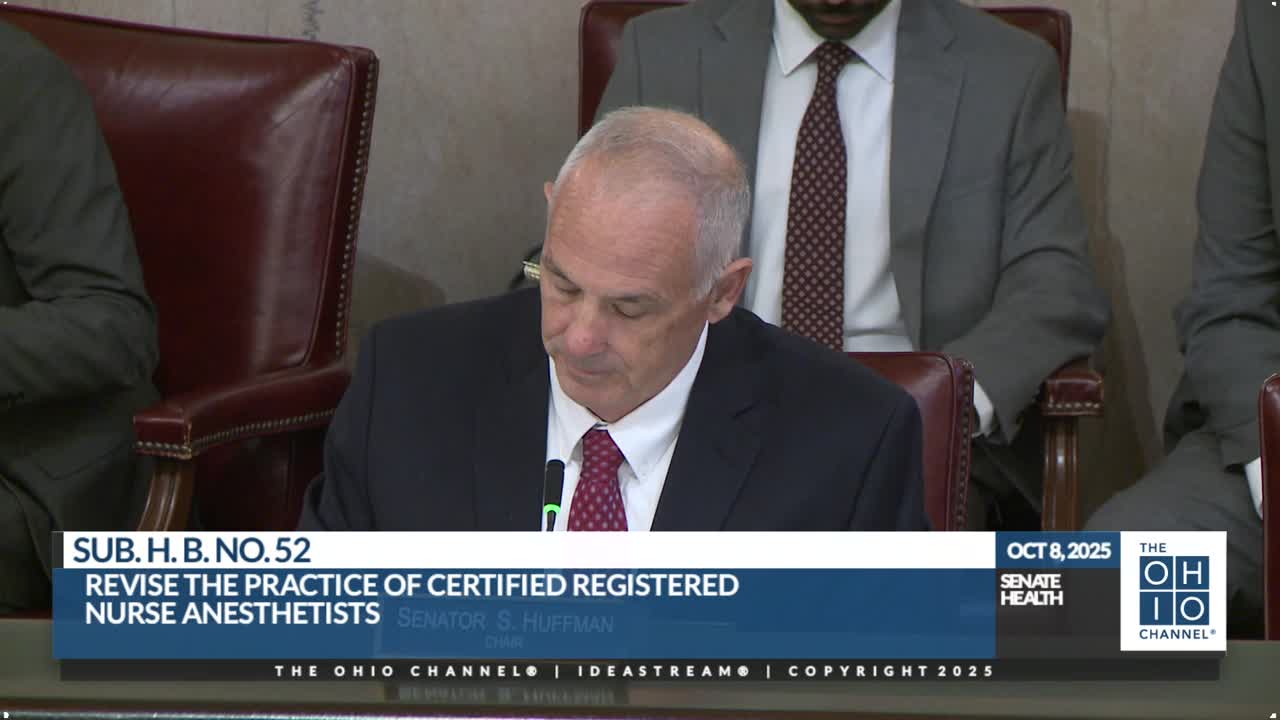
At its first hearing on House Bill 52, the Senate Health Committee heard sponsor testimony from a certified registered nurse anesthetist (CRNA) who described the legislation as a modernization and clarification of CRNA practice in Ohio.
The testifier, introduced to the committee as a board-certified nurse practitioner and nurse anesthetist with a Doctor of Nursing Practice degree and 18 years of clinical anesthesia experience, told the committee that House Bill 52 "modernizes the language in the Ohio Revised Code for certified registered nurse anesthetist or CRNAs." The testifier said the bill consolidates CRNA authority that currently appears across multiple sections of the Revised Code into a single section aligned with CRNA education, training, and national certification.
The sponsor's testimony included several data points presented to the committee: about 3,000 licensed CRNAs practice in Ohio; CRNAs provide 37 percent of anesthetics as the sole provider and participate in care teams for an additional 53 percent, meaning CRNAs are involved solely or in part in roughly 90 percent of anesthetics in Ohio, according to CMS and Ohio Medicaid billing data cited in testimony. The testifier said large independent research studies find equivalent safety across models of anesthesia care and that "Substitute House Bill 52 does not expand CRNA practice. It explicitly recognizes and clarifies it." The testimony said the bill preserves physician-led care and leaves authority to collaborating physicians and facilities to define CRNA privileges locally.
Committee members asked clarifying questions about the bill's language. Senator Ingram asked why the bill allows a collaborating provider's request for anesthesia to be written or verbal instead of always requiring a written order. The testifier replied the distinction was intended to differentiate a collaborating-provider request from an "order," which may carry different liability implications, and to preserve the ability to respond quickly in emergent situations. Chair Huffman added that, in urgent cases, verbal direction can be necessary and that documentation would occur afterwards.
The testimony noted background steps that shaped the bill, including a 2013 Ohio Attorney General review that found the prior statute was not explicit, emergency COVID-era clarifications, and a House floor vote of 94 to 1. No formal committee vote on House Bill 52 was recorded during the hearing.