Get Full Government Meeting Transcripts, Videos, & Alerts Forever!
Get email alerts on the Montgomery College Esl topic
No spam. Unsubscribe anytime.
Montgomery College reports enrollment growth in adult English programs but warns of federal funding risk
Summary
Montgomery College officials told the county Education and Culture Committee on Sept. 18 that adult English programs have rebounded since the pandemic with higher enrollments and strong completion rates, but college leaders flagged dependence on federal WIOA funds and ongoing uncertainty over recent federal rulemaking affecting eligibility.
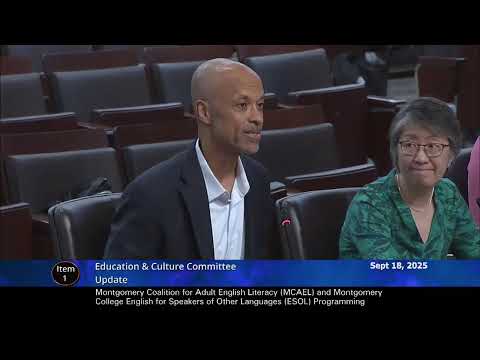
Montgomery College officials briefed the Montgomery County Council Education and Culture Committee on Sept. 18 about adult English language programs across the college, reporting multi‑year enrollment growth, high student advancement rates and new workforce‑aligned offerings — while urging continued local support in light of possible federal funding changes.
Montgomery College Vice President Sarah Campbell told the committee the college’s adult ESOL and basic skills unit (AEBSCC) grew from roughly 7,700 enrollments in fiscal 2021 to more than 10,000 enrollments in fiscal 2025; the latter figure represented more than 5,000 individual students. Campbell said the college’s noncredit ESL enrollments rose from about 1,100 in FY21 to more than 1,500 in FY25 (about 800 individual students). The English Language for Academic Purposes program (ELAP) supported over 1,300 enrollments in the most recent academic year.
“We continue to be the largest ESL provider in Montgomery County,” Campbell said, noting flexible scheduling and a mix of in‑person, hybrid and online formats to reach working adults.
College presenters emphasized student outcomes. In the AEBSCC program, nearly 75 percent of Montgomery College students advanced a level in fiscal 2024 compared with 66 percent statewide, and that advancement rate rose to roughly 78 percent in fiscal 2025, Campbell said. In the noncredit program, 74 percent of students completing level 4 and attempting ELAP were successful in entering ELAP; 96.5 percent of level 5 completers transitioned successfully.
College leaders said modality matters for different student populations: in the adult ESOL unit roughly 80 percent of offerings are offered in person, while the refugee program — focused on first‑job readiness — makes heavy use of online instruction to address transportation and childcare needs.
Montgomery College President (Dr.) Williams and other officials warned the committee that AEBSCC is largely funded by the Workforce Innovation and Opportunity Act (WIOA) and county support and said they were monitoring a June 2025 U.S. Department of Education rule that would narrow federal eligibility for certain adult education funding. "FY26 funding is fine for now," Campbell said, but the college is tracking possible impacts in later years and is working with state officials and legislators.
The college also highlighted new and pilot workforce connections: hospital‑based English courses with local hospitals, a biotech boot camp pilot, an expanded nursing pathway and efforts to embed language support into workforce training.
No formal council actions were taken during the briefing. Officials said they would continue monitoring federal guidance, pursue diversified funding and share updates with the committee as federal and state guidance evolves.
Ending: Council members praised college outcomes and asked the college to continue outreach to refugees, MCPS students and workforce partners and to keep the council informed about potential funding risks.