Get Full Government Meeting Transcripts, Videos, & Alerts Forever!
Get email alerts on the Traffic Calming topic
No spam. Unsubscribe anytime.
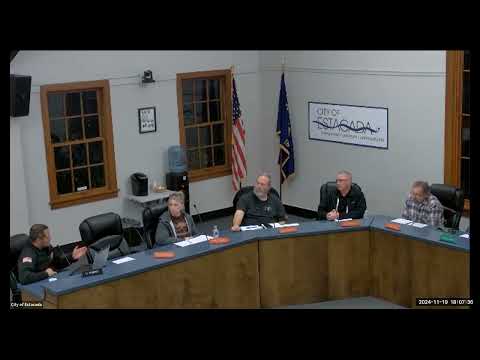
Estacada traffic committee asks public works to evaluate speed-cushion and chokepoint options after steep-grade denial
Summary
The Estacada Traffic and Public Safety Committee voted to ask the city public works director to evaluate three alternative traffic-calming measures — speed cushions, choke points and lateral shifts — after a resident's speed-hump request was determined ineligible because the street's grade exceeded the policy limit.
The Estacada Traffic and Public Safety Committee voted to ask the city public works director to evaluate alternatives to speed humps after staff determined a recent request did not meet the city's slope criteria.
Committee members directed the city public works director to study three options — speed cushions, chokepoints (chokers) and lateral shifts — and report back on whether any of those measures could be applied to the street named in the application. The committee's motion was moved, seconded and approved by voice vote.
The request under review was a resident application for two speed cushions. City staff reported on the policy and application process: the public works director reviews applications for eligibility against explicit policy criteria and then forwards eligible requests to the committee for further consideration. Staff and committee members clarified that the city's speed-hump policy is a guideline, not an ordinance, and that eligibility requires an affirmative answer to minimum questions on the application, including local-street status and posted speed limit. Committee members said the application before them failed the policy's slope threshold (greater than 8 percent) and therefore was not eligible for speed humps under current rules.
Committee members raised alternatives that do not require the same slope conditions as a speed hump, including: speed cushions (narrow devices that allow wider-axle vehicles to straddle them), chokers (road-narrowing points that reduce travel width), and lateral shifts (offsetting the travel lane to create a perception of reduced width). The public works director was asked to evaluate those three measures for feasibility, cost and any operational impacts such as effects on on-street parking and snow plowing.
Members also discussed process clarifications. Several committee members said the application and review flow should make clear when signatures are required and how applicants will be notified if a request is found ineligible. Staff confirmed the public works director provides written notice explaining eligibility decisions and that applicants may appeal to the committee per the policy language. Committee members asked staff to revise the application and guidance to make the sequence and notification steps clearer.
What the committee directed: the committee motion requests that the public works director evaluate the currently proposed location for the three alternatives (speed cushions, chokepoints and lateral shifts) and return with recommendations and any budget or operational notes needed for implementation. The motion passed by voice vote; no roll-call tally naming each voter was recorded in the transcript.
The committee also asked staff to research how Portland and Multnomah County handle traffic calming on steep streets and to confirm whether snow-plow operations or other maintenance concerns would limit some measures.
The item was the committee's first full exercise of the city's speed-hump policy since it was adopted, and members said they expect the process to run more smoothly as staff and the committee use the new policy more often.