Get Full Government Meeting Transcripts, Videos, & Alerts Forever!
Get email alerts on the Middle East Peace And Humanitarian topic
No spam. Unsubscribe anytime.
Senior U.N. official urges immediate Gaza ceasefire, backs two-state solution
Summary
A senior United Nations official speaking in Baghdad called for a permanent ceasefire in Gaza, the immediate release of hostages, unfettered humanitarian access and renewed international support for UNRWA, and reiterated support for a two-state solution and respect for Security Council resolutions across the region.
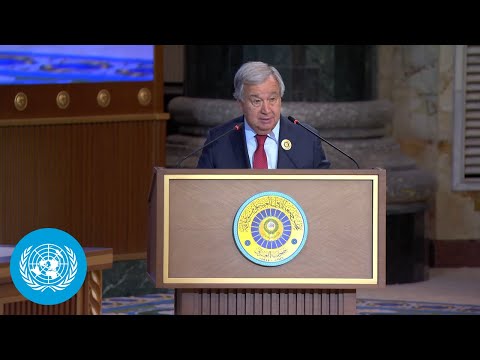
A senior United Nations official speaking at a League of Arab States meeting in Baghdad called for an immediate and permanent ceasefire in Gaza and urged the unconditional release of hostages, saying, “We need a permanent ceasefire now. The unconditional release of our hostages now.”
The official said the international community must ensure the free flow of humanitarian aid and end the blockade, adding, “I emphasize that United Nations will not participate in any so called aid operation that does not adhere to international law and humanitarian principles of humanity, impartiality, independence, and neutrality.” The speaker also repeated an appeal for urgent financial support for the United Nations Relief and Works Agency for Palestine Refugees in the Near East (UNRWA) and said the repeated displacement of Gaza’s population and any forced displacement outside Gaza were rejected.
On the West Bank, the official said annexation and settlements are illegal and said a two-state solution remains the only path to sustainable peace: “Israel and Palestine living side by side in peace and security with Jerusalem as the capital of both states in line with UN resolutions, international law, and previous agreements.” The speaker described a high-level conference co-chaired by France and Saudi Arabia in June as an important opportunity.
The speaker invoked specific Security Council resolutions when addressing other regional situations. Referring to Lebanon, the official cited Security Council Resolution 1701 and said Lebanon’s sovereignty and territorial integrity must be respected and the Lebanese government must have control over all territory; the official welcomed Lebanese officials’ stated commitment to ensure a state monopoly over weapons and encouraged deployment of the Lebanese armed forces to southern Lebanon with the support of UNIFIL.
On Syria, the speaker called for a Syrian-led political process based on Security Council Resolution 2254 to protect the rights and participation of all Syrians. On Yemen, the official said Houthi attacks in the Red Sea have harmed regional and global economies and welcomed an announcement by the Sultanate of Oman on May 6 that hostilities between the United States and the Houthis would cease; the speaker said a negotiated, Yemeni-led political settlement is needed.
The official urged release of arbitrarily arrested U.N. staff and said renewed multilateral engagement is needed in Sudan to address violence, famine, and mass displacement, commending coordination with the African Union and the League of Arab States. On Somalia, the speaker recommended that the Security Council enable predictable and sustainable financing for the African Union support and stabilization mission in Somalia.
On Libya, the official said the United Nations is engaging with national and international actors to end confrontations between armed groups, preserve the independence of key oversight institutions, address obstacles to national elections and chart a course toward long-term stability. Regarding Iraq, the speaker recognized progress since 2004 and said the United Nations Assistance Mission for Iraq (UNAMI) is working to deliver its residual mandate and an orderly drawdown by Dec. 31, 2025.
The address closed by emphasizing the shared goals of the League of Arab States and the United Nations and the need for deeper partnership: “That is the shared goal of the League of Arab States and the United Nations, and I look forward to continue to deepen our partnership together. Shukran.”