Get Full Government Meeting Transcripts, Videos, & Alerts Forever!
Get email alerts on the Alcohol Franchise Law topic
No spam. Unsubscribe anytime.
Ohio brewers testify for Senate Bill 23 to remove franchise-law protections for wholesalers
Summary
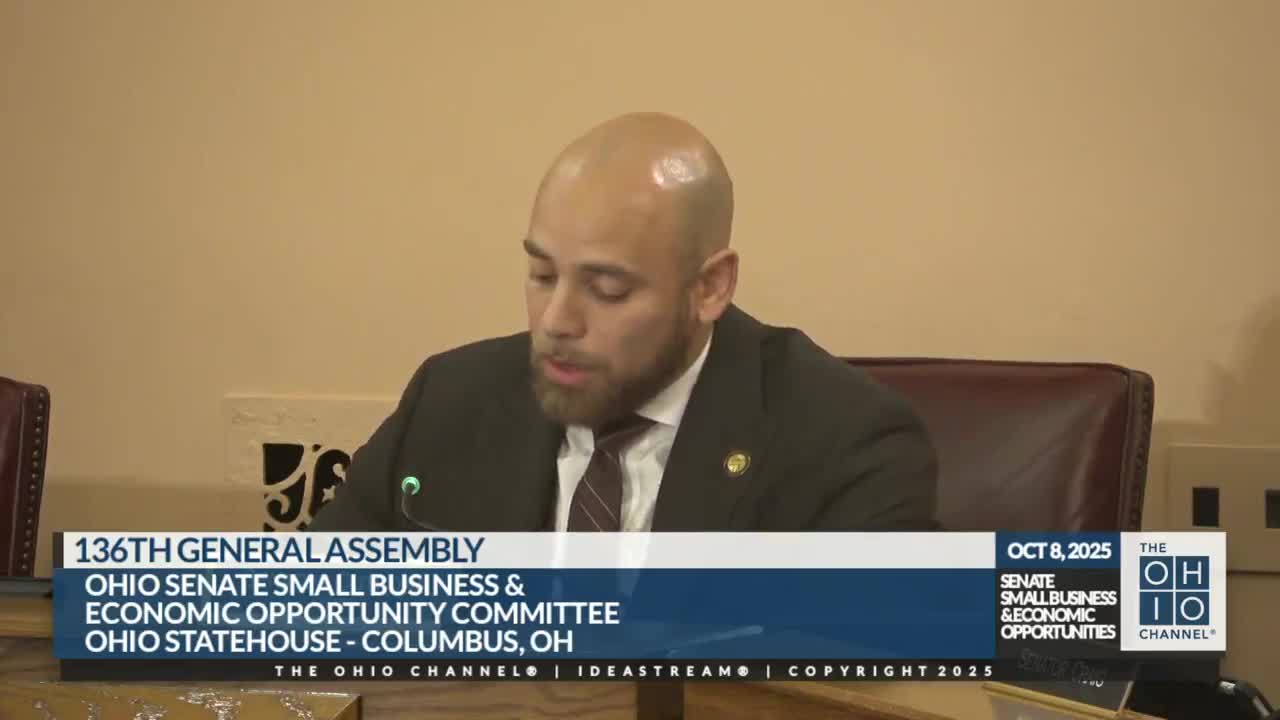
At a second hearing on Senate Bill 23, witnesses representing Ohio craft breweries told the Senate Small Business and Economic Opportunity Committee that the Ohio Alcoholic Beverages Act of 1974 gives wholesale beer distributors perpetual franchise protections that can prevent small breweries from ending nonperforming distribution relationships.
COLUMBUS — At a second hearing on Senate Bill 23, witnesses representing Ohio craft breweries told the Senate Small Business and Economic Opportunity Committee that the Ohio Alcoholic Beverages Act of 1974 gives wholesale beer distributors perpetual franchise protections that can prevent small breweries from ending nonperforming distribution relationships.
Mary McDonald, representing the Ohio Craft Brewers Association, told the committee that "craft breweries are the very definition of small businesses" and argued the bill would allow the written contract between a small brewery and a wholesaler to govern the relationship rather than the default franchise provisions set in 1974.
The bill would carve breweries that produce fewer than 250,000 barrels per year out of the statutory franchise-law protections and subject them instead to ordinary contract law, supporters said. McDonald said the existing law requires manufacturers to prove "just cause" to terminate a distribution relationship, a standard she described as deliberately undefined and one that places the burden and cost of litigation on the manufacturer.
"Small breweries can't count on bigger ones to provide them a soft landing or golden parachute via acquisition," McDonald said, noting consolidation among distributors over recent years and saying that wholesalers now "wield outsized influence over the small and independent breweries that supply them." She cited Nielsen scan data presented to the committee showing craft breweries accounted for about 4.2% of beer volume in grocery and convenience stores and 6.4% of dollar share in a recent 12-month period.
Two Ohio brewers described direct harms they said stemmed from the franchise law. John Haggerty, cofounder and brewmaster of Warped Wing Brewing Company in Dayton, described handing distribution rights to a Columbus wholesaler in April 2022, receiving $250,000 for sales development, and seeing his on-market sales fall "precipitously" to roughly half within two months and later to zero while the wholesaler held the rights.
"If I had an employee that... wasn't showing up and doing their job, they'd be terminated," Haggerty said. He said he paid $75,000 to secure release from the distributor and regain the brand, and that since reclaiming the business he has restored sales to about 50% of the prior level using limited self-distribution resources.
Duncan McFarland, owner and head brewer at Phoenix Brewing Company in Mansfield, said his business deliberately chose to remain self-distributed rather than risk a long-term wholesale contract. "We deliberately remain self distributed because we refuse to risk our independence or financial stability under one-sided lifetime contracts," McFarland said. He described wholesalers' tactics such as pressuring on-premises accounts to carry particular national brands and reported instances where a wholesaler refused to sell local craft products unless the taproom added a national brand.
Witnesses told the committee that wholesale consolidation has increased the leverage of distributors. McDonald and Haggerty referenced recent acquisitions, including Superior Beverage's 2023 acquisition of Brown Distributing and the purchase activity by groups such as Redwood Holdings and Heidelberg Distributing. McDonald said national and multinational producers and the large wholesalers that carry their brands make up the bulk of wholesaler revenues and can therefore deprioritize small local brands without immediate market consequences.
Committee members asked clarifying questions about the witnesses' ability to leave distributor contracts. Haggerty said he was able to exit only after paying the wholesaler; the committee did not take a vote on the bill at the hearing. The chair declared the committee adjourned at the conclusion of testimony.
Supporters asked the committee to replace franchise-law protections for smaller brewers with normal contract law, saying 18 other states had updated franchise statutes to address distributor consolidation without causing the market-wide harms wholesalers warn of. Opponents of the change did not appear in the transcripted testimony.
The hearing record shows substantial testimony but no formal committee action reported on Senate Bill 23 at this session.