Get Full Government Meeting Transcripts, Videos, & Alerts Forever!
Get email alerts on the Energy And Public Utilities topic
No spam. Unsubscribe anytime.
Witnesses tell committee Senate Bill 151 would let companies buy carbon offsets bundled with natural gas
Summary
At a second hearing on Senate Bill 151, industry witnesses told the Senate Public Utilities Committee the voluntary program would let commercial and industrial customers buy verified carbon offsets together with natural gas and require third‑party verification and PUCO oversight for complaints.
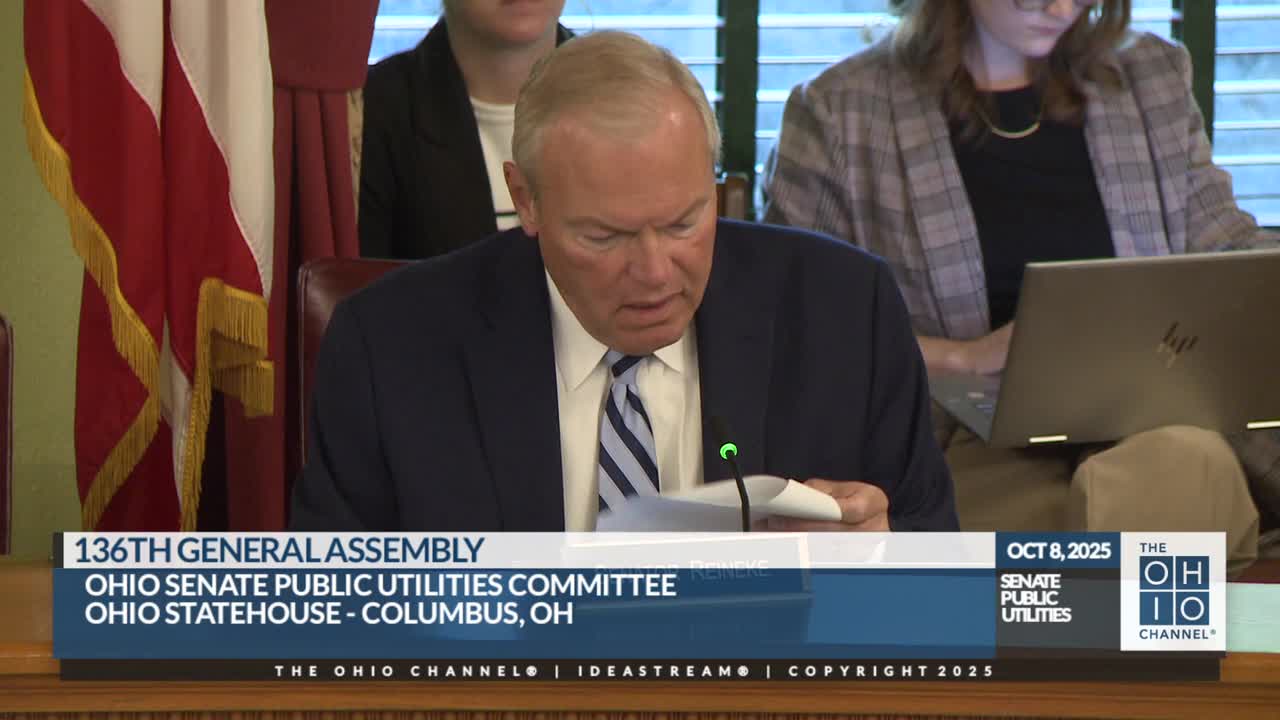
Senate Public Utilities Committee members heard testimony supporting Senate Bill 151, a proposal to let natural‑gas suppliers voluntarily offer customers the option to buy carbon offsets bundled with their gas service.
Proponents said the program would be voluntary for customers and suppliers and include third‑party verification and PUCO oversight to prevent double‑counting. "The program is completely voluntary and it does not ship cost to anyone but the company who chooses to operate the program," said Melville Nickerson, director of government affairs for NRG Central Region, during a second hearing on the bill.
The bill would let alternative natural gas suppliers offer offsets alongside gas sales and allow the retail supplier to recover the cost of offsets and a reasonable administrative fee from participating customers, proponents said. Nickerson said the measure would establish a consistent regulatory framework and require use of a "verifiable third party carbon registry" to prevent fraud or double‑counting.
Entrepreneurs and businesses that testified said a transparent carbon market would create new revenue streams tied to measurable reductions. "Every gallon of water produced, every tonne of fertilizer saved, every kilowatt of energy generated translates directly to valuable greenhouse gas reductions," said Nick York, chief impact officer for Barger Tech USA, which develops waste‑to‑value systems. He said a structured market would allow such reductions to be monetized and reinvested.
Lear McCoy of J. McCoy Lumber Company described how sustainable forest management on the company's 10,000 acres produces voluntary carbon credits and said the bill would expand markets for those credits. McCoy said his company registers credits through a project developer and the American Carbon Registry and that its timberland is SFI certified.
Senator Chavez pressed witnesses on whether costs could be socialized, asking, "So you're saying that there will be no socialized costs whatsoever even for advertising of this program or anything? It will not be passed on to anyone that does not want to participate in this program?" Nickerson responded, "that is correct senator," and added that the Public Utilities Commission of Ohio (PUCO) would have authority to audit or investigate if customers complain.
Witnesses said they do not expect large volumes of complaints and that PUCO could request documentation from companies if customers raise concerns. Supporters framed the bill as a market‑enabling measure rather than a mandate: it would provide transparency and certainty to buyers and sellers in voluntary carbon markets tied to natural‑gas consumption.
The committee received additional written testimony from the Alliance for Energy Choice. The chair concluded the second hearing on Senate Bill 151 without a committee vote.