Get Full Government Meeting Transcripts, Videos, & Alerts Forever!
Get email alerts on the Health Optometry Scope topic
No spam. Unsubscribe anytime.
Senate committee hears testimony on SB 36 to expand optometrists' office-based procedures
Summary
Supporters told the Senate Health Committee SB 36 would update Ohio law to allow doctors of optometry to perform certain non–operating-room eyelid and laser procedures and broaden prescribing authority; witnesses emphasized training and patient access while senators asked about certification and safeguards.
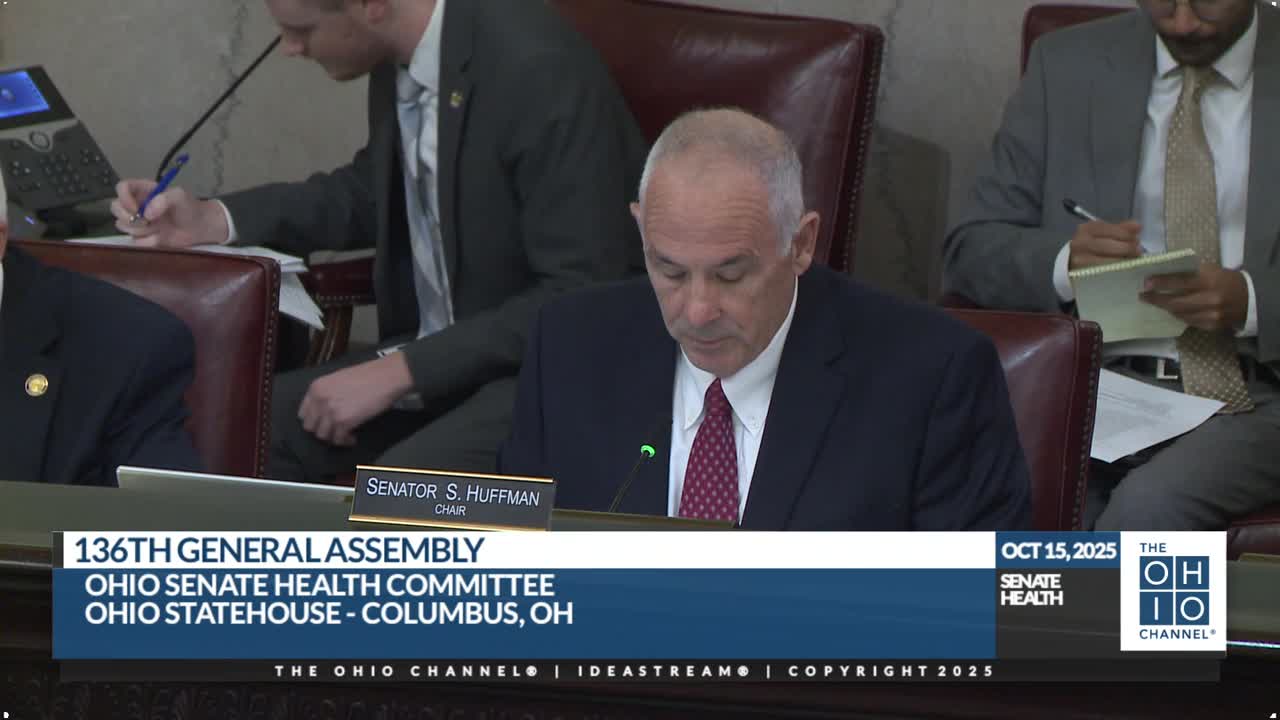
The Senate Health Committee held a second hearing on Senate Bill 36, a measure to revise Ohio law governing the practice of optometry, hearing testimony from optometry leaders about patient access, training and safety.
Dr. Elizabeth Muckley, executive director of the Ohio Optometric Association, told the committee SB 36 "would authorize doctors of optometry to perform non operating room office based procedures to remove benign eyelid lesions, permit three non invasive laser procedures, and eliminate outdated oral prescribing restrictions." She said the change would "modernize the optometric scope of practice for Ohio for the first time in nearly two decades."
Supporters argued the bill is intended to reduce patient wait times and improve access. "SB 36 is about patients, not providers," Muckley said, saying many Ohio optometrists already perform these procedures in neighboring states and that the bill would allow those patients to be treated locally by providers they already know.
The bill would allow three named laser procedures used in glaucoma and secondary cataract care (selective laser trabeculoplasty, laser peripheral iridotomy and YAG capsulotomy), plus removal of benign, noncancerous eyelid lesions, according to testimony from Dr. Aaron Zimmerman, clinical professor at The Ohio State University College of Optometry. Zimmerman and other witnesses emphasized these are non‑incisional, office‑based procedures and described typical training pathways and certification courses used in other states.
Committee members pressed witnesses on training, patient notification and how certification would be documented. Dr. Andrew Hoffman, a practicing optometrist who also holds Indiana certification, described taking a 32‑hour certification course and said he has performed hundreds of laser procedures in Indiana, telling the committee he "have had no complications whatsoever" in the roughly 503 laser procedures he and a colleague reported performing, of which he said 108 were Ohio residents referred across state lines.
Dr. Michael Early, former president of the Ohio Optometric Association and former associate dean at Ohio State, said Ohio State’s optometry program cannot provide live clinical procedural training inside Ohio under the current scope and that scope expansion affects recruitment and retention. He said of 197 recent graduates from Ohio State, 102 left to practice in other states and the college retained roughly 48 percent.
Witnesses cited national and state data in support of safety claims and noted varying practices among states: Dr. Muckley said 14 states permit all the procedures in SB 36, 24 allow benign eyelid procedures and several neighboring states already permit these services without reported increases in complications or malpractice claims. Supporters submitted written attestations and peer‑reviewed studies to the committee and said state licensing boards in other states have oversight and certification systems.
Committee members asked about consumer notification and whether patients would be informed that an optometrist is certified to perform the procedures in‑office. Witnesses responded that optometrists are "primary care eye doctors" who have established patient trust and said certification and scope limits would guide referrals and care; they characterized the bill as a conservative compromise that does not seek surgical privileges beyond the named procedures.
No formal action was taken during the hearing; the committee previewed that opponent testimony will be heard at a subsequent meeting and that written testimony submitted with witnesses will be part of the record.
The committee’s questions and the witnesses’ answers focused on training requirements, the mechanics of certification, co‑management and referral pathways to ophthalmologists for complex cases, and workforce implications for Ohio’s optometry graduates.