Get Full Government Meeting Transcripts, Videos, & Alerts Forever!
Get email alerts on the Host Budget 2026 topic
No spam. Unsubscribe anytime.
Denver housing agency proposes $205.6 million 2026 budget, warns of cuts after one-time funding ends
Summary
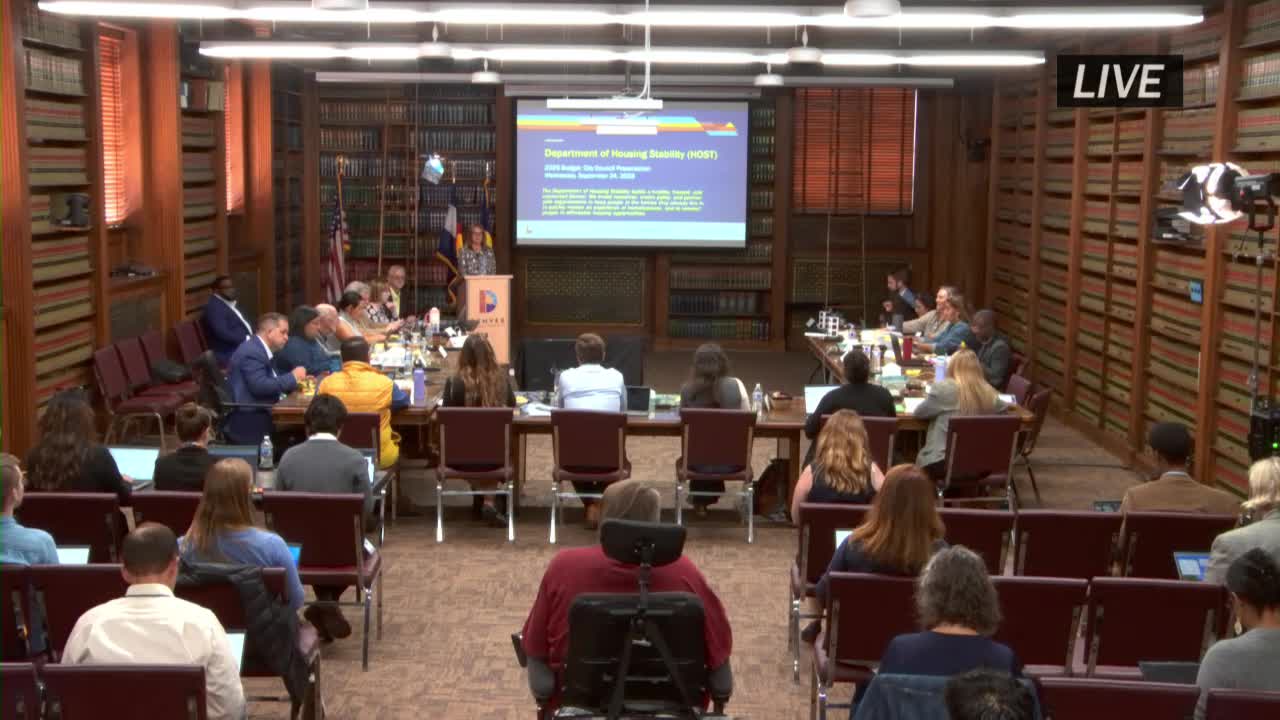
The Department of Housing Stability (HOST) presented a $205.6 million 2026 budget to the City Council committee, saying the end of pandemic-era one-time funds forces reductions across shelter, outreach and rental assistance while preserving key locally funded housing programs.
The Department of Housing Stability (HOST) presented its proposed 2026 budget to the Community Planning & Housing Committee, saying the city will operate on smaller, ongoing revenue after a period of large one-time federal and state funding. HOST Executive Director Jamie Torres said the 2026 request totals $205,600,000 and reflects hard choices after pandemic-era, one-time dollars disappeared.
"This is the year that we are in a budget season where we don't have the 1 time funding anymore that we've had really since host inception," Jamie Torres said during the committee meeting. The department said it structured the request to preserve life-safety services while shifting some programs to new delivery or reduced scale.
The nut of HOST's presentation was that the agency expects to cover most of its contract-driven work from general and special revenue but must reduce some services because about $33 million in programmatic funding is being lost as one-time grants and vouchers expire. "We are losing, I believe it's close to $33,000,000 in programmatic funding," Jeff Kositzky, Deputy Director for Shelter and Stability at HOST, told the committee.
Key budget figures HOST shared include a total ask of $205.6 million, with roughly 35% expected from general fund, 25% from the homelessness resolution fund, 24% from affordable housing funds, and about 16% from other special revenues and grants. Personnel costs were listed near $14.5 million and services-and-contracts at about $191 million. HOST said it served more than 11,500 households — about 14,500 individuals — in 2024 and estimates it will serve about 13,781 households in 2025, declining slightly to 13,231 under the current 2026 plan.
The department outlined specific program changes. HOST plans to preserve cold-weather sheltering and its outreach teams, maintain local project-based voucher payments and its annual payment to the housing authority (about $8 million), protect funding for eviction prevention and legal defense, and keep funding for targeted services such as medical respite. At the same time, the agency will reduce contracted shelter capacity, pilot performance-based contracting at several congregate sites to shorten average length of stay, and shift some pass-through grant processes so providers apply directly to federal or private funders rather than routing applications through HOST.
Temporary Rental and Utility Assistance (TRUA) was a focal point in questions from council members. Jeff Kositzky said TRUA funding peaked at about $23 million in 2024, but HOST intentionally carried $9 million into the 2026 budget to avoid a precipitous drop from 2025 to 2026. HOST told the committee the result is an effective TRUA budget of about $14 million in 2025 and $12.2 million in 2026, and that the smaller program will serve an estimated 1,300–1,500 fewer households than in 2024. "We decided to hold $9,000,000 of that funding and transfer it into 2026," Kositzky said. The department said it will use targeting and application-period changes to prioritize households most likely to become unsheltered without intervention.
Shelter strategy changes include closing several temporary shelters that were stood up during the pandemic; Kositzky said four shelters are slated to close between March 2025 and June 2026. HOST plans to rely more on housing-central-command placement strategies to shorten average shelter stays (from more than 210 days historically to frequently below 180 days) and to expand performance-based contracting to increase exits to permanent housing. HOST listed major contracts and awards in the budget: TRU (rental assistance) budgeted at $12.2 million for 2026; Denver Rescue Mission contracts at about $10.4 million; Catholic Charities at $8.8 million; and noncongregate shelter costs (DoubleTree awardee not yet announced) at roughly $8.7 million.
Council members pressed HOST staff on outreach and the risk to higher-need residents if federal and state vouchers are cut. Mayor's office staff and others warned the loss of roughly 300 state or federal vouchers could leave high-need households without housing exits, producing longer shelter stays and fewer available beds. "The thing I'm the most worried about in terms of public impact of this is the loss of somewhere around 300 vouchers on housing exits," the mayor said during committee remarks.
Committee members also discussed anti-displacement efforts and homeownership programs. Adam Lyons, Deputy Director of Housing Opportunity at HOST, said the city is finalizing an updated housing needs assessment and an anti-displacement study; HOST is procuring a contractor and expects the assessment to be completed by mid next year. Lyons described a city prioritization policy that requires developments receiving city funding to market 30% of units first to a prioritized list (longtime residents, people at risk of displacement, people with disabilities and others) for at least 14 days before broader leasing. Lyons also summarized down-payment assistance and land-trust partnerships, including work with Elevation Community Land Trust and Habitat for Humanity; HOST said a social-equity down payment assistance program funded with ARPA moved quickly and was fully subscribed.
Committee members asked for more granular follow-up information on several items: a cost-per-night comparison between cold-weather hotel vouchers and operating shelter beds; details about which shelters will close and property-owner intentions for sites (HOST said some hotel owners intend to return properties to hotel use); and the geographic footprint and duration of a four-person newcomer outreach team (HOST said the team is limited-term and is funded through next year). Budget office staff confirmed much of the 2025 TRUA pool came from one-time sources, including FEMA reimbursement and contingency transfers, and that those sources are not available on an ongoing basis.
HOST described the agency's overall priorities for 2026 as: (1) safely bring people indoors, (2) maintain housing stability and prevent returns to homelessness, and (3) preserve and create affordable units. "We focused on bringing people indoors, keeping them indoors, and creating housing opportunities," Jamie Torres said. The department said it will continue to refine performance-based contracting and expand housing-central-command placements to improve throughput and housing exits.
The committee did not take formal votes in the presentation. Council members asked for follow-ups on the cold-weather cost comparisons, the housing needs assessment timeline and public rollout, clarifications about shelter contracts and occupancy expectations, and additional detail on TRUA targeting criteria. HOST staff and budget office representatives said they would provide supplemental material and follow-up briefings to the committee.
Ending: HOST provided the committee with requested follow-ups and said it will return with additional data and rulemaking timelines for the prioritization policy and the housing needs assessment; the city budget process will continue through the fall and winter as council and staff reconcile ongoing and one-time funding sources.