Get Full Government Meeting Transcripts, Videos, & Alerts Forever!
Get email alerts on the Oca Budget Restructure topic
No spam. Unsubscribe anytime.
Office of Children’s Affairs consolidates youth services, shifts programs as 2026 budget trims staff
Summary
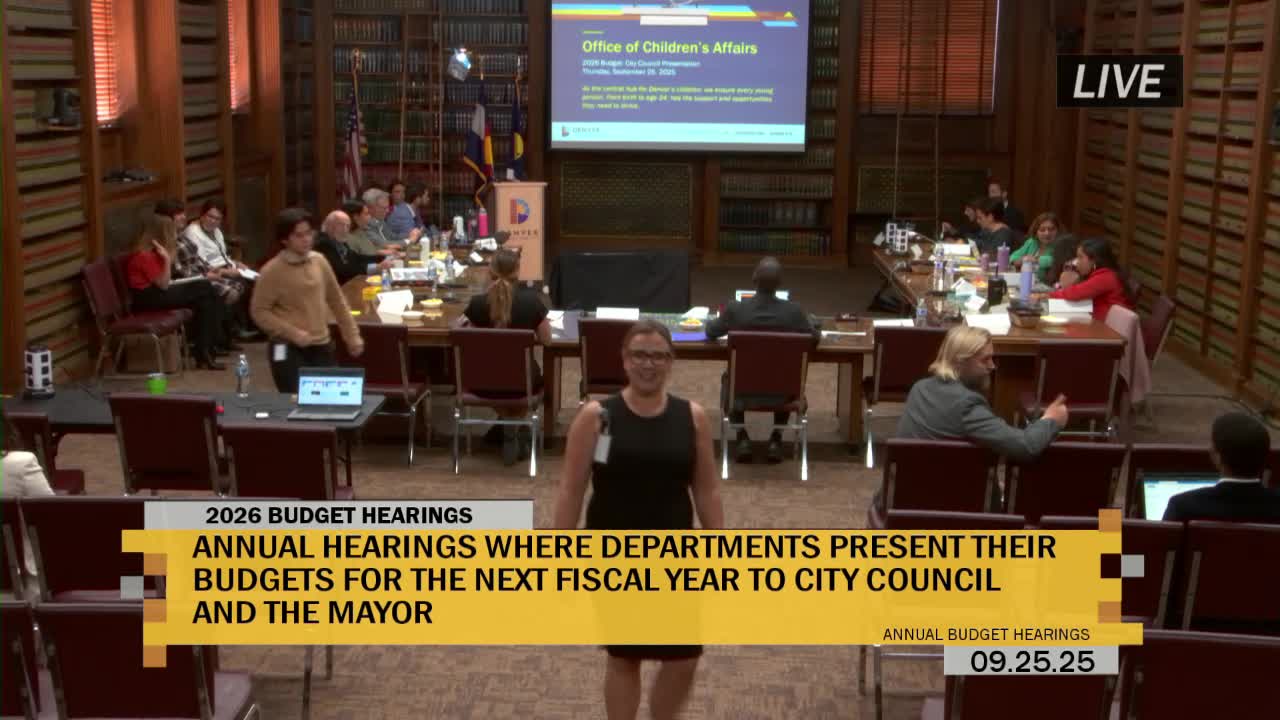
Denver’s Office of Children’s Affairs (OCA) presented a 2026 budget that consolidates youth development programs into a single division, shifts two major initiatives to other city agencies and reduces staff and operating dollars while increasing grant dollars to community providers.
Denver (Consolidated County and City) — The Office of Children’s Affairs (OCA) told the Health & Safety Committee on Oct. 29 that its 2026 budget restructures youth services into a single youth development and engagement division, transfers two programs to other city agencies and absorbs personnel and operating reductions while directing a larger share of general-fund dollars to community grants.
Jess Ridgeway, Executive Director of the Office of Children’s Affairs, said the changes are intended to “maximize the dollars that go out directly to support children and families” and to create greater cohesion across youth programs. Ridgeway described the move as “streamlining youth development and engagement services into a single division.”
The reorganization accompanies two agency transfers: the Tasty Food Program — which Ridgeway said has served “over a 100,000 meals to kids and youth in Denver from ages 3 to 18” so far this year — will move to Denver Department of Public Health & Environment (DDPHE). Youth Violence Prevention (YVP) programming and associated personnel will move to the Office of Social Equity and Innovation (OSCI), Ridgeway said. She stressed ongoing collaboration with those programs’ new host agencies.
Why it matters: OCA’s presentation frames the changes as trade-offs to preserve direct services and to route a larger share of limited general-fund dollars to community providers who deliver out-of-school-time, early childhood and workforce programs for youth.
Key budget shifts and staffing cuts Ridgeway said OCA absorbed personnel reductions and reallocated some services and supplies. She noted that youth development and engagement/out-of-school-time cost centers showed reductions and that four filled positions were eliminated in the youth development and engagement area. Ridgeway said the agency is intentionally rebalancing internal operations so a greater share of general-fund dollars are distributed as grants to community partners.
On the general-fund side, Ridgeway told the committee the OCA projects that 56% of its 2026 general-fund dollars will be routed to community grants; she framed that as part of a budget philosophy that prioritizes placing resources in “the hands of those directly serving children, youth, and families.” At the same time, the office reported an overall decline in its general-fund operating budget and headcount because several programs and positions are moving to other city agencies.
Program transfers and continuity Council members asked whether transfers would interrupt service. Ridgeway and Budget Management Office Director Justin Sykes said the transfers include both funding and personnel and are intended to preserve programming. Council members pressed for clarity about the size of reductions: council members and OCA staff referenced a roughly $500,000 reduction tied to moving youth violence prevention funding to OSCI (described in committee as a reduction from approximately $1 million to about $500,000), and Ridgeway acknowledged that some professional services and personnel did not move on a dollar-for-dollar basis.
Ridgeway repeatedly said the office intends to continue close collaboration with DDPHE and OSCI after the transfers, and committee members requested follow-up briefings from the receiving agencies to explain operational details and how grants and contract cycles will be managed going forward.
What OCA will continue to fund Ridgeway emphasized continuing core services: support for Head Start, partnerships with Denver Preschool Program (DPP), family, friend and neighbor care, Denver Afterschool Alliance quality supports and youth workforce activities. She said the office will also invest more in communications to connect families to existing programs and use an internally developed child well-being index to inform funding priorities.
Ending note Committee members asked OCA to provide more detail about program transitions, contract monitoring capacity and the anticipated effects of the staff reductions on contracting and program oversight. OCA staff committed to supply additional detail in the Q&A materials due to council members the following Monday.