Get Full Government Meeting Transcripts, Videos, & Alerts Forever!
Get email alerts on the General Services Budget topic
No spam. Unsubscribe anytime.
Denver General Services proposes 2026 reorganization, cuts contracts and vacant positions while centralizing small-business compliance
Summary
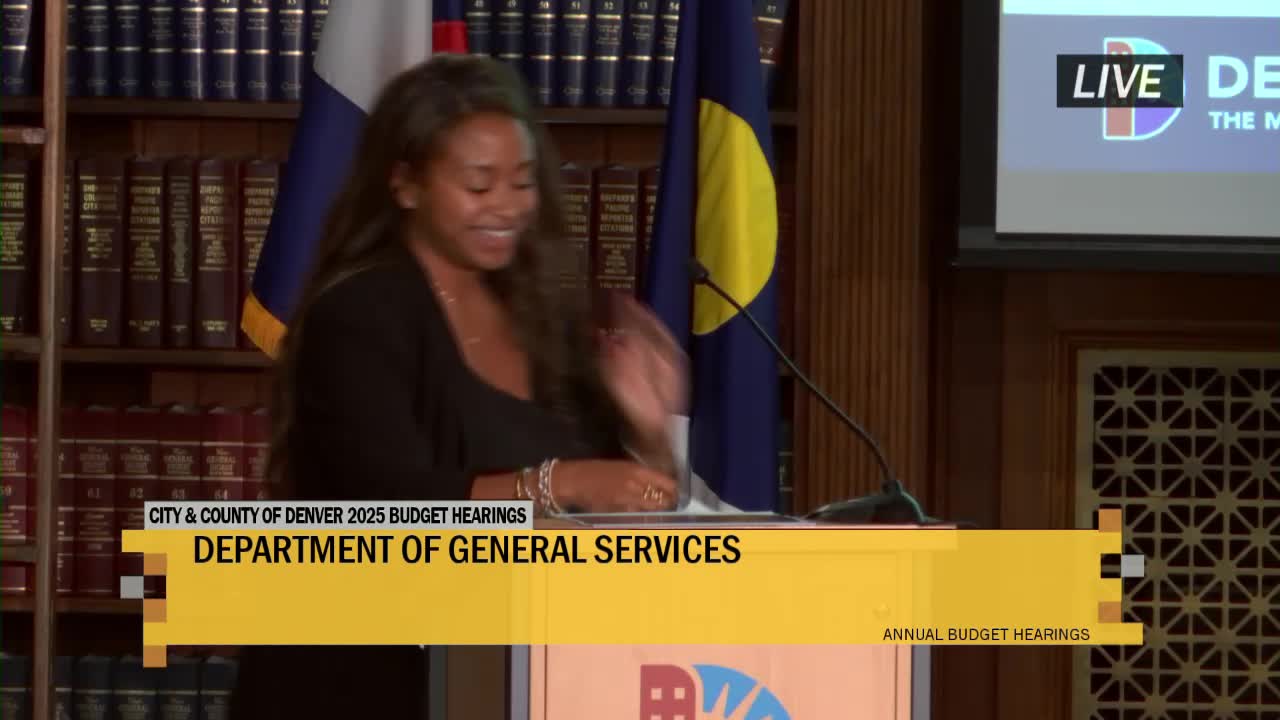
Adriana Gibson, the executive director nominee for General Services, told the City and County of Denver Finance and Business Committee on Sept. 25 that her department’s 2026 budget centers on reorganizing divisions, centralizing procurement compliance and cutting a mix of contracts and vacant positions to protect frontline staff and essential services.
Adriana Gibson, the executive director nominee for General Services, told the City and County of Denver Finance and Business Committee on Sept. 25 that her department’s 2026 budget centers on reorganizing divisions, centralizing procurement compliance and cutting a mix of contracts and vacant positions to protect frontline staff and essential services.
Gibson opened the presentation by describing General Services as “the backbone of city operations,” adding: “We source, we sustain, and we safeguard Denver.” She said the 2026 plan moves the Division of Small Business Opportunity (Dyspo) compliance function into General Services to place procurement, contracting and business utilization “under one roof,” which Gibson said should streamline accountability and reduce silos for certified small, minority and women‑owned businesses.
Why it matters: the reorganization changes where small‑business compliance lives, shifts some contract work in‑house and trims staff and contracts in a department that manages roughly 6,000,000 square feet of city facilities and pays nearly $30 million a year in utility charges. Council members pressed the department for details about service impacts, timing for a disparity study and follow‑ups on security and shelter maintenance.
Key budget and operational changes
- Centralizing small‑business compliance: Gibson said the Dyspo compliance function will be relocated into General Services and that General Services and DEDO (the city’s economic development team) have worked together on the change. Council members were told a citywide disparity study is already under way and expected to finish by the end of the year; ordinance reauthorization work will start after that and likely run through much of 2026.
- Staffing and positions: Department presenters said the 2026 recommended budget eliminates a number of vacant positions. Mike Bridal, who identified himself as overseeing facilities and surplus for General Services, said: “we did eliminate a number of vacant positions in facilities. We had 5 this year. At the end of last year, we eliminated 11 for a total of 16.” The department also reported an overall personnel reduction of about two dozen positions across General Services.
- Contracts and in‑house work: Gibson said leadership targeted reductions to preserve frontline employees and core services. The department intends to absorb some janitorial and landscaping tasks into existing facilities teams and to reduce or renegotiate other contracts. Gibson told councilmembers that three contract amendments will be returned to council for approval; the presentation said reductions tied to those contracts have already been implemented in planning.
- Core contracts and small business payments: General Services listed core contractors (including KG Clean and Roth Property Management among others) and said four of the named service contracts are held by certified small businesses. Gibson said payment trends to certified businesses have been above the department’s 100% attainment target in recent years and that the city is on track to continue timely payments in 2026.
Facilities, security and janitorial details
- Janitorial: Bridal and other presenters said about 40 locations currently receive contract janitorial services and that targeted janitorial reductions will be accomplished in part by shifting certain tasks to facilities staff. The department characterized those cuts as targeted and said it seeks to minimize public impact; one specific targeted reduction shown in the materials was roughly $158,000.
- Security screening and entrances: Cammy Jolley, director of administration for General Services, said the security contract covers screening, camera monitoring and patrols for many municipal buildings (including the City and County Building, the Webb Building and the Lindsey Flanagan courthouse). Jolley said the department plans to reduce duplicated screening stations and consolidate entrances at some buildings rather than reduce screening intensity. The department quantified a planned security‑contract reduction of about $1.1 million and told councilmembers it had done a foot‑traffic analysis of Lindsey Flanagan to guide screening changes.
- Utilities and energy: presenters said city facility utility payments are a substantial line in the services and supplies budget (described repeatedly as roughly $30 million annually). The department noted completed energy performance work across more than 40 municipal buildings and a roughly $20 million investment in upgrades that it said has begun returning savings; staff said they are coordinating with the city’s climate/energy team on further energy projects and potential solar installations.
Shelters, hotels and maintenance
- Shelters operations and occupancy: General Services said it is working with HOST to manage hotel‑based shelter capacity and noted a target occupancy increase from 75% to 85%. The department said that increase represents roughly 100 additional rooms citywide and that the change supports faster case management and moves toward permanent housing.
- Shelter maintenance staffing and lessons learned: General Services said maintenance staffing for shelters has expanded (from six initial staff for the program to roughly 11–12 positions) to cover plumbing, electrical and HVAC needs at hotels converted to shelter use. Matt Peterson of facilities described repeated plumbing clogs, the need for jetting main lines, theft and aging PTAC units in rooms, and efforts to build small safety stocks of replacement parts; he said PTAC units cost about $1,000 each and the department recently ordered an additional 25 units. Presenters said the team is moving toward a preventive‑maintenance program for these sites.
Oversight, compliance and contractor payments
- Disparity study and ordinance reauthorization: Council members were told the city procured a consultant last year to run a disparity study; that study is ongoing and expected to conclude by year‑end. Officials said ordinance reauthorization work will follow and that city attorneys and agency partners are already in preliminary discussions.
- Subcontractor payment complaints: Jolley described compliance project managers who handle contract compliance and payment checks and said there is a complaint and escalation path for payment disputes. Council members asked the department to look into recent media reports involving the National Western Center and payment concerns; General Services said it would follow up with more detail.
What the committee asked for and next steps
Council members repeatedly requested follow‑up materials: a breakdown isolating electricity costs for city buildings, an itemized explanation of the roughly $3.9 million in reductions attributed to utilities/janitorial/security and more detailed staffing and contract‑impact analyses. Department staff agreed to provide the requested data and to bring an overview of the security system when they return with contract amendments.
No formal votes or motions were taken during the presentation; staff said they will return to council later in the year to seek contract amendments where required.
Ending
General Services framed the 2026 budget as a mix of consolidation, targeted reductions and reinvestment in preventative maintenance and data systems. The department said it aims to protect core services and frontline staff while centralizing small‑business compliance and pursuing efficiency gains; several councilmembers signaled they will seek detailed follow‑up information on utilities, shelter maintenance and contract amendment specifics.