Get Full Government Meeting Transcripts, Videos, & Alerts Forever!
Get email alerts on the Downtown Development topic
No spam. Unsubscribe anytime.
Finance committee forwards DDA’s Sixteenth Street activation projects and gap loans to full council
Summary
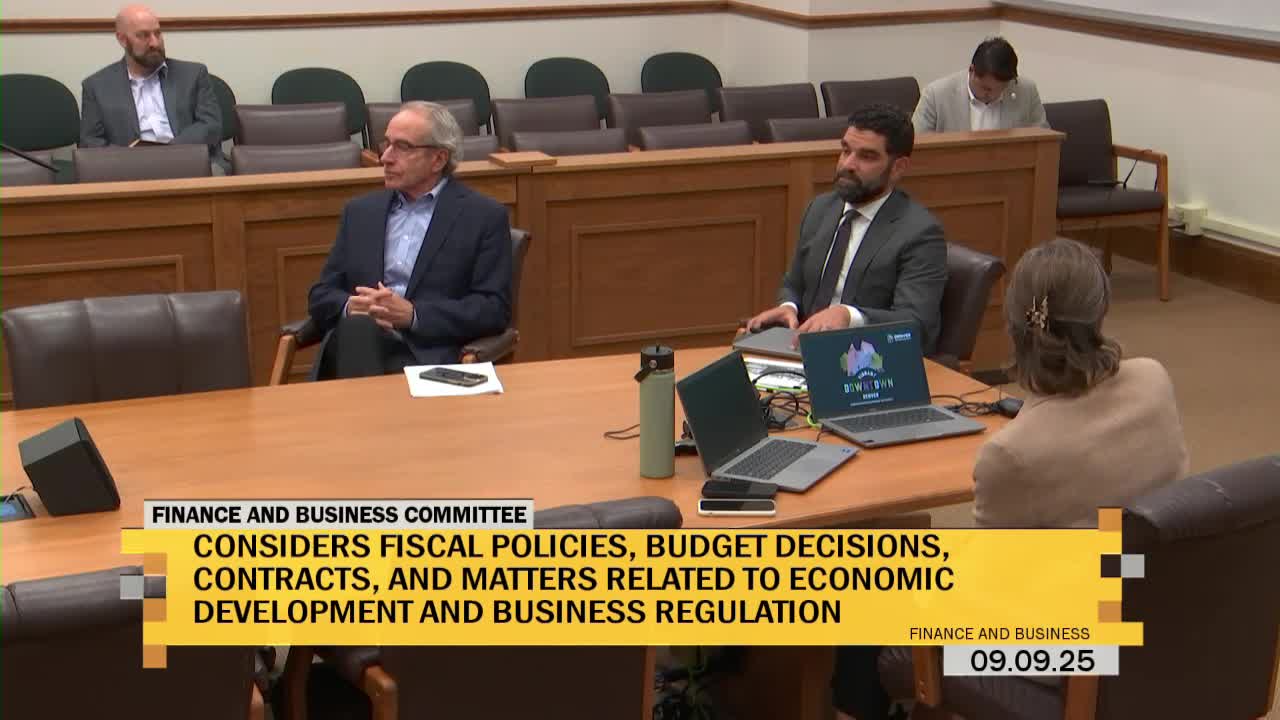
The Finance & Business Committee voted to move a package of Downtown Development Authority projects — loans and gap financing focused on Sixteenth Street, Skyline Park and Civic Center Park, and two Brookfield lots — to the full Denver City Council for final approval.
The Finance & Business Committee on Tuesday voted to send a package of projects and funding agreements from the Downtown Development Authority to the full Denver City Council for approval, including gap loans for ground-floor retail activations on Sixteenth Street and funding to fill capital gaps for Skyline Park and Civic Center Park.
The committee acted after presentations from city staff and the DDA board on projects tied to the Amended and Restated Plan of Development that City Council adopted in December. Donna Wilder, director-level staff with the Department of Finance, told the committee: “We are here today really as a result of, the Amended and Restated Plan of Development, that was adopted by City Council in December.”
Why it matters: the DDA proposal packages public gap financing and loans intended to activate underused first-floor spaces, support conversions of historic buildings and seed park and cultural projects downtown. City staff said the investments are designed to generate tax-increment revenues that the DDA can reinvest in future projects; several of the funding agreements described require City Council approval because they exceed the DDA cooperation agreement thresholds.
Key projects and funding described to the committee included: - Green Spaces master lease (600 and 622 Sixteenth Street): a 17,500-square-foot program to operate roughly seven to nine ground-floor retail spaces with a master lease and below-market rates for local, minority- and women-owned businesses. DDA staff said the package would cover about $3.4 million in five years of fixed rent and an additional $900,000 for tenant improvements, with a projected five-year economic impact and modest revenue sharing back to the DDA after year three. - Denver Immersive Repertory Theater (15th & Blake): a proposed loan of $400,000 covering roughly 20% of the buildout of a 10,000-square-foot immersive theater; staff projected significant ticket-based economic activity if the venue reaches its attendance goals. - Milk Tea People (Sixteenth & Blake): a $640,000 loan to relocate and expand a local operator into an approximately 3,000-square-foot corner storefront on Sixteenth Street. - Sunday Artisan Ice Cream (Sixteenth & Glenarm): a proposed $750,000 loan to create a flagship, interactive ice-cream venue in a roughly 5,000-square-foot ground-floor space; staff estimated substantial daily foot traffic and a multi-year economic impact. - Skyline Park and Civic Center Park: DDA staff described the authority as “the last money in” to fill capital gaps on these park projects; staff said both projects would return to the council soon as construction contracts from Denver Parks and Recreation and that Skyline Park and Civic Center Park are intended to be under construction by year’s end. The Civic Center Conservancy was described as agreeing to repay $10 million of a $30 million DDA allocation through naming-rights fundraising. - McNichols Building: the DDA indicated it would consider providing roughly $7 million as part of the capital stack to reactivate the building across multiple floors and issue requests for proposals for uses that could animate Civic Center. - Two vacant Brookfield-owned lots behind the Pavilions (15th Street): the DDA described a proposed purchase and a two- to five-year process to disentangle parking revenue arrangements so the lots can be redeveloped with mixed uses, including potential housing, office, hotel or entertainment uses.
Staff described an eligibility and vetting process that included statutory review, alignment with the DDA Plan of Development, financial-feasibility checks and readiness assessments. Donna Wilder noted the DDA has about 13 years left in its initial statutory term and therefore prioritized projects that can be delivered in the near term.
On measuring outcomes, Councilmember Diana Romero Campbell asked about the REMI economic model used to produce five-year impact projections. Bill Mosher of the Mayor’s Office said REMI is an economic modeling tool the Department of Finance uses to estimate outputs such as jobs, wages and tax revenue for public policy decisions. The Downtown Denver Partnership’s data partner also described how foot-traffic metrics are collected: Brad Dale of the Downtown Denver Partnership said the Placer.ai data “pings cell phone data” and that “spending 7 or more minutes somewhere, that designates you as someone who is in that place.”
Committee members pressed for coordination with existing downtown services and maintenance plans. Several members asked how additional park investment would be maintained; staff said park maintenance would fall to Denver Parks and Recreation for city-owned parks, while private-property projects would be maintained by property owners or BID arrangements as applicable.
Votes at a glance - Motion to forward the DDA petitions and funding agreements to the full City Council for final approval: moved by Councilman Daryl Watson; seconded by Councilmember Diana Romero Campbell. Committee chair Serena Gonzalez Gutierrez announced there was no roll-call vote and that the item would move forward to the full council.
What committee members said: Council President (unnamed in the committee transcript) framed the package as an implementation of the December Amended and Restated Plan of Development and stressed the DDA’s role in creating a “full neighborhood” downtown with housing, economic recovery and parks. Councilman Daryl Watson and other council members highlighted equity goals and the DDA’s selection of locally owned and minority-owned businesses for first-floor activation.
Next steps: staff said several individual projects will return to the council as petition and contract items — in particular, any property petitions and any funding agreements over $500,000 will require full City Council review. Committee members asked for continued reporting on tax-increment receipts and on whether projects meet projected jobs and foot-traffic targets.