Get Full Government Meeting Transcripts, Videos, & Alerts Forever!
Get email alerts on the Technology Budget topic
No spam. Unsubscribe anytime.
Technology Services presents $96.5 million 2026 budget, cites contract renegotiations and personnel reductions
Summary
City and County of Denver Technology Services outlined its proposed 2026 budget Thursday, saying it will prioritize cybersecurity and core systems while deferring some upgrades and pursuing contract savings and internal consolidations to cover shortfalls.
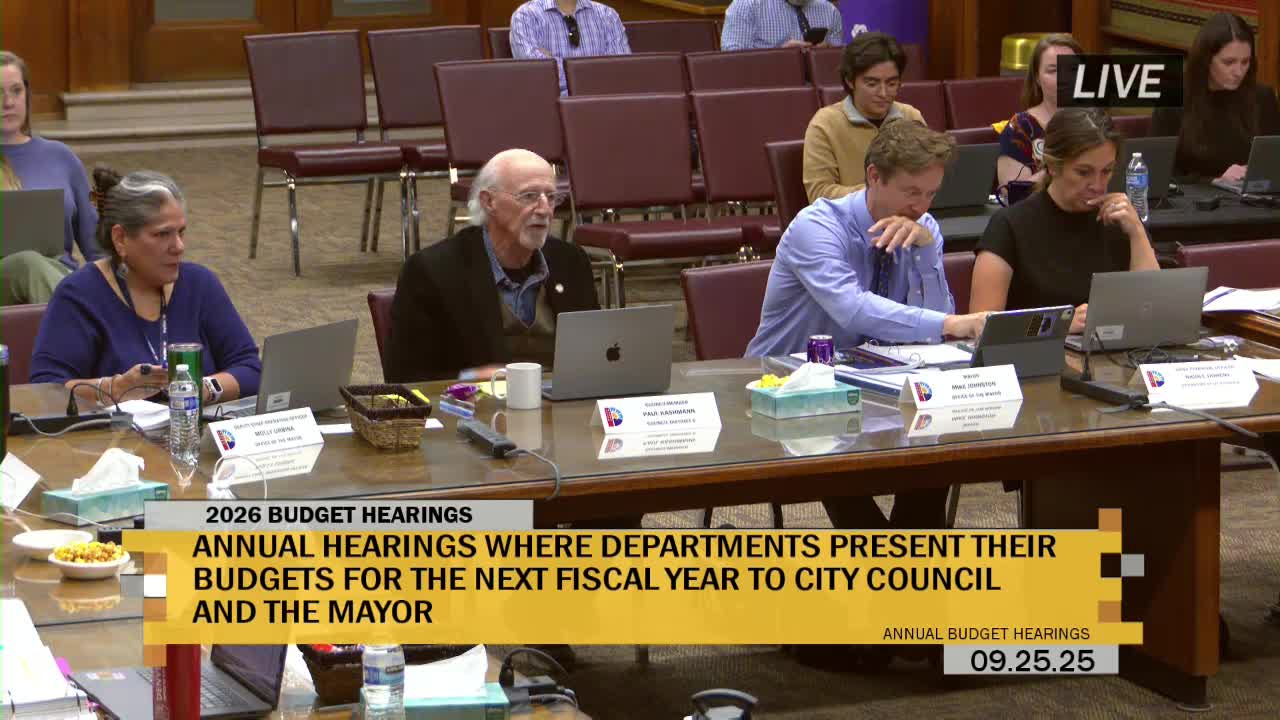
At a Sept. 25 Denver City Council budget hearing, Suman Lalapati, chief information officer for the City and County of Denver, outlined Technology Services’ recommended 2026 spending plan and the agency’s approach to reducing costs without cutting essential cybersecurity or core operations.
Lalapati told the council that Technology Services’ proposed general-fund budget for 2026 is about $96,500,000, with roughly $3.3 million in special-revenue funds and $1.5 million in capital transfers. She said personnel and services-and-supplies are roughly balanced in the request, with about 48.3% of expenditures for personnel and about 48.1% for services and supplies.
The department described several steps intended to reduce costs and preserve essential services: renegotiating vendor contracts, consolidating redundant tools and teams across agencies, establishing a prioritization framework that directs limited resources to projects with approved funding and clear execution plans, and pausing one-off technology purchases that increase long-term support costs.
Lalapati said Technology Services is planning reductions in planned PC replacements and a shift toward repairing and reissuing extant inventory where feasible. The agency also plans to reduce the number of city-owned mobile devices and to limit one-time, highly customized software projects in favor of standardized solutions.
Stephanie Adams, deputy chief financial officer, and other staff explained that a portion of the year-over-year changes shown in the budget documents reflect transfers of positions and expenditures between cost centers inside Technology Services rather than net new spending. Deputy CIO Paul Creston said the Office of the CIO cost center will receive functions and purchases that previously sat in infrastructure and operations, which explains a large increase on paper in the CIO office budget.
Technology Services said it has identified contract- and operational-savings measures already in motion; city staff reported the team’s work identified more than $20 million in savings across the city’s technology budgets. The presentation listed major supplier relationships used across the enterprise, including Workday and CareSoft, and said the department is conducting a detailed review of terms and conditions to capture additional savings.
Lalapati emphasized cybersecurity and operational stability as the top priorities for 2026 and said the agency plans to implement AI and generative-AI tools “in a very responsible way” to improve efficiency and decision-making while maintaining strong security controls.
The presentation also noted two recent grants: a CIPA grant around $500,000 to enhance IVR and 311 services, and a second grant to build a digital streaming platform through SIPA. Staff said those grants will support enhancements to customer-facing services. Technology Services also referenced accessibility responsibilities tied to a listed policy, “HP 21 1 10 (accessibility),” and said it is working with disability-access partners to meet those obligations.
The council’s budget hearing included questions about specific line items and service impacts; council members asked about the effect of proposed staff reductions, the department’s prioritization framework and the treatment of capital vs. operating expenditures. Technology Services officials said they would provide follow-up details to members and continue coordination with agencies to minimize service disruption.
The presentation closed with staff noting that the department will prioritize maintaining core services — server patching, application uptime, network operations — while deferring nonessential upgrades until funding and clear project plans are in place.
Ending: Councilmembers and Technology Services staff agreed to follow up on specific budget-line questions and supporting detail; the council moved on to other budget hearings scheduled for the day.