Get Full Government Meeting Transcripts, Videos, & Alerts Forever!
Get email alerts on the Rapid Rehousing topic
No spam. Unsubscribe anytime.
Denver HOST previews contract amendments to expand rapid rehousing; no vote taken
Summary
Department of Housing Stability staff briefed the Community Planning and Housing Committee on proposed amendments to several existing rapid-rehousing contracts that would add funding, reallocate canceled Salvation Army funds and expand family-focused supports; the meeting was informational and no formal action was taken.
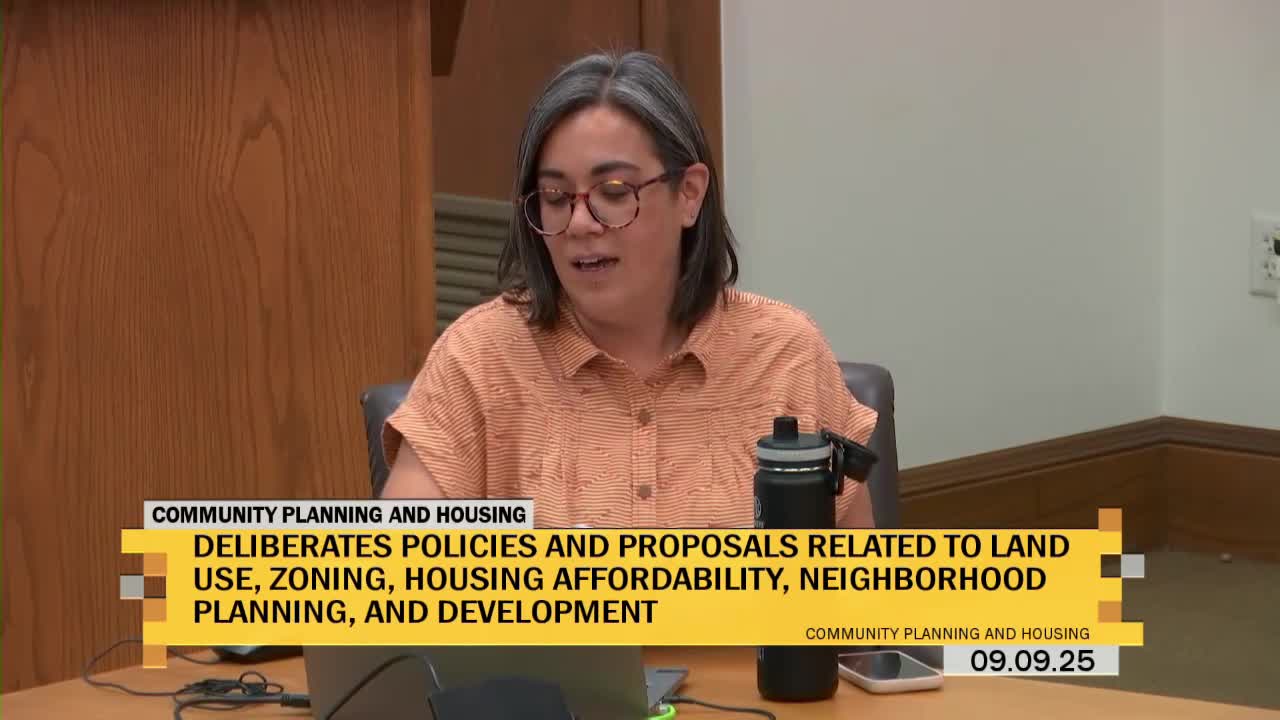
Denver City Council’s Community Planning and Housing Committee heard an informational briefing Sept. 9 from Midori Higa, director of homelessness resolution programs at the Department of Housing Stability (HOST), on proposed amendments to a set of existing rapid rehousing contracts intended to add cost-of-living increases, reallocate funds from a canceled Salvation Army contract and expand services targeted to families.
Higa told the committee that the amendments would add funding to several existing contracts, including: Jewish Family Service of Colorado (locally funded) +$1,467,487; Dolores Project +$22,278; Urban Peak +$12,079; Volunteers of America — Rapid Rehousing Plus Care +$1,102,542; Volunteers of America — Green Willow (domestic-violence survivor program) +$6,663; Volunteers of America — Shelter-into-Rapid Rehousing (families) +$1,184,433; and a separate Jewish Family Service state/grant contract +$795,766. Higa said one Jewish Family Service contract term would be extended through June 30, 2026, after an initial misstatement, and that most of the other affected contracts were originally three-year terms.
The proposed increases are primarily for staffing cost-of-living adjustments (COLAs), ongoing rental and move-in assistance, and to cover households transferred after Salvation Army’s canceled contract. "Most of these contracts... have already been approved for the first time," Higa said. "In some cases we're adding funds that came from the Salvation Army's canceled contract so just needing to reallocate the funds that were originally for that." She emphasized the amendments are for existing programs and that this meeting was a preview; the committee chair later clarified there were no action items that day.
Why it matters: Rapid rehousing provides short- to medium-term rental assistance and case management intended to move people from shelter or unsheltered settings into permanent housing. HOST tracks program metrics tied to national standards, Higa said: average move-in time of 60 days or less, at least 80% of households exiting to permanent housing, and at least 80% of households not returning to homelessness within one year of exit. HOST reported that through Aug. 25, 2025, its rapid rehousing programs had served 224 households this calendar year, with providers having housed 98 households in 2025 and about 39 households enrolled and still in housing search. For 2024, staff reported 713 households served across programs.
Committee members asked for clarifications on staffing versus direct assistance and on housing supply. Councilwoman Diana Romero Campbell asked about the share of contract dollars that pay for case management; Higa said case manager caseloads are targeted around 20 households per case manager and that staffing costs are smaller than housing costs because rent is expensive. Councilwoman Jamie Torres asked about availability of multi-bedroom units for families; Higa said HOST does not directly track affordable housing stock but that many providers use a separate housing-connector contract that partners with landlords on a Zillow-based platform and can produce multi-bedroom units. HOST staff said Housing Connector offers landlord incentives and mitigation funds and has been reporting more multi-bedroom units available on its platform.
Committee members also pressed on funding sources. Higa said the contracts on screen would be funded from the city’s Homelessness Resolution Fund for 2026–27; she also noted small amounts of HOME funding (federal) are braided into some tenant-based rental assistance, and that one small Volunteers of America rapid rehousing contract is funded through ESG (federal Emergency Solutions Grants). Several previous years’ expansions had used ARPA funds, Higa said.
Jeff Kosicki, HOST deputy director, briefed the committee on family homelessness: the agency’s wait list for families was 259 as of his remarks, "up by nearly a 100" from the prior year’s average, he said. Kosicki cited factors including recent changes to work authorization for newcomer households and ongoing increases in evictions. HOST said it is deploying additional bridal crisis fund dollars for some newcomer families and will add an emergency congregate winter shelter to ensure families are not unsheltered during cold months.
No formal action: Chair Sarah Paradis and staff confirmed multiple times that the presentation was informational and that "we actually have no action items today." The committee did not vote on the contract amendments at this meeting.
What’s next: HOST staff said they will return with related material about Housing Central Command and a future hearing on family homelessness. Higa offered to supply more specific budget breakdowns per contract, and staff noted that the department’s rapid rehousing oversight includes monthly provider convenings and case conferencing to improve performance and data accuracy.
(Ends)