Get Full Government Meeting Transcripts, Videos, & Alerts Forever!
Get email alerts on the Rent Stabilization topic
No spam. Unsubscribe anytime.
Passaic council moves proposed 3% rent cap to second reading after hours of testimony
Summary
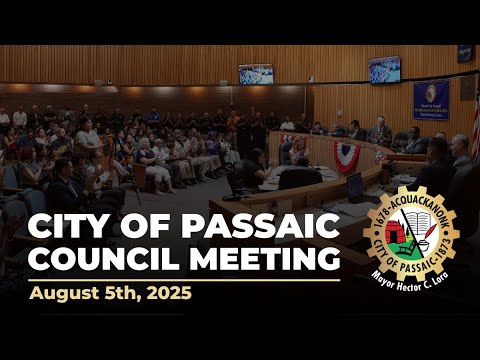
After more than two hours of public comment, the Passaic City Council voted to set a revised rent-stabilization ordinance — reducing the annual allowable rent increase to 3% — for second and final reading on Sept. 2, 2025. Dozens of tenants, advocates and some landlords spoke during a packed public hearing.
The Passaic City Council voted Aug. 5 to set a revised rent‑stabilization ordinance for second and final reading on Sept. 2, 2025, a measure that would lower the maximum annual rent increase to 3% if ultimately adopted.
The measure was moved to a second reading after a lengthy public hearing in which more than two dozen residents, tenant organizers and advocacy groups urged council members to adopt a 3% cap and vacancy control. The hearing opened when Council President Schaer called the item, listed on the agenda as “chapter 231, rent stabilization.”
Supporters said current rent increases are driving displacement and harming vulnerable households. “A 3% cap gives people a fighting chance,” said Carla, a representative of Lasos America, Unida, and Fuerza Migrate, describing families she said pay high rents for substandard housing. Mitchell Khan, vice president and director of organizing for the New Jersey Tenants Organization, who said he has worked on rent-control laws in the state for decades, told the council the proposed reduction was “long overdue.”
Organizers from Make the Road New Jersey and other tenant groups framed the proposal as a protection for working families, seniors and survivors of domestic violence. Natalie Catarina Bracamonti Melendez de Nogueira, a Passaic teacher and petitioner for the referendum, said the city had collected more than 400 signatures supporting stronger limits and vacancy control. Nicole Morella, co‑executive director of the New Jersey Coalition to End Domestic Violence, told the council that predictable rents are critical for survivors trying to rebuild stable lives.
Several speakers described finding mold, pest infestations, and other habitability problems alongside steep rent increases. “My rent was $987 and the increase brought it up to $2,257,” Mariela, a Make the Road New Jersey organizer, told the council, recounting the stress and health impacts she said followed the increase.
Speakers who identified as landlords or property owners urged caution. One small landlord said he owns two‑family homes, pays roughly $16,000 in annual taxes on his properties and worried that a 3% cap would be particularly burdensome for owners of small buildings who must cover large, infrequent costs including roofing or other major repairs.
After the public portion, the council voted to deny a separate petition version of the ordinance and to advance a council-drafted amendment (listed as item 44) amending section 231‑23 of the city code to reduce the maximum allowable rental increase to 3% and to schedule a second and final reading for Sept. 2. Council members voting in favor in the roll call were Councilman Monk, Councilman Love, Councilwoman Mello, Councilman Mayer, Councilman Garcia, Councilwoman Colombo Montanez and Council President Schaer.
Mayor Laura and council members said they expected a short period of further drafting to reconcile language between the petitioners and the administration before final adoption. Council President Schaer indicated there had been preliminary agreement with tenant organizers to finalize details in a few days to weeks and then return for the final vote.
The proposed ordinance retains administrative provisions discussed earlier this year, including hardship and capital improvement pass‑throughs, but the council and organizers signaled there would be additional drafting before adoption. No final policy was adopted at the Aug. 5 meeting; the council’s action was to set the revised ordinance for additional public consideration and a final vote on Sept. 2.
If adopted at second reading, the ordinance would replace the city’s earlier 6% cap adopted earlier in 2025. City staff and tenant advocates said questions about enforcement, vacancy control mechanics and how to handle new construction or substantial rehabilitation remain to be finalized.
Next steps: the council will post the revised ordinance, take public comment again at the Sept. 2 meeting and conduct a final roll‑call vote. Organizers in the room urged residents to attend that session; tenant groups said they planned continued outreach and legal review during the interim.