Get Full Government Meeting Transcripts, Videos, & Alerts Forever!
Get email alerts on the Emergency Medical Services topic
No spam. Unsubscribe anytime.
Board approves countywide ambulance contract, names American Medical Response as exclusive operating provider
Summary
The Monterey County Board of Supervisors voted unanimously July 8 to award the county's advanced and basic life support ambulance exclusive operating-area contract to American Medical Response. The five-year operational period will begin Feb. 1, 2026, and includes provisions for clinical monitoring, new BLS units, and community equity reporting.
The Monterey County Board of Supervisors unanimously approved awarding the exclusive operating-area contract for advanced life support (ALS) and basic life support (BLS) ambulance services to American Medical Response (AMR) on July 8. The contract covers 9-1-1 emergency response, interfacility and critical care transports, standby and dispatch services for the county's exclusive operating area and begins operationally Feb. 1, 2026 after a transition period following agreement execution.
The county's EMS agency presented the recommendation after a competitive RFP process. The agency received two responsive proposals and a review panel recommended AMR based on clinical, operational and dispatch quality scores. The RFP and award process was reviewed and approved by the California Emergency Medical Services Authority as part of the county's procurement oversight.
The contract includes several notable operational and clinical provisions. AMR committed to additional weekly ambulance unit hours and to introduce BLS ambulances staffed by two EMTs to handle lower-acuity 9-1-1 calls and interfacility transfers, freeing ALS/paramedic units for higher-acuity incidents. The contract also phases in Type 3 (box-style) ambulances, calls for a bariatric ambulance and access to regional disaster resources, and expands critical care transport (CCT) capacity by permitting appropriately trained paramedics to perform some higher-acuity transfers.
The agreement requires a new clinical scorecard for the county to monitor and report on clinical care and patient outcomes, and it mandates disaggregation of data so the county can check for unequal performance by race, language, gender or geography. AMR also committed to obtaining national and regional accreditations (CAAS, ACE, and American Heart Association Mission: Lifeline recognition) and to deploy software tools for near real-time clinical and operational monitoring, including tools to detect crew fatigue by tracking provider workloads.
Board members pressed EMS staff and AMR during the public discussion about billing practices and reimbursement for special users (state facilities and prisons). AMR's Mike Rice, vice president of operations, said the company is researching low reimbursement rates in some cases and is willing to work with county officials to pursue state-level remedies where appropriate. Rice told the board, "Typically, governments pay on a fee schedule much like medical and Medicare... Medicare pays at a fixed schedule. Medi-Cal pays a fixed schedule. We believe there's a component of that that's influencing it. But we're doing our research to ensure that the reimbursement is there and appropriate according to whatever the statute or law is associated with those transports." (Mike Rice)
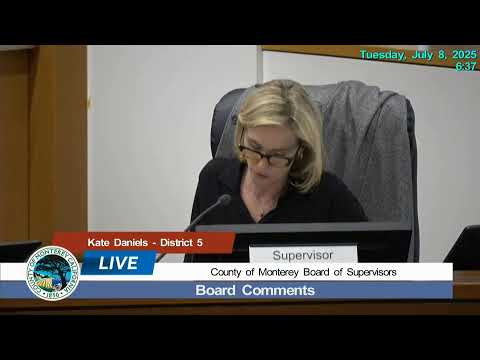
Motion and vote: Supervisor Alejo moved to approve the staff recommendation awarding the contract to AMR; Supervisor Askew seconded. The clerk recorded a unanimous roll call: Alejo, Church, Askew, Daniels and Chair Lopez all voted "Aye." The agreement becomes effective on execution to allow transition activities; the operational period runs from Feb. 1, 2026 through an initial term with extension options that AMR can earn by meeting contractual performance standards.
What changed and why it matters: The contract shifts the county's ambulance system from a simple response-time model toward a combined response-and-clinical-quality approach, with new dispatch nurse navigation, clinical monitoring, equity-focused reporting and additional BLS resources meant to preserve paramedic capacity for the most serious calls. It also increases some ambulance rates included in proposers' rate submissions (the EMS presentation noted a roughly 25% increase in frequently seen charges submitted in the RFP), while noting that state law (AB 716 / ground medical transportation provisions) limits the impact of rate increases on insured or uninsured patients and requires carriers to pay noncontracting providers the difference.
Board directions and next steps: Staff will finalize the contract, oversee AMR's transition plan for the county-wide service, and implement the clinical scorecard and equity reporting described in the agreement. The EMS agency will publish performance reports and monitor AMR for compliance with the contract requirements and accreditation milestones.
Ending: County officials said they will follow up on reimbursement issues for particular high-use facilities and continue stakeholder engagement with fire agencies, hospitals and law enforcement as the transition moves into the operational phase.