Get Full Government Meeting Transcripts, Videos, & Alerts Forever!
Get email alerts on the Oregon Main Street Visit topic
No spam. Unsubscribe anytime.
Oregon Main Street progress visit recommends building on events, targeting economic vitality and design projects
Summary
Oregon Main Street representative Sherry Stewart visited the Downtown Estacada Commission and recommended focusing on the organization's four pillars—organization, promotion, design and economic vitality—while noting a new revitalization grant program offering up to $400,000 per project.
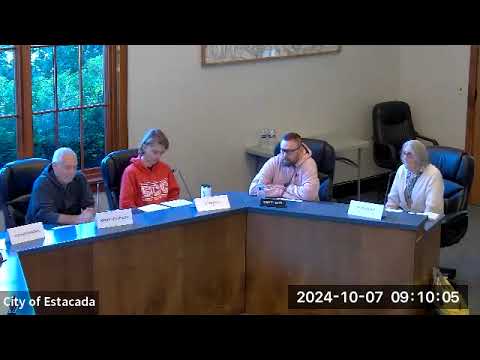
Sherry Stewart of the Oregon Main Street program made a progress visit to the Downtown Estacada Commission on Oct. 7, outlining available technical assistance, training resources and grant opportunities and offering recommendations to expand the commission’s economic and design activities.
“Through Oregon Main Street, based upon the tier you’re in our Main Street track, you’re eligible for a wide range of technical assistance,” Stewart said. She described a now-expanded Oregon Main Street revitalization grant program that can support building improvement projects and new construction “up to $400,000 per project,” and said the commission would apply as the applicant on behalf of property owners for projects within the commission’s designated district.
Stewart recommended that the commission use the Main Street program’s four pillars—organization, promotion, design and economic vitality—as a framework for prioritizing work. She said the commission’s strong event schedule and growing board position it well for promotion and organization work, and encouraged the group to pursue targeted design projects (public gathering spaces, temporary or permanent) and economic-vitality initiatives to fill commercial gaps such as retail and evening activity.
Commissioners and the visiting representative discussed multiple local ideas: pursuing urban renewal tools to expand the redevelopment footprint, exploring incentives or URA-supported grants for developing vacant lots, experimenting with temporary public-space activations to create family-friendly downtown gathering spots, and using youth-led projects for design implementation. Stewart suggested the commission review short webinar modules Main Street has produced for each pillar and consider a focused strategic-planning session in January.
Members raised practical ideas including free downtown Wi-Fi (citing an Oregon City example), pet-friendly amenities (dog-waste stations), more evening uses to increase foot traffic, and possible small-scale lodging or boutique accommodations to encourage overnight visits. The commission also discussed a vacant-building code that is intended to preserve building condition but does not apply to undeveloped lots; Stewart noted URA grants are typically a “carrot” rather than a “stick” for site redevelopment.
Stewart said she would follow up with a written visit report that includes observations, recommendations and links to resources and training modules.
Ending: Stewart offered to return and to provide facilitation or a facilitator for a strategic planning session; commission members were encouraged to review Main Street resources and identify priorities they want to pursue in the next 12–18 months.