Get Full Government Meeting Transcripts, Videos, & Alerts Forever!
Get email alerts on the Economic Development Plan topic
No spam. Unsubscribe anytime.
Greeley unveils draft economic development strategic plan focused on jobs, sites and workforce pipelines
Summary
City economic development staff and consultants presented a draft strategic plan aimed at growing jobs, preparing shovel‑ready sites and improving workforce pipelines to help Greeley compete for higher‑value employers.
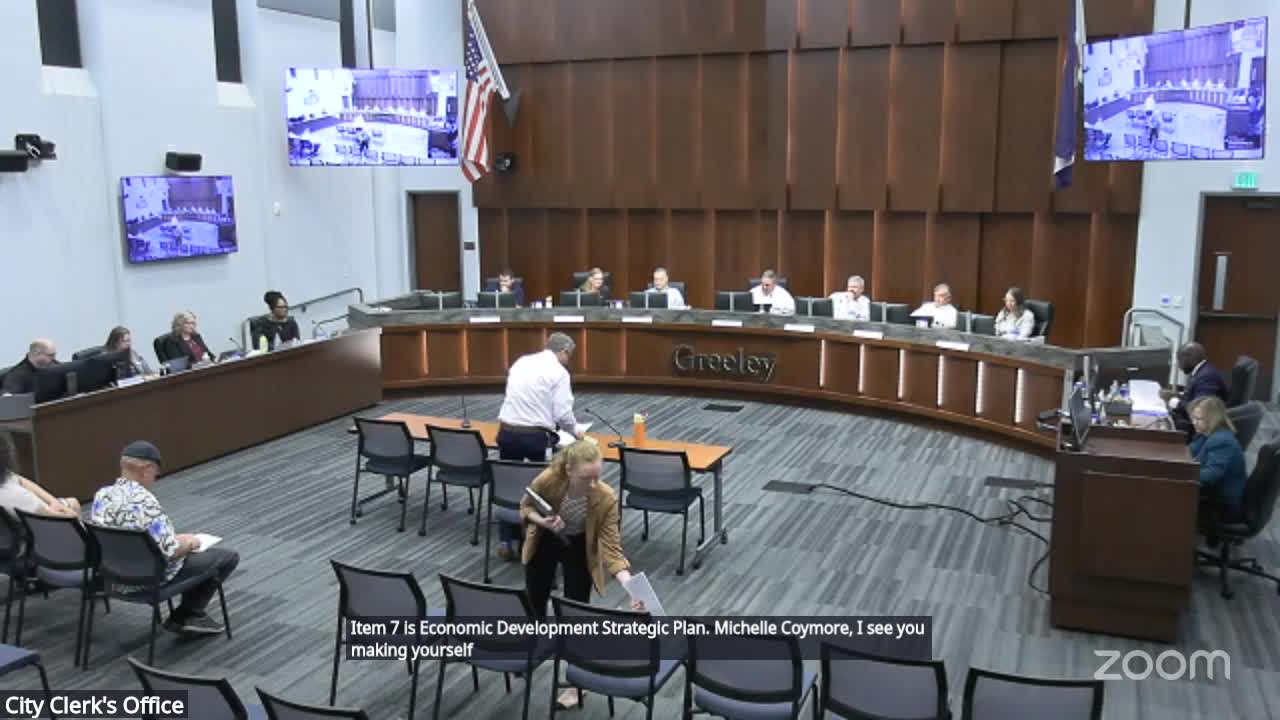
The Greeley City Council heard an informational presentation on a draft economic development strategic plan that outlines priorities for diversifying the local economy, preparing development sites and strengthening workforce pipelines.
Michelle Claymore, interim economic development director, and Dan Gardner, principal with the plan’s consulting team, presented the plan’s findings and recommended focus areas. The presenters described Greeley as a fast‑growing city with advantages—regional market access, higher education partners and water resource availability—but also facing affordability and workforce skills gaps that affect employers’ ability to locate and expand in the city.
The draft plan identifies eight strategic focus areas: marketing and promotion; targeted business recruitment; retention and expansion of existing employers; entrepreneurial ecosystem and incubation; workforce development and education‑to‑employment pipelines; site and infrastructure readiness (including downtown, East Greeley and airport area); business‑friendly policies; and investment attraction for mixed‑use redevelopment.
Claymore and Gardner emphasized the plan’s dual emphasis on primary employers (those exporting goods or services beyond the local region) to bring new dollars into the economy and secondary employers (retail, services) that sustain local job markets. The plan encourages aligning city investments and policies to attract higher‑wage and higher‑skill jobs in sectors such as advanced manufacturing, health care, ag tech and logistics while sustaining retail and small business support.
Key recommendations and implementation notes included: - Create a phased action plan with short‑, mid‑ and long‑term initiatives and measurable performance indicators to allow the city to track progress and show near‑term wins while committing to longer investments. - Prioritize site readiness and infrastructure to make parcels shovel‑ready, including industrial and downtown mixed‑use opportunities. Consultants flagged the need for water and other utilities to be available for advanced manufacturing, data center and tech users. - Build an entrepreneurial pipeline and physical/incubator space to retain start‑ups; staff noted options such as partnerships with Aims Community College or third‑party operators and an estimated early cost for an incubator pilot was discussed during related budget deliberations. - Strengthen workforce pathways with local education partners and employers to match skills to target industries and to reduce out‑commuting by higher‑paid workers.
Council discussion focused on workforce development, the role of housing and the need for streamlined processes for existing businesses. Councilor Olson urged stronger collaboration with the Chamber of Commerce, Aims and UNC and stressed that permitting and regulatory hurdles were repeatedly raised by local businesses as barriers to expansion. Councilor McDonald asked staff to quantify where workers leave the city for jobs and to explore retaining higher‑paying positions tied to institutions such as the medical school and other regional anchors.
Claymore and Gardner said implementation will require staffing, partnerships and realistic resource commitments. They recommended treating the plan as a living document with annual updates on progress and measurable KPIs such as job growth, wage levels, number of shovel‑ready sites and retention metrics.
Ending: Staff presented the plan as informational and said it will guide departmental priorities and partner coordination. There was no council vote; staff said the next steps include preparing implementation actions and exploring partnerships and funding for incubator facilities and workforce initiatives.