Get Full Government Meeting Transcripts, Videos, & Alerts Forever!
Get email alerts on the Noise Control topic
No spam. Unsubscribe anytime.
Council adopts Residential Tranquility law to restrict overnight amplified noise targeting homes; debate centers on dispersal procedure and First Amendment ties
Summary
The Council approved the Residential Tranquility Amendment Act on July 1 after debate and a failed amendment to require a cross-reference to First Amendment dispersal notice; sponsors said the bill targets amplified overnight noise aimed at residences, not protests in general.
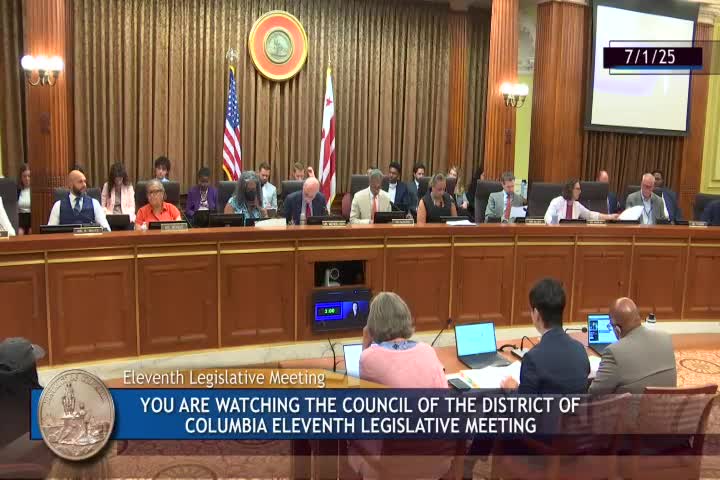
The Council on July 1 approved the Residential Tranquility Amendment Act of 2025, legislation that creates targeted restrictions on amplified sound aimed at private residences during overnight hours.
Sponsor Councilmember Brooke Pinto described the measure as a narrowly drawn tool to address repeated incidents in which amplified speakers and large sound systems were used near private homes during early-morning or late-night hours, producing levels one councilmember said measured as high as 128 decibels at the source. Pinto and other supporters said the ordinance is limited to amplified sound targeting a residence in a residential neighborhood and does not prohibit demonstrations in public spaces.
Councilmember Nadeau proposed an amendment to require that police issue order-to-disperse warnings before arrests or criminal enforcement actions. Supporters of the amendment argued it would protect free-speech rights and avoid escalation; opponents said the dispersal protocol is already required under the First Amendment dispersal code (Title V, section 5-331.07) and that adding the language would be duplicative or, in the amendment's form, would lower the number of warnings from three two-minute warnings to a single warning. The amendment failed on a voice vote (members later disputed whether a timely roll-call was requested).
The chair explained specific incidents in Kalorama and other neighborhoods where repeated amplified noise targeted residences, saying the bill focuses on amplification-based disruption and on protecting neighborhood tranquility during meals, school-start times, and sleeping hours. On final passage the secretary recorded at least two members voting no; the chair declared the bill approved.
Supporters said the bill cleans up cross-references in code and provides law enforcement a narrowly tailored tool to address amplified noise targeted at homes overnight; critics warned about potential chilling effects on protest and urged caution and robust safeguards.