Get Full Government Meeting Transcripts, Videos, & Alerts Forever!
Get email alerts on the Public Safety Pension Tax topic
No spam. Unsubscribe anytime.
Oxnard staff recommends 5.0615¢ per $100 property tax to fund public-safety pensions for 2025–26
Summary
City of Oxnard finance staff recommended the city council adopt a resolution setting a 5.0615¢ per $100 property tax rate to cover voter-approved public safety pension obligations for fiscal year 2025–26, citing CalPERS costs, an actuarial estimate of eligible expenses, and unitary property revenue that reduces the levy needed from other parcels.
Jim Costello, an administrative services analyst in the City of Oxnard finance department, told the council the recommendation is that the council adopt a resolution establishing the fiscal year 2025–26 tax rates on property in the City of Oxnard to pay voter-approved public safety pension obligations.
Costello said the City’s public-safety pension tax stems from a 1951 voter measure that enrolled Oxnard’s fire and police employees in the California Public Employees’ Retirement System (CalPERS) and obligated the City to pay participation costs through a property tax levy. He noted that the levy is treated as voter-approved indebtedness under the California Supreme Court’s Carmen v. Alverd decision and is therefore exempt from Proposition 13’s 1% cap.
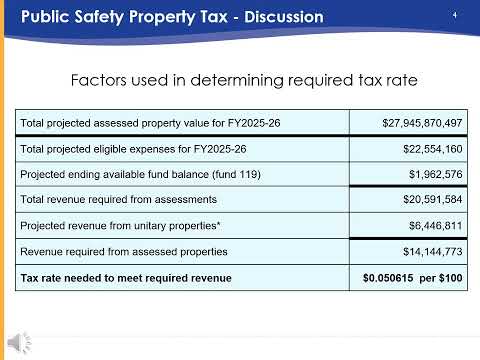
City staff described the mechanics and calculations behind the proposed levy. The City’s actuarial consultant, Foster & Foster, identified eligible pension expenditures of $22,554,160 out of total estimated public-safety retirement costs of $31,283,920 for approximately 137 fire positions and 242 police positions. With a projected FY 2025–26 assessed property value of $27,945,870,497, an anticipated fund balance of $1,962,576 to apply toward eligible expenses, and projected unitary property tax revenue of $6,446,811, staff said $14,144,773 would need to be raised from assessed parcels. Using a projected assessed base of roughly $27.9 billion, staff calculated a tax rate of 5.0615¢ per $100 of assessed value — about $50.62 per $100,000 of assessed value.
Costello said that the computed rate is a 7% increase over the current year’s rate but remains well below the statutory maximum for Oxnard of 7.6637¢ per $100, set by Assembly Bill 13 in 1985 based on rates in effect in 1983–84. He also noted a 2002 court ruling limits the tax to payment of benefits that were in effect on July 1, 1978, the date Proposition 13 took effect; benefits conferred after that date cannot be charged to this levy. To ensure compliance with that limitation, the City retained Foster & Foster to perform the eligibility analysis.
Staff explained unitary property tax revenue — revenue from railroads and utilities taxed at the statewide level and apportioned to jurisdictions — has begun to be received into the Public Safety Retirement Fund beginning in FY 2020–21 after an audit requested by the City’s property tax consultants. That revenue, staff said, reduces the amount that must be collected from other parcels.
Costello closed the presentation by restating the recommendation that the City Council adopt a resolution establishing the FY 2025–26 tax rate for payment of voter-approved obligations related to public-safety pension expenses and said staff would be available at the meeting to answer questions.