
Board reviews Trust Policy Chapter 5; debates open enrollment, attendance, special education and discipline rules
Get AI-powered insights, summaries, and transcripts
Subscribe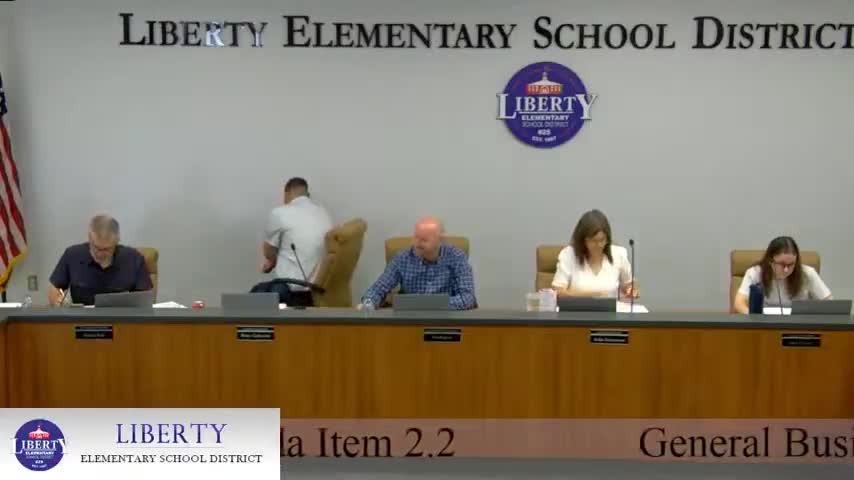
Summary
Board members reviewed Trust Policy Chapter 5, discussing attendance boundaries, open-enrollment priorities, truancy and tardiness, homebound certification, 504/IDEA wording, and proposed changes to extracurricular eligibility standards and discipline procedures.
The Liberty Elementary District Governing Board held an extended review of Trust Policy Chapter 5 during its June 7 special meeting, discussing a package of proposed rules covering student enrollment, attendance, special education procedures and discipline. No final vote was taken on Chapter 5 during this meeting; staff and the board agreed to return the chapter for additional edits and a later read.
Amy Castellanos, who presented the draft chapter and the trust’s redlines, told the board the trust’s legal team had reviewed much of the language and that staff had spent several weeks reconciling statute and local practice. Castellanos said roughly 30 staff hours had been devoted to the revisions prior to the meeting.
Open enrollment and capacity: The draft makes a distinction between students the district must enroll under statute (for example, students in foster care or covered by McKinney-Vento) and general open-enrollment applicants for whom space is reserved only “as capacity allows.” The board discussed whether the policy should set an explicit priority ranking for open-enrollment applicants and whether the district should reserve seats for certain classes of students. Board members expressed concern about school capacity and noted staff shortages: President Michael Todd asked for a clear priority order and suggested listing preferences in the order discussed; several members suggested prioritizing resident students and students returning from the prior year, with other preferences (such as children of employees) ranked lower.
Tardiness and attendance: Trustees and principals raised chronic tardiness and out-of-boundary students who chronically arrive late. The draft includes a definition for habitual truancy (unexcused absences of at least five school days in a school year) and delegates to the superintendent the duty to establish procedures for notification and interventions. Board members asked staff to add language addressing excessive tardies, how tardies intersect with the discipline matrix, and whether open-enrollment authorizations can be revoked for repeated tardiness or absenteeism; staff said they would draft wording and add it to the discipline matrix and to the open-enrollment procedures for the next read.
Homebound certification and medical documentation: Board members debated whether the draft should say a student absent for 90 days or for “three school months” must provide medical certification; some members preferred “90 calendar days” for clarity. Castellanos and staff proposed consistent wording across the chapter: for absences fewer than 90 days, an appropriately licensed health-care professional may provide certification; absences expected to exceed 90 days should be documented by an appropriately licensed medical provider.
Special education (IDEA) and Section 504: The board reviewed proposed language to align 504 and IDEA procedures with federal requirements. Trustees requested clarifying language about who may act as the district representative at IEP meetings and about how child-find and referrals for children near age 3 are handled (the board noted state and federal timelines differ and asked staff to confirm statutory requirements). Castellanos said some introductory text for IDEA sections might require separate legal review because of copyrighted model language and federal specifics.
Extracurricular eligibility and discipline matrix: Trustees discussed whether the bar for extracurricular eligibility should be raised from a D to a C average. President Todd voiced support for moving to a C standard, and some board members proposed a system of weekly grade checks or short-term remediation rather than season-long suspensions to keep students engaged while encouraging academic progress. The board also discussed adding discipline-matrix references to juvenile behavior consequences and tying excessive tardiness or truancy to possible revocation of open-enrollment status.
Other items discussed included updating terminology (for example, adding “reading interventionist” alongside literacy coach/specialist to reflect district titles), clarifying who provides immunization and medical documentation (reference to ARS noted), and whether the district should retain explicit authority to provide transportation for open-enrolled students in special circumstances. Several board members asked staff to research past district practice where the district had provided transportation in certain cases and to propose a transparent approach if transportation for open-enrolled students is to be allowed.
Next steps: Staff will revise Chapter 5 per board directions: add tardiness language cross-referenced with the discipline matrix; standardize medical-provider terminology; review open-enrollment priority wording and capacity language; and work with legal counsel on IDEA/504 introductory text and discrepancy/eligibility language for special education. The board tentatively scheduled to read Chapter 5 again on June 17, 2025, with a goal of finalizing before July 1 if possible.
Speakers credited in this report include Amy Castellanos (presenter/staff), Dr. Mahorn (staff member), President Michael Todd, Vice President Kenyon, Board member Kelly Zimmerman, Board member Schmidt and Board member Cerencioni.