Get Full Government Meeting Transcripts, Videos, & Alerts Forever!
Get email alerts on the Municipal Finance topic
No spam. Unsubscribe anytime.
Cooper City officials warn of sharp budget impact if property-tax revenue is cut
Summary
Commissioners reviewed a new revenue-forecast model and were told property taxes make up roughly half of the city's general-fund revenue; officials discussed scenarios if state action reduces property-tax collections and the need to plan for next year's budget.
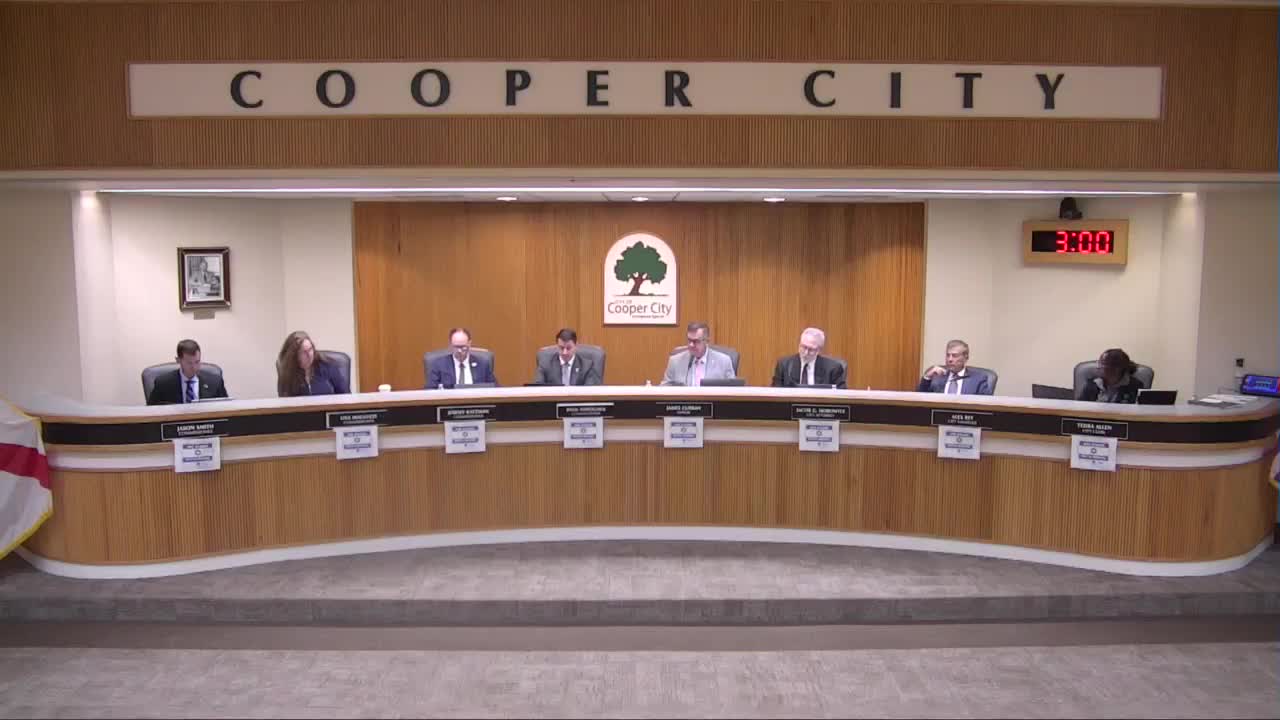
Commissioners at the Cooper City Commission's May 27 meeting were told that property taxes account for about half of the city's general-fund budget and that the city must factor potential state changes into next year's budgeting.
In a presentation on the six-month financials ending March 31, the finance staff introduced a revenue-forecast model intended to project revenues for the remainder of the fiscal year and support next year's budget planning. The model is appended to the monthly financial report that commissioners received before the meeting.
The finance director told the commission that property-tax revenue represents roughly $25,000,000 of a $52,000,000 general fund, meaning the city would face a roughly 50% reduction in revenue if property taxes were eliminated, a scenario raised hypothetically by Commissioner Smith during the discussion. "Property taxes account for $25,000,000 over $52,000,000 general fund budget," the finance director said.
Commissioner Smith pressed staff to show residents what a dramatic property-tax change would mean, asking for a clear estimate of the resulting deficit so citizens could better understand tradeoffs for parks and capital projects. Commissioner Schroeder cautioned that while outright abolition of property taxes is unlikely, proposals under consideration in Tallahassee could require local rebate programs such as a $1,000-per-resident credit. He said most of the city's current property-tax receipts have already been collected for the current fiscal year, and the fiscal impact would be felt in FY 2026 and later.
City Manager Erwin and staff said the forecast tool will be used to model a range of scenarios, including reduced sales tax and revenue-sharing changes. Commissioners asked staff to incorporate possible reductions into the budget planning process for the coming fiscal year.
The presentation prompted repeated requests that the administration incorporate scenario planning into public-facing communications so residents understand what large revenue reductions would mean for services and planned capital projects.
Looking ahead, staff said they will incorporate the forecast model into next year's budget work and return to the commission with updates as state proposals and revenue assumptions evolve.