
Encinitas council renews Landscape & Lighting District charges, asks staff to review large reserves
Get AI-powered insights, summaries, and transcripts
Sign Up Free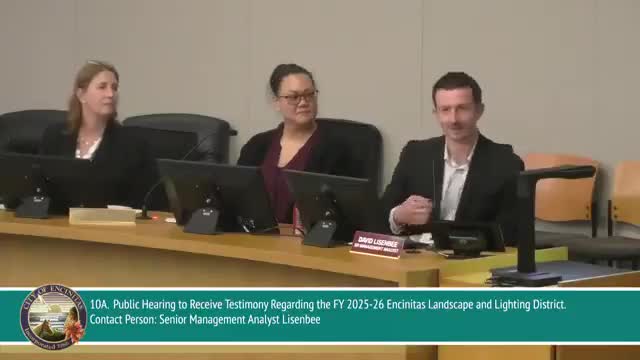
Summary
Council confirmed the annual engineer’s report and assessments for the Encinitas Landscape & Lighting District and asked staff to analyze reserve levels and return with options to reduce assessments where zones hold large balances.
The City of Encinitas on May 21 held the required public hearing and adopted a resolution confirming the annual engineer’s report renewing the Encinitas Landscape & Lighting District (Zones A–H) and ordering collection of assessments via the county tax roll.
Senior management analyst David Lisonbee presented the engineer’s report and explained the district’s structure: Zone A is a citywide zone supporting thoroughfare lighting and traffic signals; Zones B and C fund localized residential and commercial street lighting; Zones D–G fund subdivision‑level landscape and park improvements tied to specific development obligations; and Zone H covers the Encinitas Ranch specific plan area.
The nut graf: Staff recommended confirmation of the engineer’s report and transmission of the assessments to the county auditor. During the hearing councilmembers reviewed fund balances presented in the engineer’s report and directed staff to examine zones that have comparatively large reserves and return next year with options to reduce assessments where appropriate.
Public comment asked whether the district maintained unusually large fund balances. Lisonbee showed the budget appendix (staff report pages 18–19) and said the engineer’s report lists beginning and ending fund balances by zone; some zones (E and F) are currently assessed at $0 because property tax contributions and existing balances cover costs. Council members asked staff to prepare scenarios showing what lower operating‑reserve targets (for example 35–45 percent) would look like by zone and how any change would affect assessments for next year.
Why it matters: The landscape and lighting assessments are a dedicated funding source for street lights, traffic signals and landscaping; confirmation of the engineer’s report is a statutory step that places the charges on the tax roll unless a ballot process is required. Council recognized the statutory limit that operating reserves cannot exceed 50 percent of annual expenditures and asked staff to return with more granular reserve‑level recommendations for next year’s assessment setting.
Next steps: Council adopted the engineer’s report and directed staff to return with analysis of reserve levels and draft options that could reduce assessments in zones with large fund balances for consideration during the next renewal cycle.