Get Full Government Meeting Transcripts, Videos, & Alerts Forever!
Get email alerts on the Solar Energy Siting topic
No spam. Unsubscribe anytime.
Commissioners adopt statewide siting standards for solar and battery projects; developers urged to strengthen decommissioning and fire-suppression plans
Summary
Worcester County adopted siting standards tied to Senate Bill 931 that give the county review authority over landscaping, setbacks and bonding for utility-scale solar projects; county staff flagged gaps on decommissioning and fire suppression for storage systems and asked for follow-up
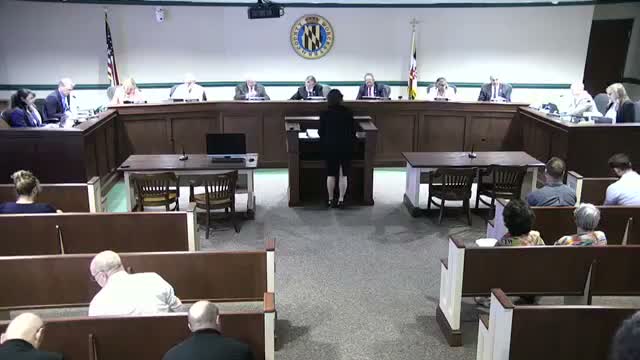
The Worcester County Commissioners voted May 20 to adopt siting standards for utility-scale solar and battery projects that were added to state law this session (Senate Bill 931). The change gives counties new review elements — including setbacks, multilayer landscape screening and strengthened bonding and inspection requirements — intended to preserve local siting control for projects larger than 2 megawatts.
Jen (presenter from the Department of Development Review and Permitting) told the board the state bill “is much more restrictive than what Worcester County has on the books right now” and that it “claws back a little bit from the Public Service Commission” by embedding siting standards the county can apply. She recommended the county treat projects over 2 megawatts as subject to the standards and to review projects of 1–2 megawatts via site-plan review.
Commissioners discussed enforcement and long-term protections several times. Commissioners asked whether bonding and vegetation maintenance requirements would last the life of projects; staff said new bonding rules create an initial five-year maintenance period with staged releases tied to plant survival, but that decommissioning bonds for large projects remain under Public Service Commission (PSC) jurisdiction. Commissioner Bertino and others urged the county to press for stronger local control of decommissioning bonds so property owners and taxpayers are not left with cleanup costs if a developer abandons a project.
Commissioners also raised safety concerns about energy-storage systems. Commissioners asked whether fire-suppression requirements for battery systems were addressed in the state standards; staff said the statute’s energy-storage provisions did not include the same local approval pathway and that the PSC retains broad authority. Commissioner Bertino said fire suppression is a “major consideration” in rural counties and asked staff to pursue additional protections.
Staff presented Woodside Solar, a proposed 5-megawatt single-axis tracker project on a roughly 92.6-acre parcel near Snow Hill. The developer, Drew Funk of New Leaf Energy, and engineers from ARM Group described surveys and mitigation steps: they identified a single wetland to avoid, said they would avoid removal of a specimen tree, planned 100-foot setbacks from parcel boundaries, 150 feet from nearest dwelling, a 35-foot vegetative buffer and that they would keep topsoil on-site per the state law. Drew Funk described outreach plans and said the company would hold two public meetings as part of the public-service commission review.
Commissioners pressed the developer about decommissioning. Funk said his lease contains decommissioning language and that a contract provision would trigger decommissioning after operations cease for a set number of days; he offered to provide redacted lease language to the county. County planning staff said the bill now includes salvage in the decommissioning calculation and stronger bonding and inspection requirements, but noted that for projects under PSC jurisdiction the state agency still holds the decommissioning bond.
The board approved the siting-standard approach (per the state bill) and directed staff to return with more detailed options to strengthen local protections for decommissioning and to address fire-suppression concerns for battery-storage systems.
Votes at a glance - Adopt siting standards consistent with Senate Bill 931: motion to approve by Commissioner Fiore, second by Commissioner Bertino. Outcome: approved unanimously.
Why this matters The state law (Senate Bill 931) changes how counties and the Public Service Commission share review authority for solar siting: it gives counties clearer design standards to require setbacks, landscaping, fencing and bonding but leaves some decommissioning authority and certain preemption questions under PSC review. Local officials said the standards will give Worcester County more leverage to protect residential and agricultural areas, but they want follow-up work on long-term bonds and battery safety.
Next steps County staff will provide more detailed options on decommissioning bonding that could increase local oversight and will look for ways to strengthen battery-storage fire-suppression requirements or site-selection limits; the Woodside Solar developer agreed to submit a redacted decommissioning clause for staff review.
Sources and evidence This article is based on the Department of Development Review and Permitting presentation of state legislation and the Woodside Solar concept presentation at the Worcester County Commissioners meeting on May 20, 2025. Direct quotes are from the meeting transcript and attributed to speakers who appeared at the hearing.