Get Full Government Meeting Transcripts, Videos, & Alerts Forever!
Get email alerts on the School Board Partisanship topic
No spam. Unsubscribe anytime.
Senate committee approves listing party affiliation for school board ballots after heated debate
Summary
Senate File 98 passed the Senate Education Committee by 3–2 after testimony for and against listing party affiliation on school board ballots. Supporters, including the secretary of state, said party labels improve transparency; opponents said labels risk injecting partisanship into local school governance and will not increase turnout.
CHEYENNE — The Senate Education Committee on Jan. 20 approved Senate File 98, a bill that would print a school board candidate’s party affiliation on the general election ballot. The committee vote was 3–2.
Proponents said adding party labels increases transparency and helps voters align candidates with party platforms. Opponents said school boards should remain nonpartisan to preserve local deliberation and reduce partisan pressure.
Secretary of State Chuck Gray testified in support and urged the committee to set a clear date for determining a candidate’s party affiliation to avoid last‑minute party changes during the primary crossover period. “I’m in complete and total support of Senate File 98,” Gray said, and suggested using the day the crossover period begins as the reference date for a candidate’s party label on the general-election ballot.
Support also came from the state superintendent’s office; Dickie Schoenher, speaking for Superintendent Megan Degenfelder, said the superintendent supports the bill as a transparency measure.
Those opposing the bill included Gail Simmons of Civics 307 and the group WhyVote (nonpartisan), which argued party labels would encourage tribal voting and inject outside political agendas into local school governance. “School boards are always focused on the well‑being of our children, not political ideologies,” Simmons told the committee.
The Equality State Policy Center also urged opposition, arguing that partisan labels increase divisiveness and reduce the deliberative space needed for community governance. The Wyoming School Boards Association and the Wyoming Education Association similarly urged the committee to keep school board races nonpartisan.
Supporters said party labels can make local races easier for voters to cross-reference with party platforms; critics said those heuristics make voters less informed about individual candidates’ qualifications. Joseph Martinez, a Fremont County resident, said party labels are not a barrier to independents and argued they provide helpful information for voters. Jeff Daugherty, a former public-education official, spoke in favor of the bill, saying it would help voters find candidates who align with community values.
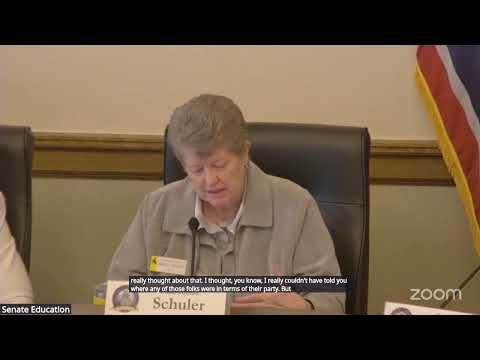
During committee discussion, some senators said the change would increase turnout by engaging party organizations; others said it would deepen partisan conflict in local school affairs. The committee ultimately advanced the bill. Recorded committee votes on Senate File 98 were: Senator Brennan — Aye; Senator Olson — Aye; Senator Rothfuss — No; Senator Scott — Aye; Chairwoman Schueller — No. The committee reported the bill favorably (3 ayes, 2 nays).
Committee members and witnesses repeatedly urged the secretary of state’s office to provide implementation details — chiefly how to lock party affiliation when candidate filing and primary crossover deadlines can overlap — before the bill moves further.