Get Full Government Meeting Transcripts, Videos, & Alerts Forever!
Get email alerts on the Charter School Funding topic
No spam. Unsubscribe anytime.
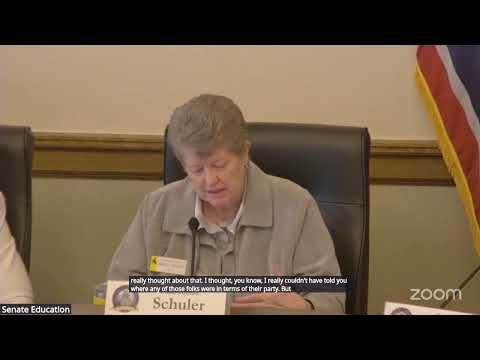
Senate Education panel advances bill to send a portion of district funds directly to charter schools
Summary
The Senate Education Committee voted Jan. 20 to advance Senate File 73, which would route a proportional share of certain district-level funds to charter schools rather than leaving that money with resident school districts.
CHEYENNE — The Senate Education Committee voted to advance Senate File 73 on Jan. 20, a bill that would direct a proportional share of certain district-level funding to charter schools rather than retaining that portion at the district level.
Supporters told the committee the change would correct an inequity that leaves state-authorized and some district-authorized charter schools with fewer resources for essential school-level and personnel items. Opponents — including district finance officials and the Wyoming School Boards Association — said the bill risks underfunding district services and creating uneven funding across districts.
Tristan Green, chief financial officer for Albany County School District, testified he supports the policy goal but warned of consequences for district budgets. “I am in favor of this bill,” Green said, “but not at the expense of the districts.” He said some districts already struggle to cover rising costs and called special education spending a growing pressure; he offered to provide specific data later to committee staff. Green and other speakers described a scenario in which roughly $300,000 across two Albany County charter schools could shift from the district to the charters under the bill’s formula.
Carrie Klein, of the Wyoming Public Charter School Association, said the bill would allow charter schools to receive “their proportional allocation of the school funding model” for listed personnel and nonpersonnel components. Klein noted an existing separate statutory practice allowing charter schools to pay up to 3% to an authorizer for oversight — a different pot of money than the model components SF73 would redirect — and said districts and charter schools should negotiate contracts in good faith where services are provided by a district.
Janine Baytowski, chair of the Wyoming Charter School Authorizing Board (participating remotely), said state-authorized charters often perform their own central-office functions and currently must cover those back-office costs out of dollars intended for instruction. “Does it help the charter schools? You betcha it does,” she told the committee, but also urged a full review of statutes to reflect the differences between state- and district-authorized charters.
Opponents framed the question as a school‑finance design problem. Brian Farmer, executive director of the Wyoming School Boards Association, said the state’s funding model is built on “prototypical” school and district blocks rather than a strict per‑student dollar and cautioned that carving district-level resources into per‑student pieces could create disparate funding across districts and between district- and state-authorized charters. “I think there is ample evidence that there is some piece of funding missing for our charter schools,” Farmer said, but he urged lawmakers to solve the underlying model math rather than repurpose blocks of central-office funding by ADM proportion.
Other witnesses urged interim study or recalibration of the funding model so the state can craft a longer-term, systemwide solution. Marguerite Herman, an elected school board member who has authorized district charter renewals, suggested treating stand‑alone charter schools using the same prototypical, cost‑based approach used for small districts.
Committee discussion reflected the split: some members said SF73 moves policy toward greater equity for students attending charter schools; others flagged transition problems for existing five-year contracts between districts and district‑authorized charters. Senator Ralphs and others urged statutory or interim work so existing contracts are not unfairly upended while new funding flows are implemented.
Votes at a glance: The committee took a roll-call vote to advance Senate File 73. Recorded votes on the motion to pass were: Senator Bridal — Aye; Senator Olson — Aye; (record shows “Senator Office” — Aye); Senator Scott — Aye; Chairwoman Schueller — Aye. The committee reported the bill favorably (5 ayes, 0 nays).
The committee indicated appetite for further work during recalibration and for informal negotiations among districts, charter schools and the Department of Education to address short‑term contract timing and longer‑term prototypical funding questions.